
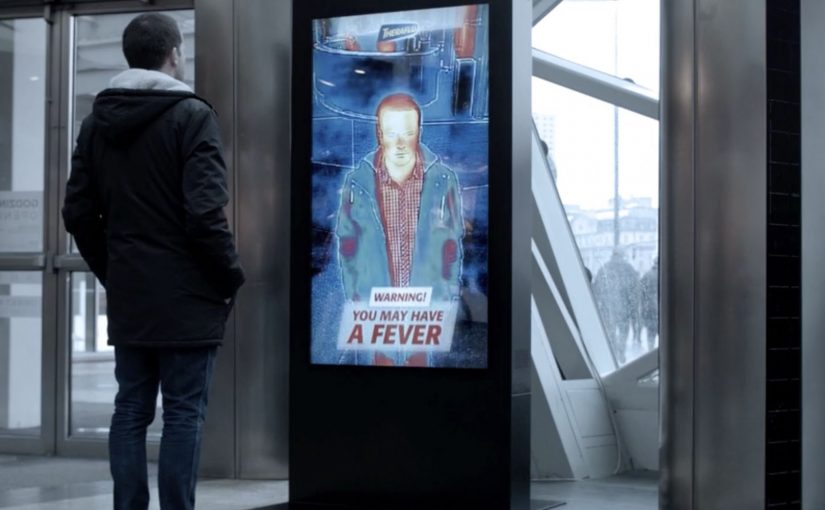
Theraflu: Thermoscanner

With the start of flu season, Theraflu in Poland wants to create a tool that lets passersby check if they have a fever without interrupting their daily commute.

So Saatchi & Saatchi develops what is billed as the world’s first outdoor ad with a live thermo-scanner camera, able to check the body temperature of the person standing next to it in real time.

The thermo-ad also lets people take a thermo-selfie, which here means a thermal-style image of themselves, download it via a microsite or QR code, and share it using the hashtag #TherafluThermoscanner, or send it by email to their boss as an explanation for absence.

Turning a symptom into an instant public check

The mechanism is a simple swap. Thermal cameras are usually associated with controlled environments like airports or clinics. Here, that same visual language is put into a familiar citylight so the “should I worry?” moment can happen on the street, in seconds. That shift matters because it turns a clinical signal into a low-friction commuter interaction, which is why the idea feels immediately useful instead of purely theatrical.

In European commuter cities, out-of-home works best when it adds utility without forcing people to break stride.

Why it lands

This works because it respects the reality of flu season behavior. Many people keep moving even when they feel off. The installation meets them where they already are, makes the result legible at a glance, and gives them an immediately shareable artifact that doubles as social proof and practical communication.

Extractable takeaway: If your message is health-related and time-sensitive, design a public utility that produces a clear personal output. Then make that output easy to reuse in the next real decision the person has to make.

What Theraflu is really buying

Beyond awareness, the ad builds a reason to act early. It reframes “flu medicine” from a product you remember later into a category you prepare for now, while the viewer is still in the mindset of assessing symptoms and deciding what to do next. The real question is how to make symptom checking feel immediate enough to trigger action before people default to pushing through the day. The stronger play here is utility-led brand framing, not spectacle for its own sake.

What to steal from the Thermoscanner

  • Embed the benefit inside the medium. If the media unit demonstrates the promise, the claim needs less persuasion.
  • Make the result portable. A shareable scan turns one interaction into many impressions.
  • Design for the commute. Fast, glanceable, and low-effort beats “immersive” when people are in motion.
  • Give sharing a job. Social posting is optional. Emailing a boss is a real utility hook.

A few fast answers before you act

What is the Theraflu Thermoscanner?

It is an interactive outdoor ad that uses a live thermal camera to estimate body temperature in real time and indicate whether a passerby may have a fever.

Why put a thermo-scanner in an outdoor ad?

It makes fever detection feel instant and accessible during daily routines, and it turns a brand message into a practical tool.

What is a thermo-selfie here?

It is a thermal-style image generated from the scan that people can download and share, or send as a message to explain they may be unwell.

What makes this more than a gimmick?

It is tied to a real, time-sensitive decision. “Do I have a fever?” and it delivers an output that can be reused immediately.

How can other brands apply the pattern?

Find a high-friction question people avoid answering, then build a quick public utility that returns a clear personal result and a shareable artifact.
Hellmann’s: Recitweet

In the past, Hellmann’s has used novel ways to encourage consumers to use their mayonnaise for more than just sandwiches. Now, for their latest campaign, they team up with Ogilvy Brazil to create Recitweet.

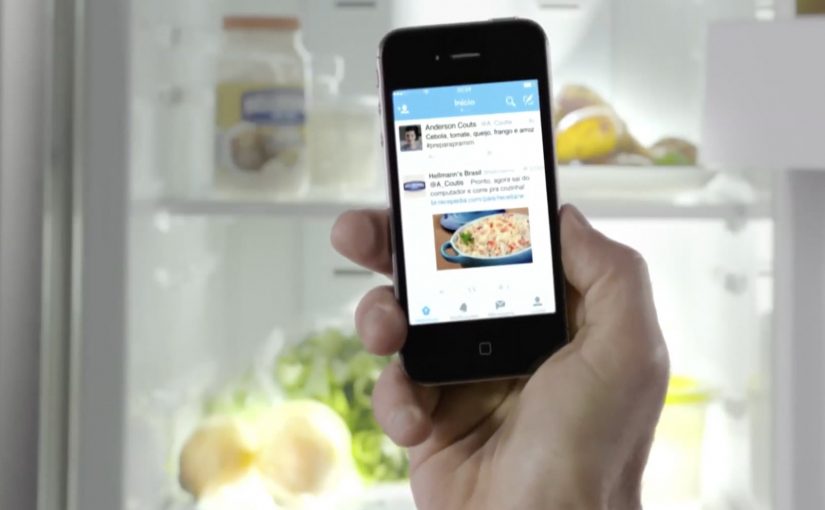
The use case is instantly familiar. You open the fridge, you see ingredients, and you still do not know what to cook. With Recitweet, consumers tweet their ingredients with the hashtag #PreparaPraMim (“prepare for me” in Portuguese). Hellmann’s replies with a recipe that is designed to use those exact ingredients.

A recipe engine built on a social reply

The mechanism is ingredient matching through a public tweet. The input is a short list of what you have at home. The output is a tailored recipe suggestion delivered back as a tweet reply, so the brand behaves like a lightweight cooking helper rather than a broadcaster.

In FMCG food brands, this utility-led social pattern turns content into a small service that appears at the exact moment the consumer is stuck.

The real question is: can a food brand reliably remove the “what should I cook” hurdle in the channel where people already ask for help. When you can answer fast and specifically, the helper role beats another round of broadcast recipes.

Why it lands

It respects the consumer’s real problem. “I have food, I lack an idea.” The campaign does not start with a product claim. It starts with a decision obstacle, then uses the brand to remove it. That makes the engagement feel earned, because the interaction produces something usable in the next 30 minutes.

Extractable takeaway: If your product is an ingredient, win by solving the “what do I do with what I already have” question. Make the brand the shortest path from inventory to action, using the channel where the consumer already asks for help.

Stealable moves for social utility

  • Constrain the input. A short list of ingredients forces clarity and makes the interaction easy to start.
  • Return a specific next step. A recipe beats a generic tip, because it includes implied quantities, sequence, and outcome.
  • Make the service feel personal, at scale. The reply is the moment of value. Treat it like customer service, not advertising copy.
  • Design for repeat behavior. The best activations are not one-off stunts. They create a habit loop people can use again the next time the fridge looks random.

A few fast answers before you act

What is Recitweet in one sentence?

Recitweet is a Twitter-based recipe helper that takes a list of tweeted ingredients and replies with a recipe designed to use them.

Why use a hashtag like #PreparaPraMim?

It standardizes the request so the brand can find, process, and respond to it consistently, while keeping participation friction low.

What makes this more effective than posting recipes on a website?

It is contextual and initiated by the consumer. The recipe arrives when the person is actively deciding what to cook, using what they say they have.

What is the minimum viable version of this idea?

A constrained ingredient input and a fast, specific reply that gives one clear next step, without forcing the consumer to leave the channel to “go search.”

What is the biggest operational risk?

Response quality and response time. If replies are slow, irrelevant, or repetitive, the “service” framing collapses and it starts to feel like a gimmick.

Friskis&Svettis Stockholm: #friskissthlm

January in Sweden is when gyms and health clubs go loud, chasing everyone who made the classic New Year’s resolution to start exercising. Stockholm-based health club Friskis&Svettis is no exception.

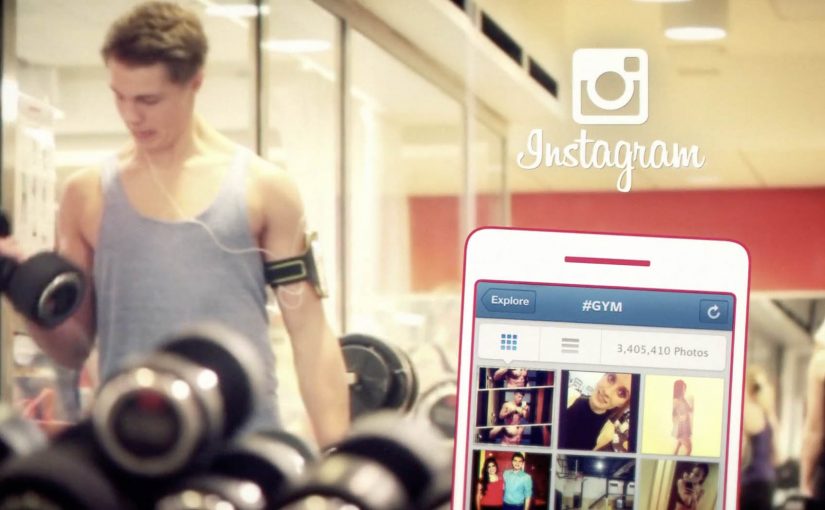
Because Friskis&Svettis is a non-profit association owned by its members, they and their agency Volt build a campaign where members inspire the wider community. A hashtag, #friskissthlm, invites people to work out, photograph the moment, and tag their pictures, so the members themselves become the creative running “around Stockholm”.

How the member-driven mechanic scales

The mechanism is participation as media: member actions create the content and also help distribute it. Instead of producing a single hero ad, the brand defines one simple behavior: train, post, tag. The hashtag becomes the aggregation layer, a single place where the posts collect and stay discoverable, and every new image becomes both proof and invitation. The campaign’s distribution is powered by the same thing gyms want more of in January: visible momentum.

In member-owned fitness communities, letting real members supply the proof tends to land harder than brand-led messaging, because the social permission comes from peers rather than from advertising.

The real question is not how to make a louder January gym ad, but how to make visible member momentum easier to join. The stronger move here is to make member behavior the campaign, not to outshout every other club in January.

Why it lands

It turns the most fragile moment in fitness, starting, into something public and shareable without making it complicated. The posts do two jobs at once. They show variety (different workouts, different people, different branches) and they reduce intimidation, because the “campaign face” is not a model, it is your neighbor.

Extractable takeaway: If you want community growth, choose one repeatable participation unit and one clear tag, then let volume and variety do the persuasion. Your members become the credibility layer.

What to borrow for your own January push

  • Make the ask behavioral. “Work out, post, tag” is easier to follow than “join our movement”.
  • Let variety do the selling. Many small proofs beat one polished claim, especially in fitness.
  • Turn members into the creative. It is cheaper, more credible, and naturally localized.
  • Design for aggregation. One hashtag, one place to browse, one loop that keeps filling itself.

A few fast answers before you act

What is #friskissthlm in one sentence?

A member-powered Instagram hashtag campaign where workouts posted and tagged by members become the campaign content for Friskis&Svettis Stockholm.

Why is this stronger than a typical January gym ad?

Because the proof is peer-generated. People trust “someone like me did this” more than they trust a brand saying “you should”.

What is the key design decision?

Keeping the participation unit tiny and repeatable, so the barrier to contributing stays low while the content volume stays high.

What is the main risk with hashtag-led campaigns?

If the tag is not actively adopted, the feed looks empty and the idea collapses. You need early seeding from members and staff so momentum is visible from day one.

How would you adapt this outside fitness?

Keep the pattern, not the category. Pick one repeatable action people are already willing to do, give it one clear tag or container, and make the resulting proof easy for others to browse and copy.