
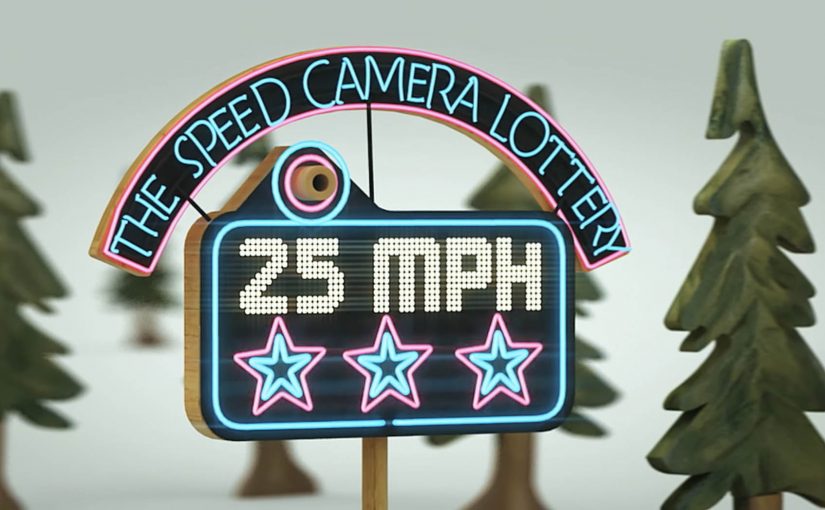
Volkswagen: The Speed Camera Lottery

The winning idea of the Volkswagen fun theory award was submitted by Kevin Richardson, USA.

Can we get more people to obey the speed limit by making it fun to do. This is the question Kevin’s idea answers, and Volkswagen, together with The Swedish National Society for Road Safety, makes the idea real in Stockholm, Sweden.

A speed camera that rewards, not just punishes

The core twist is simple. The concept is described as a lottery wrapped around a speed camera. Drivers who pass at or under the speed limit are entered into a draw. The prize money is described as coming from the fines paid by drivers who speed.

That inversion matters because it changes the emotional frame. Instead of “the camera is there to catch me”, the camera becomes “a chance to win if I do the right thing”.

The mechanic: turn compliance into a game loop

The loop is short and repeatable:

  • Trigger: you approach the monitored zone.
  • Action: you choose to stay within the limit.
  • Reward: you are entered into a lottery, and someone wins.
  • Reinforcement: the story travels because “I won by driving properly” is novel.

Why it lands: it makes “doing the right thing” emotionally positive

Most enforcement is built on fear of loss. This flips motivation into the hope of gain, without removing consequences for speeding. It keeps the stick, but adds a carrot that people actually want.

Extractable takeaway: If you want everyday behavior to change, do not only increase the cost of the bad action. Add a visible, repeatable reward for the good action, and make the reward easy to understand in one glance.

In urban road-safety environments, messaging often underperforms because it feels like punishment instead of shared benefit.

The real question is how to make compliance feel desirable often enough that people repeat it without being re-taught each time.

What the brand really gets from this

Volkswagen is not selling a feature here. It is sponsoring a philosophy. Make better choices feel desirable, and the brand becomes associated with modern, optimistic problem solving rather than lecturing.

That is also why the execution travels so well as a film. It is a simple story with a surprising twist, and it is easy to retell without technical explanation.

What to steal for your own behavior-change campaign

  • Pay attention to framing: the same rule feels different when it is presented as “win” versus “don’t get caught”.
  • Make the rule legible instantly: people must understand the mechanic in seconds.
  • Design for repeat exposure: behavior change needs loops, not one-off impressions.
  • Fund rewards credibly: link the reward source to the problem so it feels fair.
  • Keep it measurable: define the behavior metric first, then build the experience around it.

A few fast answers before you act

What is the Speed Camera Lottery?

It is a road-safety concept where drivers who obey the speed limit are entered into a lottery, making compliance feel rewarding rather than purely punitive.

Why does adding a lottery change behavior?

It introduces a positive incentive that people talk about. The hope of gain can be a stronger daily motivator than the fear of a fine for many drivers.

Does this replace enforcement?

No. The idea is described as keeping normal enforcement for speeding, while adding a reward layer for drivers who comply.

What makes this a “Fun Theory” idea?

It tries to prove that fun, not just rules, can shift behavior. The experience makes the better choice feel more attractive in the moment.

What should you measure if you copy this?

Average speed and speed variance at the intervention point, compliance rate over time, and whether the effect persists once novelty fades.
Volkswagen: The Fun Theory

I am sure some of you may have already heard of the “The Fun Theory” campaign by Volkswagen that just recently won the Cannes 2010 Cyber Grand Prix for a digitally led integrated campaign. Here, “digitally led” means the digital layer does the heavy lifting for discovery, sharing, and participation, not just for amplification.

For those who have not heard of the campaign, The Fun Theory was all about generating interest in Volkswagen’s Blue Motion technologies that deliver the same great car performance with reduced environmental impact, and to do this, they found an insight around how “fun” could change human behavior for the better, and this formed The Fun Theory, a campaign that spawned over 700 user generated Fun Theory initiatives along with a number of big viral hits that generated over 20 million YouTube views, with one rushing past 12 million views alone!

What makes this digitally led (without overcomplicating it)

This is one of those campaigns where the “digital” part is not a layer added at the end. It is the distribution engine. It is how the idea travels, how participation scales, and how a single insight turns into hundreds of initiatives people want to copy, remix, and share. The real question is whether your idea can travel without you pushing it. A campaign is not digitally led unless the channels are the mechanic that makes it repeatable.

Extractable takeaway: If you want integrated work to scale, design the participation loop and the sharing loop into the idea itself. Otherwise “digital” stays a bolt-on and the campaign stays one-off.

The strategic insight that carries the whole idea

The Fun Theory is built on a simple behavioral observation. If you make the better choice fun, more people will do it. That is the core. Everything else is execution.

  • One clear behavior frame. “Fun changes behavior for the better.”
  • A product story that benefits. Blue Motion technologies. Same performance, reduced impact.
  • A scalable content model. Big hits create attention, then user generated initiatives extend the lifespan.

In large brand organizations, integrated work scales when the behavior mechanic and the distribution loop are designed together.

What to take from this if you are building integrated work

  1. Lead with a human mechanism, not a message. People share mechanisms they can repeat.
  2. Let distribution be part of the design. If it does not travel, it does not scale.
  3. Create a format others can copy. The strongest campaigns spawn “versions.”
  4. Keep the brand role credible. The idea must connect back to a real product promise.

A few fast answers before you act

What is Volkswagen’s “The Fun Theory” in one sentence?

It is a digitally led integrated campaign built on the idea that making the better choice fun can change human behavior for the better, while building interest in Volkswagen’s Blue Motion technologies.

Why did this campaign matter beyond a single viral video?

Because it scaled into participation. It spawned hundreds of user generated initiatives, not just one-off attention.

What is the link to Blue Motion technologies?

The campaign positioned Blue Motion as delivering the same great car performance with reduced environmental impact, then used “fun” as the behavioral hook to earn attention and sharing.

What is the transferable lesson for digital and brand leaders?

If you can pair a simple behavioral mechanism with a credible product story, digital channels can turn one idea into a repeatable format that communities propagate for you.

How do you know when a “digitally led” idea is strong enough?

If people can describe it quickly, repeat it without you, and share it with minimal friction, it is built to scale.

Volkswagen Polo GTI: Fast Lane

Fast Lane: turning routine into a shortcut you choose

Volkswagen is soon going to launch its new Polo GTI. To create awareness and generate buzz, it built a “Fast Lane” in subways, malls and elevators around Germany. In this campaign, “Fast Lane” means a playful, faster-feeling alternative route placed beside the normal one, dedicated to everyone who likes to go beyond the regular, who is curious for new stuff, and who enjoys speeding it all up a little.

How it works: add a faster option that feels like play

The mechanism is simple. Place an obvious “normal” route next to an unexpected alternative that is quicker and more fun. Then let people self-select into it. The viewer controls the switch by choosing the fast lane, and that choice becomes the story.

In German urban commuting environments, small design changes in high-footfall spaces can shift behaviour quickly because routine is strong and the contrast is instantly visible.

The real question is whether you can turn “fast” from a spec into a shortcut people choose in public.

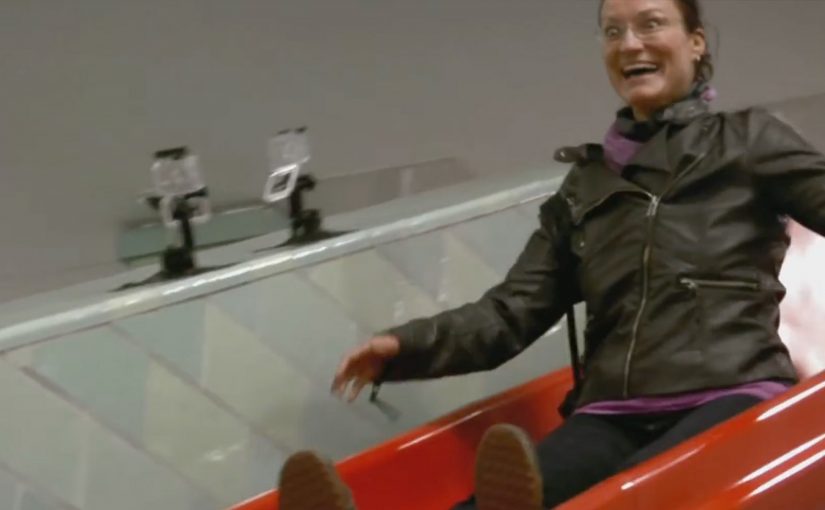
Fast Lane 1: The Slide

Long staircase. Next to it a slide. Which way would you go?

Fast Lane 2: The Shopping Carts

Some carts are pimped with a skateboard. Up for some extra shopping fun?

Fast Lane 3: The Elevator

A sound system turns the ride into a rocket take-off. Welcome on-board.

Why it lands: speed becomes a feeling, not a spec

The campaign does not explain performance. It lets people experience a mindset. Faster. Lighter. A little rebellious. Because the “fast” option is obvious and self-selected, it feels earned, which makes the idea stick without needing specs. Each execution creates a moment where the “fast” choice feels like a reward, not just efficiency.

Extractable takeaway: If you want people to believe a feature, design a situation where they can choose it and feel it, not just read about it.

The business intent: borrow everyday behaviour as proof

For a GTI launch, “fast” can easily become generic language. This is stronger than repeating performance adjectives. Fast Lane makes it concrete. It attaches the idea of speed to real-world micro-decisions, and turns the resulting participation into shareable proof that travels beyond the physical placements.

What to steal if you want to turn a feature into a behaviour

  • Build the contrast into the environment. Normal route next to the fun shortcut.
  • Make the faster choice self-evident. People should understand it in one glance.
  • Let viewer control do the persuasion. Choosing it is more convincing than being told.
  • Create a story per location. Each execution is a complete, watchable moment on its own.

A few fast answers before you act

What is Volkswagen’s “Fast Lane” for the Polo GTI?

A set of playful public-space installations (slide, skate carts, rocket-sound elevator) that let people choose a “faster” option, designed to build buzz for the Polo GTI.

What is the core mechanism?

Put a normal route next to an unexpected shortcut that is quicker and more fun. People self-select, and the choice becomes the story.

Why does this work better than talking about performance specs?

It turns “fast” into a felt experience. Participation makes the feature believable without needing explanation.

What business intent does it serve?

It makes the GTI’s positioning concrete and talkable, then relies on the resulting participation moments to travel beyond the physical placements.

What is the most transferable takeaway?

If you want people to believe a feature, design a situation where they can choose it and feel it, not just read about it.