
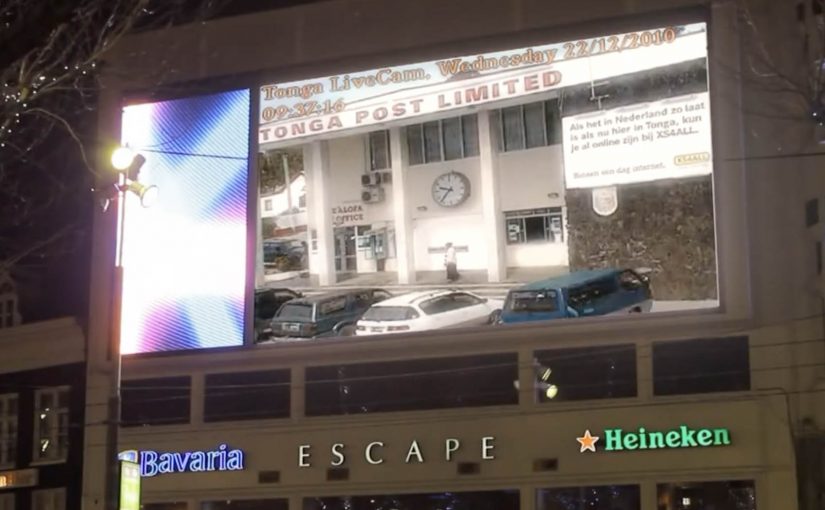
Switching internet providers in the Netherlands is often a time-consuming business, which is exactly why many people prefer not to switch at all.
XS4ALL sets out to change that with a promise that sounds almost like a hack. A connection in one day. The campaign idea is framed as “Tonga: Where Time Begins”. Order your connection at 11am Tonga time, and you can have it installed before it is 11am Netherlands time on the same day.
Putting “one day” on a clock
To make the promise tangible, Ogilvy Amsterdam erects a billboard on the Tonga post office. Alongside the billboard, a clock shows the local time in Tonga, described as being about 11 hours ahead of the Netherlands. The clock turns the claim into a visible countdown. Tonga is already “tomorrow”, so the installation can happen “today”.
The real question is not whether XS4ALL can claim speed, but whether it can make that claim feel believable before people experience the service. The strongest move here is turning service logistics into something viewers can verify in one glance.
In telecom markets where switching friction creates inertia, the fastest way to sell speed is to make the time advantage physically visible, not just verbally promised.
Why it lands
The idea works because it uses a real-world fact as the proof mechanism. Time zones are non-negotiable, so the promise borrows credibility from geography, not copywriting. The billboard and the clock also do something important. They take a service promise that feels abstract and make it photographable, retellable, and easy to understand in one glance.
Extractable takeaway: When your differentiator is speed, anchor it to a constraint the audience already trusts, then build a single physical artifact that turns the claim into a visible demonstration.
How to turn speed into visible proof
- Make the promise measurable. A clock beats a tagline when the benefit is time.
- Borrow credibility from a fixed reality. Geography, physics, rules, and infrastructure can outperform persuasion.
- Create a shareable proof object. A single photo should communicate the idea without explanation.
- Translate operations into a story. “Installed in one day” becomes a narrative people can repeat.
A few fast answers before you act
What is the core idea of “Tonga Time”?
Use Tonga’s head-start time zone to demonstrate that XS4ALL can deliver a new connection within a day, and make that promise tangible with a public clock and billboard.
Why choose Tonga for this message?
Because it is positioned as “where time begins”, so it provides a simple, memorable way to explain how the installation can happen before the Netherlands reaches the same clock time.
What does the clock add that a normal billboard cannot?
It turns a claim into a live reference. People can see the time difference and understand the “within one day” logic immediately.
What is the main risk of using time zones as proof?
If the exact time difference changes seasonally or is reported inconsistently, the concept still holds, but the numeric detail can be challenged.
When is this pattern most useful?
When you are selling speed or responsiveness, and you can tie the benefit to a trusted external constraint that makes the claim feel undeniable.