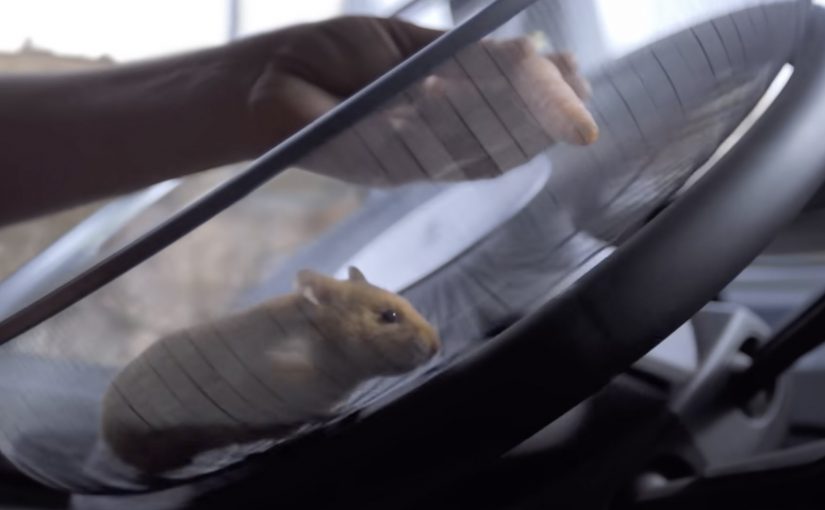
Brands all over the world are trying to create branded content. Volvo did that with great success last month when they filmed a hamster drive their entire truck up a mountain.
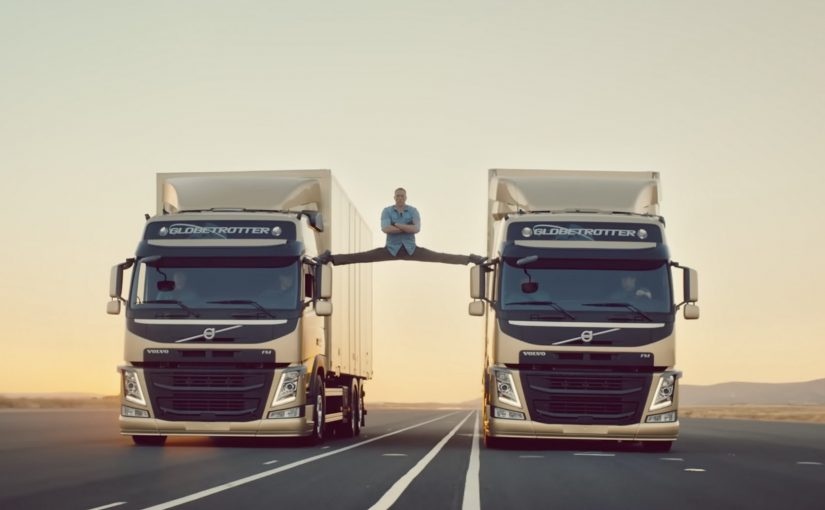
Now, Volvo demonstrates the precision and directional stability of its dynamic steering by getting Jean-Claude Van Damme to carry out his famous split between two reversing Volvo FM trucks. Here, “dynamic steering” refers to the steering system helping the truck hold a steady line under motion. The video, since release, is reported to have already passed 7 million views.
A feature demo disguised as spectacle
The mechanism is as clean as it gets. Take a technical claim, steering stability under motion. Express it in one unmistakable image that needs no explanation. Two trucks moving backwards in sync, a human balancing point-to-point between them, and the steering system as the silent hero.
In global industrial and automotive marketing, the most reusable branded content is engineered proof that compresses a technical benefit into a single, legible visual.
By “engineered proof,” I mean a demonstration where the product capability is the only plausible explanation for what you see.
Why the internet did the media buy for them
This lands because it is instantly readable and instantly arguable. People share it to say “this is real.” People share it to say “this is impossible.” Either way, the product claim travels with the argument.
Extractable takeaway: If your product advantage is hard to feel in a 30-second explanation, translate it into a one-frame “impossible” moment. The real question is “what made that possible.” Then let the audience debate the stunt while your feature becomes the answer.
It also avoids the common branded-content trap of overstorytelling. The brand stays in the background, the demonstration stays in the foreground, and the audience does the meaning-making in their own words.
How to borrow this pattern without a movie star
- Start with one feature you can prove. Pick a claim that can be demonstrated, not merely asserted.
- Design for instant comprehension. If a still frame cannot tell the story, simplify the setup.
- Make the proof self-contained. The audience should not need a voiceover to understand what is being tested.
- Keep the brand restraint. Overbranding weakens believability. Let the test carry the persuasion.
A few fast answers before you act
What is Volvo’s “The Epic Split” demonstrating?
It is designed to demonstrate the precision and directional stability of Volvo’s dynamic steering by showing two reversing trucks holding a steady path while Jean-Claude Van Damme performs a split between them.
Why does this count as branded content instead of “just an ad”?
The primary value is the demonstration itself. The content is built to be watched and shared as a feat, with the product benefit embedded in the feat rather than delivered as a sales message.
What makes a stunt like this more shareable than a typical product film?
Instant readability plus high stakes. A single image communicates the premise, and the audience immediately wants to test whether it is real, which drives sharing and discussion.
How do you know the spectacle is actually proving the feature?
If the moment works as a still frame, stays understandable without voiceover, and the technical claim is the only plausible explanation, then the spectacle is doing real demonstration work, not just decoration.
How can smaller brands apply the same approach?
Reduce the ambition, not the logic. Prove one feature with one clear test, make it understandable in one glance, and remove anything that distracts from the proof.