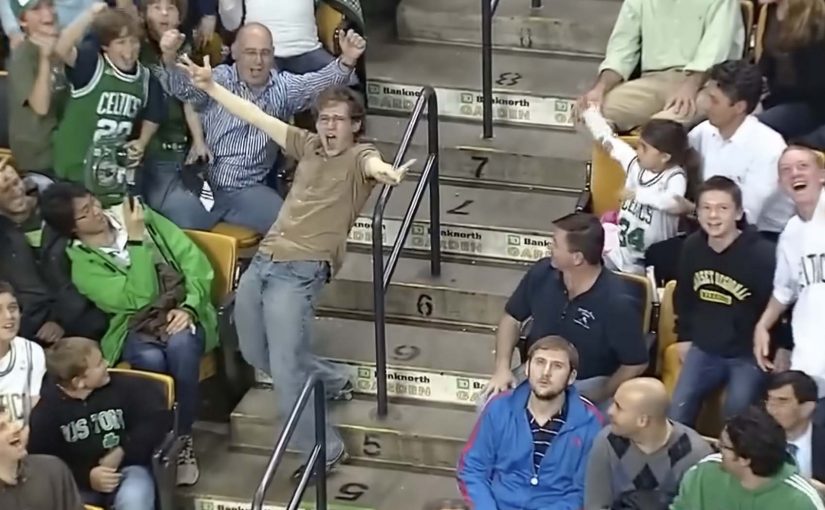
A Boston Celtics fan is shown on the big screen during a break. Bon Jovi’s “Livin’ on a Prayer” is blasting. He commits fully, dancing like the arena is his stage. It is the kind of moment that feels tiny in real time, until the internet decides otherwise.
In 1987, Bon Jovi’s “Livin’ on a Prayer” topped the Billboard charts for four consecutive weeks. Then in 2009, Jeremy Fry did an epic dance to it while the Boston Celtics blared it during a break at a home game. The dance was then uploaded to video platforms four years ago and, at the time, was reported to have been watched more than 5 million times.
Then on October 17, 2013, a user named Jose Duran re-uploaded the clip to his own channel, adding the title “One Man Dances Like Nobody’s Watching While Everyone Is. He’ll Crack You Up!”. In one month, that newly uploaded video was reported to have been watched more than 12 million times and Liked on Facebook more than 1.7 million times.
This renewed interest has landed “Livin’ on a Prayer” at the number 25 spot of the Billboard Hot 100 charts.
The re-upload loop that restarts demand
The mechanism is not complicated. The re-upload loop is when the same asset re-enters feeds as if it is new because its metadata and context reset. An old clip gets a new headline, a new uploader, and a fresh social context. That reframing makes the content feel “new” to people who missed it the first time, and “worth sharing again” to people who remember it.
A re-upload is not the same as a repost. It is the same asset packaged as a new piece of media, with new metadata (title, thumbnail, description) that can change how algorithms and humans interpret it.
You should treat reframing as a first-class distribution lever, not a leftover tactic, especially when you already own a library of strong moments.
The real question is whether you have a repeatable way to notice the loop restarting and package the next iteration deliberately.
Why it turns into a chart event
In social and content-driven organizations, recontextualizing an older asset with a sharper framing can restart attention and measurable demand without changing the underlying product. What makes this story more than a funny clip is the translation layer. The viewing spike does not stay inside the video. It spills into listening, searching, and buying behavior, and that shows up in consumption-based charts.
Extractable takeaway: When a second wave hits an existing asset, optimize the wrapper first. Title, thumbnail, and context are often the fastest path to downstream demand.
It is also a reminder that “distribution” is not only paid. Sometimes distribution is the internet looping back on itself, and your role is simply to recognize the moment and understand what it can move downstream.
What to steal if you market catalog content, brands, or culture
- Package beats production. A new framing can outperform a new asset when the original moment is already strong.
- Headline for retellability. If people can summarize the clip in one sentence, they will share it more.
- Watch the “spillover” signals. Search, streams, downloads, and social sharing often move together when a loop restarts.
- Be ready with the next step. When attention spikes, the easiest follow-on action should be obvious, not hidden.
A few fast answers before you act
What caused the Bon Jovi chart comeback in this case?
A second viral wave. A re-upload with new framing drove renewed sharing and viewing, which then translated into higher consumption of the song.
Why can a re-upload outperform the original upload?
Because metadata changes distribution. A new title and context can reach new audiences and re-trigger sharing among people who already know the clip.
What is the core mechanic behind “viral recontextualization”?
The same content is made to feel newly discovered by changing how it is introduced. The asset stays the same. The wrapper changes.
How do you spot that a “second wave” is starting?
Look for a sharp uptick in shares and searches around an older asset, especially when the spike is attached to a new uploader, headline, or meme format.
What is the practical takeaway for marketers outside music?
Build and maintain a library of “still-good” assets, then learn how to repackage them for new contexts. The easiest growth sometimes comes from distribution, not production.