
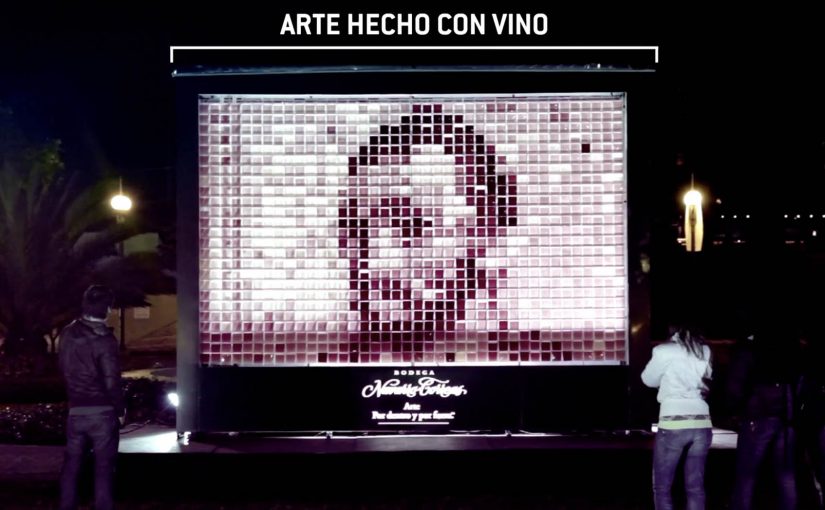
Navarro Correas creates a 13 x 8.2 meter structure in Bogotá, Colombia. It consists of 1,000 acrylic cells and an automated robotic mechanism that fills each cell with six different shades of wine.
How the installation works
People activate the robotic mechanism by sending a text message with the acrylic cell number they want filled. Over time, 1,000 text messages build the full image, described as recreating Van Gogh’s self-portrait. A masterpiece made with Navarro Correas’ own wines.
An SMS-controlled installation is a public artwork where participants trigger physical changes by texting simple commands, turning the audience into the “interface”.
In large-scale city activations, participation gets dramatically stronger when the crowd can see their input change a shared object in real time.
The real question is not whether people will send one text, but whether each text feels like a visible personal contribution to something bigger.
Why it lands: it turns contribution into ownership
This works because it makes participation concrete. You are not “liking” or “voting”. You are choosing a specific cell and watching a physical outcome appear. The growing picture becomes a public scoreboard of collective effort.
Extractable takeaway: If you want mass participation, design a mechanic where each small action is visible, additive, and irrevocably part of the final outcome. People engage longer when they can point to “their piece” of the whole.
The stronger idea here is the visible build, not the SMS channel by itself.
The wine-as-paint choice also earns attention twice: first as a spectacle (liquid filling the grid), and then as a reveal (the final portrait). The mechanism creates suspense, and suspense keeps people texting.
What the brand is really doing here
The installation positions the wine as a maker’s material, not just a drink. It borrows the credibility of craft and art, then backs it with a participatory system that feels modern and social without needing a social network.
What to steal for your next interactive public piece
- Make the input trivial: one action, one identifier, no learning curve.
- Make the effect observable: people should immediately see change after they act.
- Use “additive progress”: partial completion should still look interesting, so the build phase has its own payoff.
- Design for attribution: let participants feel “I contributed”, even if the contribution is small.
- Pick a reveal that rewards patience: the final image should be worth waiting for.
A few fast answers before you act
What is the Navarro Correas Wine Art Project?
It is a public installation made of 1,000 acrylic cells that are filled by a robotic mechanism with different shades of wine. People participate by texting a cell number to trigger a fill, gradually revealing a final portrait image.
Why use SMS for interactivity?
SMS is frictionless and universal. It requires no app download, works on basic phones, and is fast enough for impulse participation in a public space.
What makes this different from a normal billboard stunt?
The audience directly controls the build. Each message produces a visible change, so the piece becomes a collective construction rather than a one-way display.
What is the key behavioral driver?
Ownership through contribution. People engage more when they can claim a specific part of the outcome and see the shared progress accumulate.
What should you measure for a campaign like this?
Participation volume, unique participants, repeat participation, time-to-completion of the full artwork, dwell time around the installation, and any earned media or social mentions driven by the live build.