
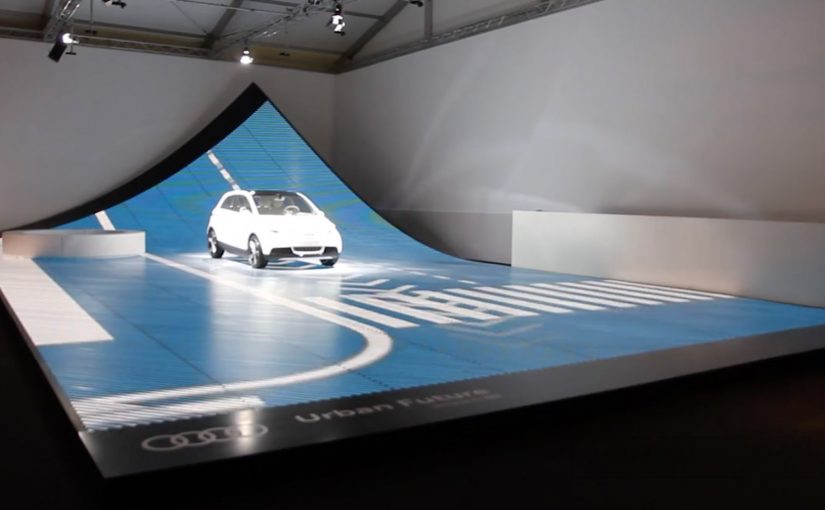
Audi: Urban Future at Design Miami 2011

A 190m² LED city surface that reacts to people

Audi, to showcase its A2 concept at Design Miami 2011, created a 190 m2 three-dimensional LED surface that provided a glimpse of the future of our cities where infrastructure and public space is shared between pedestrians and driverless cars. The installation demonstrated how the city surface would continuously gather information about people’s movements and allow vehicles to interact with the environment.

The installation used a real-time graphics engine and tracking software that received live inputs from 11 Xbox Kinect cameras mounted above the visitors’ heads. Through the cameras, the movement of the visitors was processed into patterns of movement displayed on the LED surface.

In global mobility and smart-city work, embodied demos beat decks when you need belief fast.

The punchline: the street becomes an interface

This is a future-city story told through interaction, not a render. You do not watch a concept. You walk on it. The floor responds, and suddenly “data-driven public space” is something you can feel in your body. Here, “data-driven public space” means a shared surface that senses movement and responds with immediate feedback.

In smart city and mobility innovation, the fastest way to make future infrastructure feel believable is to turn sensing and responsiveness into a physical interaction people can experience in seconds.

Why it holds your attention

Because it turns an abstract topic, infrastructure sharing, sensing, autonomous behavior, into a single, legible experience. Your movement creates immediate visual feedback, and that feedback makes the bigger idea believable for a moment.

Extractable takeaway: If a future system is hard to explain, compress it into one cause-and-effect loop a person can control, then let the feedback do the convincing.

What Audi is signaling here

The real question is whether a smart-city vision can be made legible through a single, shared interaction.

A vision of cities where surfaces sense movement continuously and systems adapt in real time. Not just cars that navigate, but environments that respond.

Moves to borrow for experiential design

  • Make the future physical: Translate complex futures into one physical interaction people can understand instantly.
  • Show the feedback loop: Use real-time input, processing, output, so the concept feels alive.
  • Let visitors generate the proof: Make the visitor the driver of the demo so their movement generates the proof.

A few fast answers before you act

What did Audi build for Design Miami 2011?

A 190 m2 three-dimensional LED surface installation showcasing an “urban future” concept tied to the Audi A2 concept.

What was the installation demonstrating?

A future city surface that continuously gathers information about people’s movements and enables vehicles to interact with the environment.

How was visitor movement captured?

Visitor movement was captured via 11 Xbox Kinect cameras mounted above visitors’ heads, feeding live inputs to tracking software.

What was the core mechanic?

Real-time tracking of visitor movement was translated into dynamic patterns displayed on the LED surface.

Why did this format make the idea feel believable fast?

Because visitors could trigger immediate feedback with their own movement, turning an abstract “responsive city” claim into a felt experience.
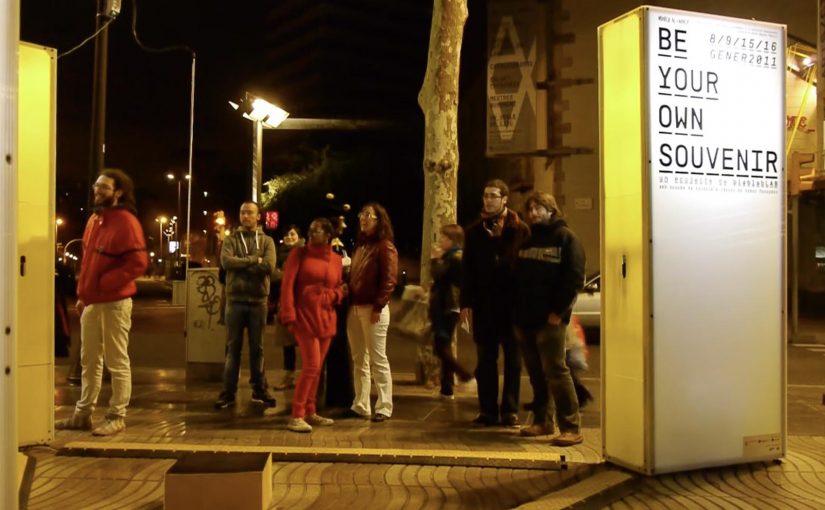
Be Your Own Souvenir: 3D-printed human statue

The crew from blablablab.org creates a unique digital installation in La Rambla, Barcelona, a place made famous by street artists posing as “human sculptures” and the constant flow of tourists who stop to watch them stand still.

This installation reverses the roles and lets the tourist become the producer as well as the consumer. The system invites visitors to perform as a human statue, with a free personal souvenir as the reward: a small figure of themselves, printed three-dimensionally from a volumetric reconstruction generated using three structured-light scanners (Kinect).

On La Rambla, where people already queue for a photo moment, converting spectators into performers is a reliable way to earn attention without forcing a pitch.

A street ritual, rewritten

La Rambla already has a clear “script”. You stop, you watch, you take a picture, you move on. This project keeps the same script, but switches the hero. Instead of photographing someone else’s performance, you become the performance, and you leave with a physical artifact that proves you did it.

The real question is how you get strangers to choose public participation without feeling like they are being pitched.

How the scanning becomes the experience

The tech is not framed as “3D scanning”. It is framed as a playful stage. You step into position, hold still like the living statues nearby, and the system quietly captures you. The output is a miniature you can take home, which makes the digital process feel tangible and earned.

In European tourist corridors with heavy foot traffic, public-space interactivity succeeds when the action is instantly legible and the payoff is immediate.

Why the reward loop works

A souvenir is usually generic. Here it is personal, location-specific, and instantly story-worthy. The value is not the plastic. The value is the transformation: tourist to performer, data to object, moment to keepsake. The reward loop here is simple: pose, get captured, receive a miniature you can take home. This kind of public-space interactivity works best when the reward is earned through participation, not handed out as a promo.

Extractable takeaway: Turn spectators into performers with a one-step action and an earned artifact, and you can win attention without forcing a pitch.

What to steal for public-space interactivity

  • Borrow a behavior people already understand. The “human statue” pose needs no explanation in this location.
  • Make participation the content. The audience is literally the subject.
  • Deliver a physical takeaway. A real object extends the memory past the street corner.
  • Keep the instruction simple. “Stand here and pose” beats any multi-step onboarding.

A few fast answers before you act

What is “Be Your Own Souvenir”?

It is a public installation on La Rambla that invites tourists to pose as human statues, captures them with structured-light scanning, and produces a small 3D-printed figure as a personal souvenir.

How does the system capture the person?

It uses volumetric reconstruction generated from three structured-light scanners (Kinect), producing a digital model that can be sent to a 3D printer.

Why does the “human statue” framing matter?

Because it matches the culture of the street. People already understand the pose-and-watch ritual, so the interaction feels native rather than imported.

What makes this more than a tech demo?

The outcome is personal and physical. The tech disappears behind an experience and a takeaway that visitors actually want.

What is the main lesson for experiential design?

Anchor the interaction in a familiar behavior, then reward participation with an artifact that makes the moment portable.