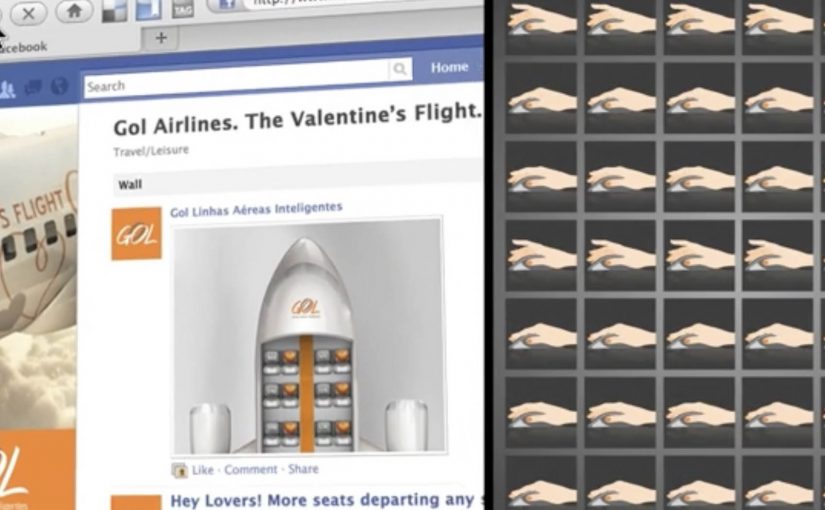
Brazilian airline GOL ran a Facebook activation designed to grow its online community and raise brand awareness in a highly competitive airline market. The insight behind it was simple. A trip can be one of the most romantic Valentine’s gifts to receive.
Over the Valentine’s weekend, GOL posted a series of images featuring empty airplane seats on its Facebook wall, without warning. The first people to see each image and comment the correct seat numbers won a pair of return tickets to any of GOL’s destinations.
The campaign was reported to have grown GOL’s Facebook community from 12,000 to over 200,000 in three days, making it number one in its category for the period.
A giveaway that rewards attention, not effort
The mechanism is a speed game disguised as a romantic prize. You do not fill out a form or write a story. You notice a post. You read a seat layout. You comment a number faster than everyone else.
In mass-market consumer categories, lightweight “attention rewards”, small prizes for noticing and reacting in the feed, can outperform complex promotions because they fit how people already behave in social feeds.
Why it lands
The execution stacks three accelerators. Surprise timing. A simple visual puzzle. A high-value reward that feels emotionally relevant to the weekend. That combination converts scrolling into urgency, and urgency fuels sharing and repeat checking, even among people who never win. The real question is whether your winner logic is instantly believable at feed speed.
Extractable takeaway: If you want rapid community growth, design a loop where the behaviour is already native to the platform, and the winner selection is instantly credible. Speed plus clarity beats creativity-plus-forms.
What the brand is really buying
Beyond awareness, this format buys habit. People learn that the page can drop value without notice, so they follow, refresh, and invite friends to watch too. The prize is the hook. The real outcome is an audience that has trained itself to pay attention at the brand’s tempo.
Steal this: Surprise-seat giveaway loop
- Use a recognisable visual trigger. A seat map is instantly readable, even at feed speed.
- Keep participation to one action. Commenting is frictionless. That matters more than polish.
- Make the rules self-verifying. Everyone can see the seat numbers and understand who was first.
- Lean on surprise scheduling. Unannounced drops drive repeat checking far better than a fixed timetable.
- Match prize to context. A Valentine’s weekend mechanic wants a prize that feels like a shared experience.
A few fast answers before you act
What is the Valentine’s Flight Seat Challenge in one sentence?
It is a Facebook giveaway where GOL posted surprise images with empty seat layouts, and the first users to comment the correct seat numbers won return tickets.
Why does “first to comment” work so well on Facebook?
Because it rewards attention and speed, which are native behaviours in a feed. It also creates a visible, easy-to-trust winner logic.
What makes the seat map a strong creative device?
It is instantly legible, visually distinctive in the feed, and turns the brand’s core product into a simple game mechanic.
What is the biggest risk with this format?
Perceived fairness. If timing, moderation, or winner confirmation is unclear, the campaign can trigger backlash rather than growth.
What should you measure beyond follower count?
New follower retention after the weekend, engagement rate on subsequent posts, repeat participation behaviour, and whether awareness lift correlates with search and booking intent.