
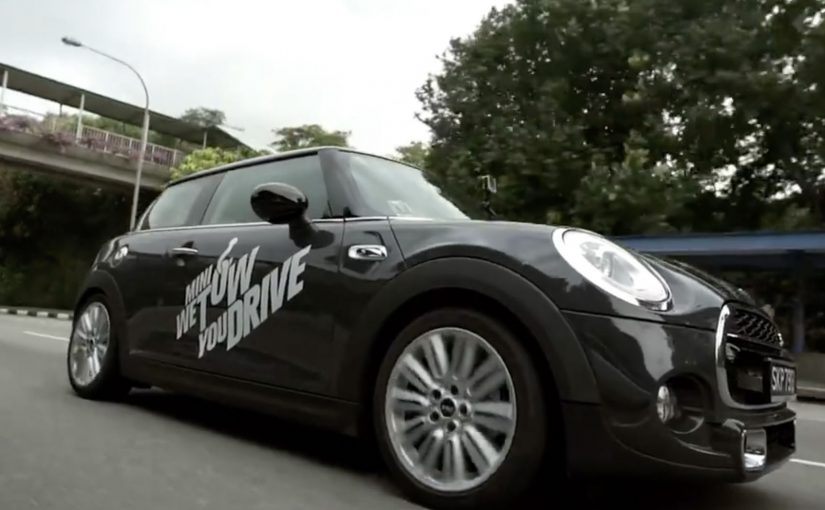
MINI: We Tow You Drive

Driving a MINI is addictive. Which is why drivers who test drive are more likely to buy one. So to get prospective customers to test drive, MINI decides to help drivers stranded by their own cars.

MINI partners with a tow service company and responds to breakdown calls in real time throughout Singapore. The campaign not only takes the test drive out of the showroom and onto the streets. It also turns an annoying situation into a pleasant surprise.

A test drive that arrives exactly when you need a lift

The mechanism is the point: instead of asking people to come to MINI, MINI shows up when a driver has an immediate mobility problem. The tow moment becomes the conversion moment, because the customer is already thinking about reliability, comfort, and what it feels like to be back in motion.

In urban automotive acquisition, the strongest test drives happen when the product solves a real, present problem, not when it is scheduled as a chore.

Why this is more than a stunt

This idea works because the brand is doing something useful first. The “surprise” is not a discount. It is relief. That usefulness makes the experience feel earned, and it also makes the story more shareable. Brands should earn attention by delivering utility before they ask for consideration. The real question is whether your operations can make the promise true in real time, not whether your creative can make it look clever.

Extractable takeaway: When your acquisition moment solves an urgent problem, the product benefit lands as lived proof, and the customer tells the story for you.

A similar play from Brazil

A Brazilian Chevrolet dealership in 2012 reportedly ran a very similar “breakdown to test drive” promotion in Brazil with the Chevrolet Cobalt.

What to steal from tow-to-test-drive

  • Move the product moment into real life. A test drive is more persuasive when it is embedded in a situation that matters.
  • Use real-time operations as marketing. The experience is the message when the service delivery is visible.
  • Turn frustration into gratitude. Solving a pain point creates a stronger memory than any feature list.
  • Design for talk value without forcing it. Talk value is the retellable detail someone repeats to friends. If the help is genuine, sharing happens naturally.

A few fast answers before you act

What is “We Tow You Drive” in one line?

A test drive activation where MINI partners with a tow service and turns real breakdown moments into an unexpected opportunity to drive a MINI.

Why is roadside assistance a smart acquisition moment?

Because the customer has immediate need. They are receptive to a solution and they feel the product benefit in the exact moment mobility is restored.

What is the main risk in copying this idea?

Operational failure. If response times are slow or the handoff feels messy, the “rescue” story flips into frustration.

How do you keep this from feeling opportunistic?

Lead with help, not pitch. The driver should feel rescued first, and only then invited to try the car, with an easy opt-out.

What is the most transferable lesson?

Stop treating test drives as appointments. Put the product into a real situation where it solves a real problem, and let the experience do the persuasion.

Norwegian Airlines: Red Cab Remote Taxi

A shopper in an Oslo mall steps up to a big screen and “hails” a cab in New York City. Seconds later, they are effectively riding along in real time, steering what they see and getting a guided tour from someone inside the taxi.

Remote sightseeing as a route launch

Norwegian Airlines creates an interactive experience that lets visitors in an Oslo shopping mall control a New York City taxi in real time. A tour guide inside the cab helps participants discover New York while building awareness of Norwegian’s direct long-haul destinations from Oslo to New York, Miami, LA, San Francisco, and Bangkok.

The mechanism: viewer control, live feed, human guide

The activation is built like a two-way window. A live camera setup in the taxi transmits the streets of New York back to the mall installation, and mall visitors can influence what they are seeing while talking with the person in the cab who keeps the “tour” moving. Here, viewer control means the participant can steer the camera’s attention and request what the cab shows next. That matters because even light control makes the experience feel personal, which turns passive watching into active participation.

It is also described as an M&C Saatchi Stockholm idea with production support from Stopp, using a 360-degree style camera approach to make the feed feel explorable rather than like a fixed livestream.

In European airline marketing, real-time remote experiences can make new long-haul routes feel tangible before anyone commits to a flight.

Why this lands

This works because it turns a schedule update into a lived moment. People do not just hear “we fly direct.” They experience the destination, live, in a way that creates an instant story to tell. The red cab visual also keeps the brand present throughout the interaction without needing heavy-handed messaging.

Extractable takeaway: When you are launching access (routes, coverage, delivery zones, service areas), design a live, controllable preview that lets people feel the place or outcome, then attach the brand benefit as the enabler of that experience.

What Norwegian is really buying

The stunt earns attention like an event, but it is strategically a conversion tool. It reduces psychological distance to long-haul travel by giving people a low-friction “trial,” and it reframes the airline as a bridge between cities rather than as a price-and-seat product.

The real question is whether a route launch can make distance feel emotionally short before the first booking happens.

What to steal from Red Cab

  • Turn claims into access. If your promise is reach, let people sample the reach.
  • Use a human guide. A live host makes the experience coherent, warm, and watchable.
  • Design for the crowd. Make the installation entertaining for bystanders, not just the participant.
  • Make the brand a prop. The red cab functions as an always-on brand cue without interrupting the experience.

A few fast answers before you act

What is Norwegian Red Cab?

It is a mall-based interactive installation where people in Oslo can explore New York City through a live taxi connection, with a guide inside the cab.

What does “control the taxi” mean here?

It refers to viewer control over the live viewing experience, such as directing the camera perspective and interacting with the person in the cab, rather than physically driving the vehicle.

Why is real-time important to the idea?

Because “live” removes doubt. It makes the destination feel present, which strengthens the message that direct long-haul routes bring far-away places closer.

What makes this more than a livestream?

The combination of viewer control and a human tour guide turns passive watching into an experience people can participate in and retell.

What’s the main operational risk with this pattern?

Reliability. If latency, audio, or camera control fails, the magic breaks quickly, so technical robustness matters as much as the creative concept.

EA SPORTS: Madden NFL 15 GIFERATOR

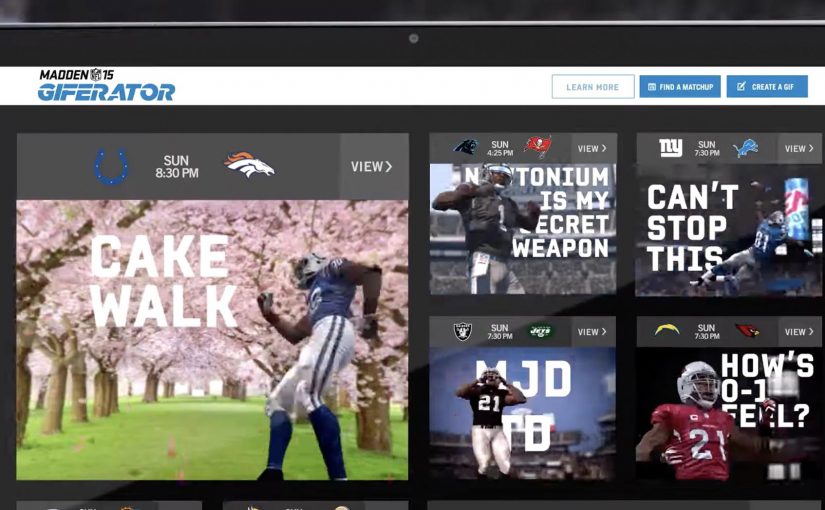
To launch their new game Madden NFL 15, EA Sports wanted to connect with young, football-obsessed fans and grow its association with the real world NFL. Since the average football fan was watching the game with their smartphone in hand, EA teamed up with Google to allow sport fans to provoke rivals from the comfort of their own sofa and bring trash talk into the 21st century.

Using pioneering technology, live NFL data was fused with Madden 15 game footage to generate GIF highlights for every single game. All of this was delivered via real-time ads across sports websites and apps. As a result there was an ever growing collection of GIFs that football fans could simply take, edit and share to shove in the face of their rivals.

How the GIFERATOR works

The mechanic is a real-time trigger loop. As live NFL moments happen, a data signal maps those moments to a library of Madden NFL 15 visuals, headlines, and team-specific ingredients. The system then assembles a ready-to-share GIF that matches what fans are watching, right when the emotion spike is highest.

In sports marketing, second-screen behavior turns live moments into shareable social currency.

Why it lands

The creative idea is not “GIFs”. It is timing plus relevance. Because the asset shows up while the emotion spike is still live, it feels native to the fan conversation instead of delayed brand content. When fans are already checking stats, group chats, and social feeds mid-game, you meet them where their thumbs already are. The format just happens to be the internet’s fastest unit of trash talk.

Extractable takeaway: If you can translate a live moment into a personalized, ready-to-share asset within the same minute, you convert attention into participation, and participation into distribution.

Where the real value sits

The real question is how to make a boxed game feel as live, social, and rivalry-ready as the sport it simulates.

This is also a credibility move. By fusing live NFL action with Madden footage, the game positions itself as culturally current, not just a boxed product. It borrows the emotional heat of real games and channels it into the Madden universe, play after play.

What second-screen marketers should steal

  • Build a trigger map: define which live signals create which assets, and keep the mapping simple enough to scale all season.
  • Design for viewer control: let people tweak copy or choose variants, so the output feels like “mine”, not “an ad”.
  • Win the second screen: deliver creative where fans already browse during live events, not only on your owned channels.
  • Make rivalry the editor: structure content around opponents, not around generic brand lines, so sharing feels inevitable.
  • Ship a content engine, not a one-off: the compounding library is the advantage, because it stays fresh week after week.

A few fast answers before you act

What is the Madden GIFERATOR?

It is a real-time GIF creation system that generates Madden NFL 15-themed GIFs that match what is happening in live NFL games, designed for instant sharing and trash talk.

Why does “real-time” matter here?

Because it catches fans during peak emotion. The closer the asset appears to the live moment, the more it feels like part of the conversation instead of an interruption.

What is the core pattern to reuse?

Use live signals to automatically assemble relevant, lightweight assets, then distribute them on the channels people naturally use while watching.

Is this mainly a social campaign or an ad campaign?

Both. The distribution is described as real-time advertising across sports sites and apps, while the product experience is built for fans to edit and share the output socially.

What is the biggest execution risk?

Relevance drift. If the mapping from live moments to generated assets feels off, or if the output arrives too late, it stops feeling “in the game” and becomes just another banner.