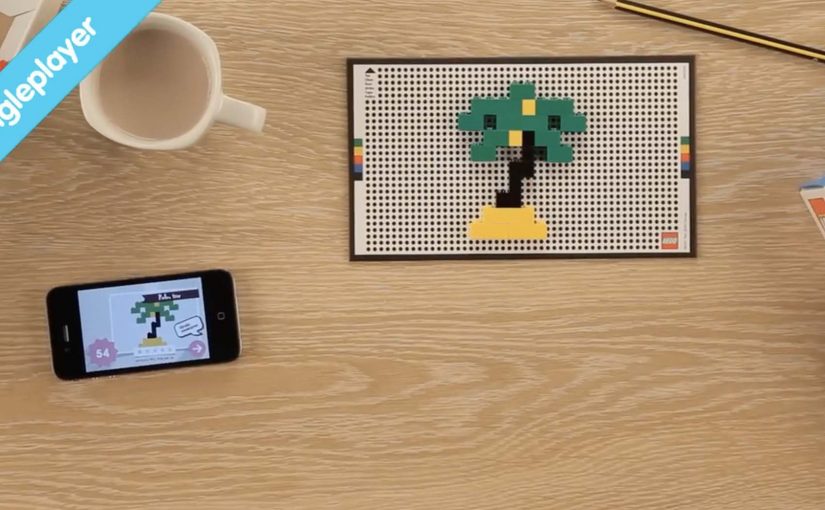
George shows you a photo from his travels and challenges you to rebuild it, fast, using real LEGO bricks. You scramble through a small set, build the scene on a dotted playmat, snap a picture, and the app scores you for speed and accuracy. The game is pretty useful as kids do not need to lug their entire LEGO collection around. While for parents the game helps in teaching counting and hand-eye coordination as you need to find blocks as quickly as possible and then put them together.
It is an exciting time for 12 year olds as they witness the first wave of electronic gaming. Digital-to-physical gameplay. Last year Disney announced a new line of toys called Disney Appmates that worked in tandem with the iPad. Now with “Life of George”, LEGO combines real bricks with an app for iOS and select Android devices.
Definition tightening: Digital-to-physical gameplay uses a screen to set the challenge and validate the outcome, while the actual play happens with real objects in the room.
The mechanic that makes it feel like a “real” game
The loop is clean. The app presents a reference image. You recreate it with 144 pieces. You photograph your build on the dotted playmat. The app reads the build using image recognition, then awards points based on how close you got and how quickly you did it.
In global toy categories where screens compete for attention, hybrid play wins when the device camera becomes a bridge back to hands-on making.
The real question is whether the app uses the screen to replace LEGO play, or to make physical LEGO play faster, clearer, and more replayable.
Why it lands for kids and parents
For kids, the fun is the time pressure and the treasure hunt. Finding the right brick and placing it correctly becomes the challenge, not navigating menus. For parents, the value is that the rules structure the chaos. Counting, pattern matching, and hand-eye coordination are baked into the race.
Extractable takeaway: The strongest digital-to-physical games treat the screen as referee, not as the playground. They keep the “doing” physical, and use the device only to prompt, verify, and reward.
What to steal from this format
- Make the rules visual. A single reference image beats a paragraph of instructions.
- Use the camera as validation. Let players “submit” their physical work in one tap.
- Keep the kit portable. A small curated set can travel, unlike a whole LEGO tub.
- Reward speed and accuracy. Those two levers create replay without adding complexity.
A few fast answers before you act
What is LEGO Life of George?
A hybrid LEGO game where the app shows a picture challenge, you rebuild it with real bricks on a playmat, and the app scores your photo using brick recognition.
What is the core mechanism?
Prompt with an image. Build physically. Photograph on a patterned play surface. Use computer vision to validate and score speed and accuracy.
Why does the dotted playmat matter?
It standardizes the photo capture so the app can recognize scale and placement more reliably, which makes scoring feel fair.
What is the main benefit versus classic LEGO play?
Structure and portability. A small set plus timed challenges creates a “game” you can play anywhere without carrying a full collection.
What is the most reusable lesson for digital-to-physical products?
Use the device to create clear prompts and instant feedback, but keep the core activity tangible and social in the real world.