
Technology in 2014

A 2014 screen daydream from The Astonishing Tribe

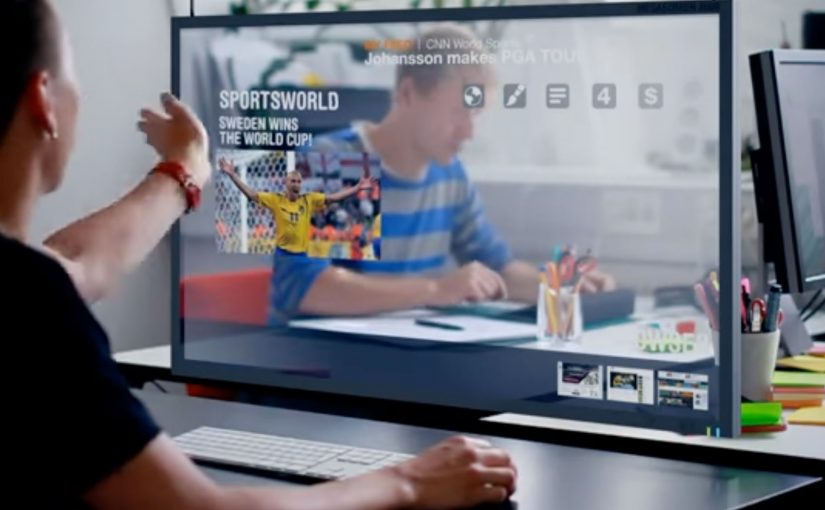
This is essentially an experience video by Swedish interface gurus The Astonishing Tribe, envisioning the future of screen technology with stretchable screens, transparent screens and e-ink displays, to name a few. An experience video is a short concept film that prototypes interface behavior and user flows before the underlying hardware is ready for the market. E-ink is a reflective display technology designed for readability and low power use.

How the film turns “new screens” into real interactions

Instead of listing specs, the video uses everyday moments to make the screen itself feel like a material you can bend, place, and share. The point is not the exact device. The point is the interaction model that becomes possible when the display is flexible, see-through, or paper-like. That works because a familiar human moment makes an unfamiliar screen feel usable, not speculative.

In consumer electronics and enterprise device ecosystems, display form factors shape interaction patterns, content formats, and the business models built on top of them.

The real question is which interaction model you want your screens to enable before you commit to devices, layouts, and content formats.

Concept experience videos are still one of the fastest ways to align teams on interaction shifts before the hardware is ready.

Why “stretchable, transparent, e-ink” is a strong provocation

Stretchable screens challenge the idea that UI must live inside rigid rectangles. Transparent screens challenge the idea that a screen must block the physical world. E-ink displays challenge the assumption that every screen is emissive, high-refresh, and power-hungry.

Extractable takeaway: Pick one screen assumption to break (rigid, opaque, emissive) and demonstrate the behaviors that follow.

Steal these moves for your next interface pitch

  • Show behaviors, not features. Demonstrate how people move, share, and switch context when the screen stops behaving like a slab.
  • Prototype the handoffs. The “wow” is usually in the transitions, not the destination screen.
  • Use one material shift as the story engine. Flexible, transparent, or reflective. Pick one and build a coherent set of moments around it.
  • Make it boring on purpose. Ground the future in ordinary work, home, and commuting situations so the audience focuses on usability.

A few fast answers before you act

What is “Technology in 2014” about?

It is a concept experience video that imagines how screens could evolve by the year 2014. The focus is on new display form factors and the interactions they enable.

Which display ideas does it highlight?

The video spotlights stretchable screens, transparent screens, and e-ink displays. Those three examples are used to suggest different ways UI could live in the physical world.

What should marketers or product teams take from it?

Use concept films to communicate interaction shifts early, when prototypes are still rough. Anchor the story in everyday scenarios so the intended behavior is unmistakable.

How do you apply the idea without future hardware?

Focus on the interaction principles: continuity across surfaces, simple sharing moments, and readable, low-friction information layers. You can prototype those behaviors with today’s devices and materials.

What’s the biggest pitfall when making this kind of video?

Over-indexing on visual spectacle and under-explaining the user flow. If viewers cannot repeat the “how it works” in one sentence, the concept will not travel inside an organization.
Nike Air Digital Installation

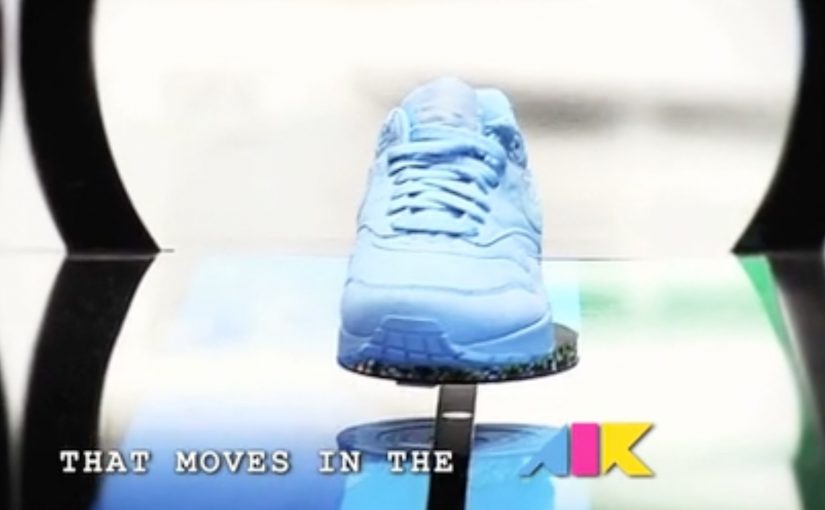
A Nike Air shoe hovers above a levitating platform in-store. The installation makes “Air” physical. The shoe looks suspended, and the display behaves like it is defying gravity.

The idea. Bringing “Air” to life

This digital installation for Nike, by +Castro and BBDO Argentina, turns the Nike Air story into something you can experience in a store. A levitating shoe platform suspends the new range of Nike Air shoes and makes the benefit feel real, not claimed.

How it works. Blow to race

The twist is that the experience is not limited to the store. If you are in-store, or even online at The Nike Air Show, you get to race the Nike Air shoes live by blowing into a microphone. The installation reads the volume of air you blow and translates it into power for your Nike Air Race. It also lets one shared mechanic run across both environments. Here, the shared mechanic is simple: blowing air is the input that powers the race in-store and online.

In retail and experiential marketing, the strongest product demos make an invisible benefit visible through a simple action the shopper can trigger.

Why it works. In-store plus online, one mechanic

The activation keeps the interaction simple and intuitive. Air in. Speed out. It also connects two environments that are usually separate. A physical point of sale moment and an online experience. Because the same input powers both versions, the idea is easy to understand, easy to demonstrate, and easy to retell.

Extractable takeaway: When a product promise is abstract, the fastest way to make it believable is to turn it into a simple user action that works the same way across channels.

What the business move really is

The real question is whether one product truth can drive attention, participation, and memory across both retail and online touchpoints.

The stronger strategy is to use one product truth across both environments, not to treat the store demo and the online experience as separate ideas.

What to steal for in-store to online experiences

  • Make the product benefit physical. The levitating platform turns “Air” into something people can literally see in-store.
  • Use one simple input as the bridge. Blowing into a microphone works in a shop environment and maps cleanly to an online race mechanic.
  • Turn a demo into a challenge. Racing converts “looking at” into “doing”, which increases dwell time and talk value.
  • Let the same idea travel across channels. The installation is the proof. The online experience is the shareable continuation.

A few fast answers before you act

What is the Nike Air digital installation?

The Nike Air digital installation is a levitating in-store platform that suspends Nike Air shoes and turns the “Air” benefit into a physical experience.

What is the interactive element?

The interactive element is a microphone-based mechanic where people blow air to generate power for a live Nike Air Race.

Where does the race happen?

The Nike Air Race happens in-store and online at The Nike Air Show.

Who is behind the work?

The work is by +Castro and BBDO Argentina.

What is the transferable pattern?

The transferable pattern is to make the product benefit tangible, then use one simple input to connect the in-store moment to a parallel online experience.

Banrock Station: 100K Live Bees Billboard

An SOS written by a living swarm

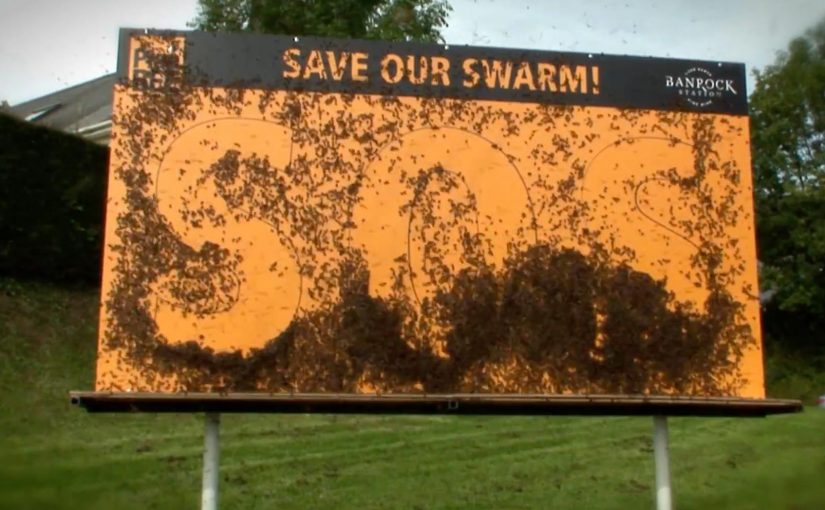
Honey-bee populations are mysteriously dwindling worldwide. In England, the Banrock Station winery created what it described as the world’s first ad with live bees to call attention to the problem.

Using queen-bee pheromones, the team attracted a giant swarm of bees, as many as 100,000, from a nearby honey farm to spell out an “SOS” message on a billboard.

Queen-bee pheromones are chemical signals that draw worker bees toward what they perceive as the queen’s location, making it possible to guide where a swarm clusters.

How it works: make the message unavoidable

The mechanism is blunt and brilliant. Use the medium itself as proof. A billboard about bees becomes a billboard made of bees, so the problem is not explained. It is witnessed.

In UK cause marketing, a conservation message that becomes a public spectacle can travel faster because it creates a stoppable moment people feel compelled to verify and share. A stoppable moment is one that makes people pause long enough to look twice or pull out a phone.

In European consumer brands and other enterprise marketers, cause messages break through fastest when the proof is visible in the same moment as the claim.

Why it lands: it turns concern into a physical reaction

This works because it compresses a complex topic into one immediate sensation. Surprise first, meaning second. You see the swarm, you read “SOS”, and only then do you connect it to the decline story.

Extractable takeaway: The most effective cause marketing often turns an abstract problem into a physical moment, then ties that moment to a simple action that funds or advances the cause.

The real question is whether your cause message can be proven in the same glance it is read.

Because the billboard is literally formed by the subject of the campaign, the message feels less like persuasion and more like evidence, which increases attention and recall.

The business intent: build salience and fund the cause

The film earns awareness, but it also links the stunt to action. Banrock Station also donates 5p to the honey-bee cause for every bottle sold, turning attention into a measurable contribution. Proof-first cause marketing is strongest when it is paired with a simple give-back mechanism, meaning a clear, fixed contribution that turns attention into funding.

Steals for cause marketing that feels real

  • Make the medium the proof. If you can embody the issue in the execution, you do not need long explanation.
  • Design for a “verify it” reaction. Meaning people want to confirm it is real before they repeat it.
  • Connect attention to a concrete contribution. Pair the story with a simple, trackable give-back mechanism.
  • Keep the message legible at a glance. “SOS” works because it is instantly readable even before context arrives.

A few fast answers before you act

What is Banrock Station’s “live bees billboard” in one sentence?

An out-of-home awareness piece that uses a real, visible “live bees” element to make the environmental message feel tangible rather than symbolic.

What is the core mechanism?

The medium becomes the proof. The execution embodies the issue in a way passers-by can immediately see, which makes the story inherently shareable.

Why does this kind of cause marketing earn attention?

Because it triggers a “verify it” reaction. People are more likely to share something they feel others need to see to believe.

What business intent does it serve beyond awareness?

It links brand meaning to a concrete, memorable moment, and can be paired with a trackable give-back or action mechanic to convert attention into contribution.

What is the most transferable takeaway?

If you can turn a cause into a physical, legible proof-point, you reduce explanation and increase both recall and retellability.