
Norwegian Airlines: Red Cab Remote Taxi

Norwegian Airlines: Red Cab Remote Taxi

A shopper in an Oslo mall steps up to a big screen and “hails” a cab in New York City. Seconds later, they are effectively riding along in real time, steering what they see and getting a guided tour from someone inside the taxi.

Remote sightseeing as a route launch

Norwegian Airlines creates an interactive experience that lets visitors in an Oslo shopping mall control a New York City taxi in real time. A tour guide inside the cab helps participants discover New York while building awareness of Norwegian’s direct long-haul destinations from Oslo to New York, Miami, LA, San Francisco, and Bangkok.

The mechanism: viewer control, live feed, human guide

The activation is built like a two-way window. A live camera setup in the taxi transmits the streets of New York back to the mall installation, and mall visitors can influence what they are seeing while talking with the person in the cab who keeps the “tour” moving. Here, viewer control means the participant can steer the camera’s attention and request what the cab shows next. That matters because even light control makes the experience feel personal, which turns passive watching into active participation.

It is also described as an M&C Saatchi Stockholm idea with production support from Stopp, using a 360-degree style camera approach to make the feed feel explorable rather than like a fixed livestream.

In European airline marketing, real-time remote experiences can make new long-haul routes feel tangible before anyone commits to a flight.

Why this lands

This works because it turns a schedule update into a lived moment. People do not just hear “we fly direct.” They experience the destination, live, in a way that creates an instant story to tell. The red cab visual also keeps the brand present throughout the interaction without needing heavy-handed messaging.

Extractable takeaway: When you are launching access (routes, coverage, delivery zones, service areas), design a live, controllable preview that lets people feel the place or outcome, then attach the brand benefit as the enabler of that experience.

What Norwegian is really buying

The stunt earns attention like an event, but it is strategically a conversion tool. It reduces psychological distance to long-haul travel by giving people a low-friction “trial,” and it reframes the airline as a bridge between cities rather than as a price-and-seat product.

The real question is whether a route launch can make distance feel emotionally short before the first booking happens.

What to steal from Red Cab

  • Turn claims into access. If your promise is reach, let people sample the reach.
  • Use a human guide. A live host makes the experience coherent, warm, and watchable.
  • Design for the crowd. Make the installation entertaining for bystanders, not just the participant.
  • Make the brand a prop. The red cab functions as an always-on brand cue without interrupting the experience.

A few fast answers before you act

What is Norwegian Red Cab?

It is a mall-based interactive installation where people in Oslo can explore New York City through a live taxi connection, with a guide inside the cab.

What does “control the taxi” mean here?

It refers to viewer control over the live viewing experience, such as directing the camera perspective and interacting with the person in the cab, rather than physically driving the vehicle.

Why is real-time important to the idea?

Because “live” removes doubt. It makes the destination feel present, which strengthens the message that direct long-haul routes bring far-away places closer.

What makes this more than a livestream?

The combination of viewer control and a human tour guide turns passive watching into an experience people can participate in and retell.

What’s the main operational risk with this pattern?

Reliability. If latency, audio, or camera control fails, the magic breaks quickly, so technical robustness matters as much as the creative concept.
Happy Holiday Videos 2013: Agency Stunts

Happy Holiday Videos 2013: Agency Stunts

Welcome back. Hope everyone had a great holiday season. Now for a great start to 2014.

Taking off from my last post, here are a series of holiday action videos created by agencies around the world in their lead up to Christmas 2013. By “holiday action videos” I mean greetings built around a single visible action or interaction, not a passive message.

Holiday greetings that behave like products

The mechanism across this set is simple. Use the “holiday card” moment as permission to ship a stunt, an installation, or an interactive video that people can experience rather than merely watch.

In global agency culture, holiday cards are a low-stakes sandbox for experimentation that teams can ship fast and share widely.

The real question is whether your greeting can demonstrate something people can experience, not just a sentiment you can post.

This format is worth copying because it turns a seasonal hello into proof of craft.

Why this format keeps working

These pieces earn attention because they trade greeting-card sentiment for an observable action. Put in a coin. Click a button. Gather people in front of a webcam. One clear trigger, one visible result.

Extractable takeaway: If you want something to travel during peak-season noise, design a one-step interaction that produces a visible payoff, and make the payoff easy for someone else to describe in a sentence.

Christmas Chocolate Coin Factory by W+K London

Wieden+Kennedy London turned their Hanbury Street office window into a Christmas installation. Passers-by who inserted a 1 pound coin into Dan & Dave’s Chocolate Coin Factory activated the machine on display which then dispensed a special gold Belgian chocolate coin at the other end. All the money collected from this coin factory was donated towards building a new playground for Millfields Community School in Hackney, East London.

Disrupted Christmas by Holler

Holler, an agency from Sydney, created a live interactive installation that gave the general public a chance to disrupt the agency as it worked throughout the day. Electric Muscle Stimulation (EMS) units were hacked and hooked up to the Internet via IP cameras. Then key members of the agency were connected to the EMS units, and the Internet via a live stream. The public could then watch the agency staff online and instantaneously zap them at will with the click of a button.

For each disruption the agency donated $1 to The Factory, a local community centre with a long history of supporting socially and economically disadvantaged local residents.

The More the Merrier by Publicis Groupe

The Publicis Groupe was back again with another Maurice Lévy holiday video. This time they worked with DigitasLBi to create a video that uses your webcam to detect how many faces are watching together, and then adapts the video based on the number of viewers.

The Epic Christmas Split by Delov Digital

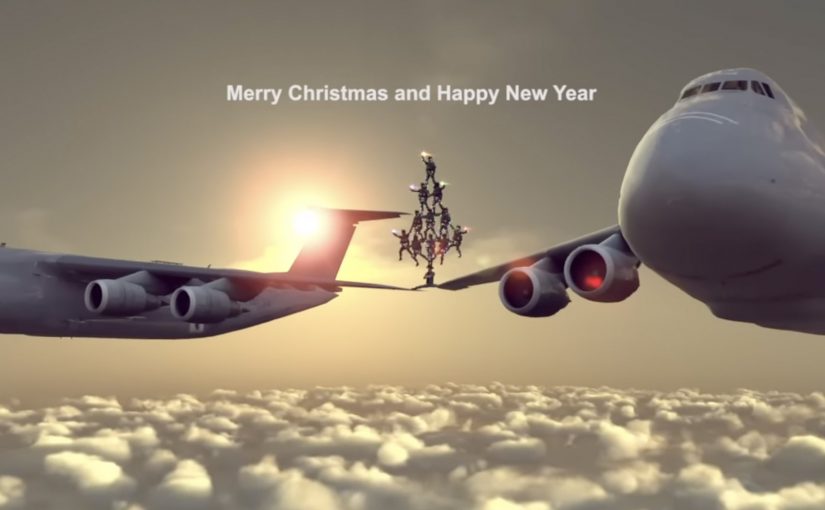
Delov Digital from Hungary used Chuck Norris to top Jean-Claude Van Damme’s epic Volvo split with the help of some serious digital enhancement.

A repeatable structure for next year’s greeting

  • Give the audience one trigger. A single action that anyone can explain and repeat.
  • Make the payoff visible. Something that changes on-screen or in the real world, immediately.
  • Design for retellability. If the idea cannot be summarized in one sentence, it will not spread.
  • Let craft do the selling. Use the holiday excuse to demonstrate what you can build, not just what you can say.

A few fast answers before you act

What makes “holiday action videos” different from normal holiday ads?

They are built around a visible action or interaction. The greeting is the excuse. The experience is the asset that people talk about and share.

Why do agencies use holiday cards as a playground for experimentation?

The stakes are lower and the audience is receptive. That creates room to try unusual formats, technical tricks, and interactive mechanics that would be harder to justify in a client campaign.

What is the common mechanism across the best ones?

One clear trigger and one clear payoff. Insert a coin and get a coin back. Click a button and something happens. Add more people and the video changes.

How do you choose a mechanic that people will actually try?

Pick a one-step trigger that feels effortless, then make the payoff obvious within seconds. If someone cannot explain both in one sentence, the interaction will not travel.

How do you keep it from feeling like a gimmick?

Anchor the interaction in a simple human reward. Delight, togetherness, surprise, or a small act of good. Then keep the mechanic effortless so the idea does not collapse under friction.

BMW i window into the near future

BMW i window into the near future

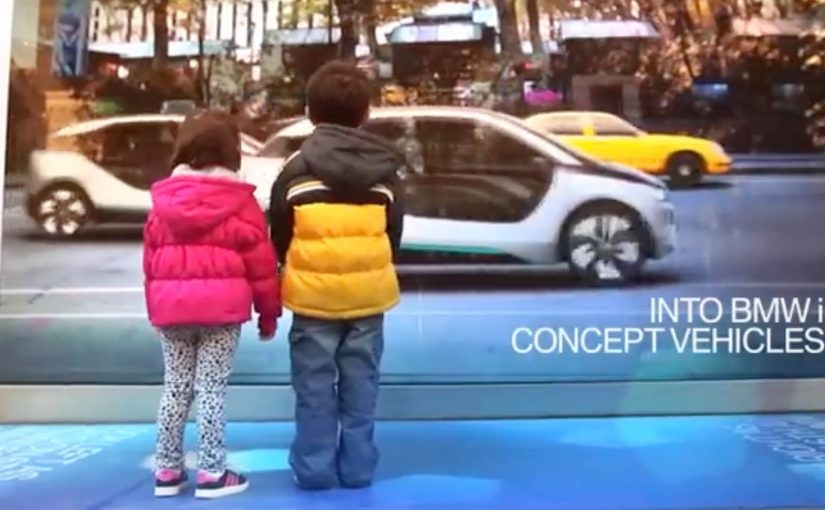
A street-level window in New York City behaves like a digital mirror. Here, “digital mirror” means a live street scene that can replace the cars in the image in real time. As traffic passes, the “reflection” transforms everyday cars into BMW i3 and i8 vehicles, giving passersby a glimpse into the near future.

The context. BMW i and “Born Electric”

The upcoming BMW i vehicles look distinctly futuristic and are positioned to arrive as early as late 2013. To build awareness for the BMW i Born Electric Tour in New York City, BMW reinforces a simple message. The future is closer than you think.

The real question is whether you can make a future-state product promise feel present without asking people to opt in.

This kind of work succeeds when the transformation is unmistakable from a distance and repeats for every passerby.

The execution. A live reflection that rewrites reality

BMW turns a window at the event location into a real-time “reflection” of passing traffic. The system captures what is happening on the street and swaps the vehicles in the live view for BMW i models, so the future feels present in the exact moment people walk by.

In public spaces, low-friction interactive experiences win when they are legible from a distance and require no download or instruction.

Why this works. Low friction, high surprise

The interaction requires no download, no instruction, and no commitment. It is immediate, legible from a distance, and designed for public curiosity. Because the swap happens in the same sightline people already have, surprise arrives before skepticism. The value is the reveal. A familiar street scene. Then a future version of that same scene.

Extractable takeaway: If you want people to believe “the future is close,” show the future inside a familiar frame, in real time, with one unmistakable before-and-after.

Make the promise feel present

  • Borrow a default behavior. Use a frame people already check, like a reflection or a window, so attention is automatic.
  • Make the change binary. One clear swap that anyone can spot, even in motion.
  • Let repetition do the work. Design it so the reveal happens again and again for new passersby, without setup.

A few fast answers before you act

What is BMW i Window Into the Near Future?

A street-level installation that turns a window into a live digital “reflection,” transforming passing traffic into BMW i3 and i8 vehicles.

What is it promoting?

Awareness for the BMW i Born Electric Tour in New York City, and the idea that the future is closer than you think.

What is the main user behavior?

Walk by, notice the window, and experience the surprise as the street scene is transformed in real time.

Why is the window format effective?

It uses a natural behavior, looking at reflections, then subverts it with a future-state overlay.

What is the transferable pattern?

Place the experience where attention already exists, then deliver one high-clarity transformation that makes the product promise tangible.