

Mercedes-Benz: Flying Car

Mercedes-Benz: Flying Car

Mercedes-Benz, with the help of Ponto de Criacao from Brazil, executed a highly segmented vertical action to increase visibility for the brand among top executives and business people. Here, “vertical action” means a narrowly targeted activation placed in a single corridor that concentrates the exact audience you want.

Flying Car by Mercedes Benz

As a courtesy, passengers also received a miniature car.
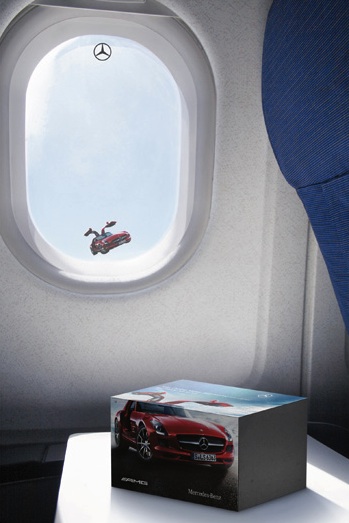
Flying Car by Mercedes Benz

In one month, 100% of the target audience was reached, nearly 400 executives.

In premium automotive marketing aimed at senior business travelers, attention is scarce and context is often the only reliable way to earn it.

When the audience is this narrow and valuable, precision distribution can outperform broad reach because the placement becomes the idea.

Why this placement is so effective

The mechanism is simple and the payoff is immediate. By turning the aircraft window into the “media unit,” the mind completes the illusion, which makes the moment feel native, surprising, and worth retelling.

Extractable takeaway: When your audience is concentrated in a repeatable corridor, design a message that only works in that context so the situation does the persuasion for you.

  • Context does the work. The illusion only makes sense in-flight, which turns a standard window view into a brand moment.
  • Precision beats scale. Shuttle flights concentrate the exact audience Mercedes-Benz wanted, without wasting impressions.
  • Low friction, high memorability. A simple sticker creates an instant “did you see that?” effect, then the miniature car extends the memory.

What to take from it

The real question is which high-value corridor your audience repeats, where attention is naturally high, and where your message can feel native instead of intrusive.

When the audience is narrow and valuable, distribution can be the idea. This activation did not rely on complex tech. It relied on selecting the right corridor, placing the message where attention is naturally high, and creating a visual that feels native to the moment.

  • Start with the corridor. Identify the repeatable moment where your audience is already together and already looking.
  • Make the context do the explaining. Build the visual so it only makes sense there, so the placement becomes the punchline.
  • Extend the memory. Add a small, simple takeaway that keeps the moment alive after the corridor ends.

A few fast answers before you act

What was “Flying Car” by Mercedes-Benz?

It was a targeted activation that placed SLS AMG window stickers on shuttle flights, creating the illusion of the car “flying” outside the aircraft window for executive travelers.

Why use shuttle flights for this?

Because those routes clustered top executives and business travelers, delivering near-perfect audience fit with minimal wasted reach.

What role did the miniature car play?

It extended the experience beyond the flight as a physical takeaway, reinforcing recall after the moment passed.

What is the transferable pattern?

Pick a narrow, high-value corridor, design a context-native visual that only works there, then add a small extension to carry the memory forward.

How do you apply this pattern without access to flights?

Find any repeatable corridor that concentrates your audience, then design a context-native cue that only works in that moment and can be carried forward with a simple takeaway.

Fundación Altius: Message in a Bottle

Fundación Altius: Message in a Bottle

Fundación Altius (Altius Foundation) runs education support for children in Latin America, and Leo Burnett Iberia builds a fundraising action around a simple, loaded object. A bottle that carries a message.

The case film frames it as a direct marketing idea where the bottle itself becomes the medium. It turns “support education” from an abstract appeal into a tangible artifact people can notice, hold, and pass along.

How Message in a Bottle turns packaging into fundraising

The mechanism is presented as promotional packaging used as a donation trigger. Instead of relying on a poster or a banner to explain the need, the action uses a familiar container and a clear message to pull attention toward the cause, then convert that attention into money for education.

In European cause and charity communications, physical objects still outperform pure awareness copy when the goal is to move someone from empathy to action.

Why it lands

A bottle is instantly readable. It signals “take me”, “open me”, “share me”. That makes it a natural carrier for a cause message because it invites interaction without asking for it. When the fundraising mechanism is embedded in a physical cue, people do not feel like they are entering a campaign. They feel like they are responding to something human.

Extractable takeaway: If you need donations, compress the story into a single object with one clear behavior attached to it. The object becomes both the message and the moment of conversion.

What this kind of action is optimized for

This is designed to work in the messy middle of everyday life, where people do not stop for “awareness”. Here, the messy middle means the in-between moments where people are busy, distracted, and not actively looking for a cause to support. A direct marketing action that lives on an object can travel further than its media buy, because the object itself carries the pitch into new contexts.

The real question is whether your cause can be reduced to one object and one behavior without losing meaning. For donation-driven work, object-led asks are stronger than awareness-led messaging when the job is immediate response.

What to steal for your own nonprofit or CSR work

  • Attach the ask to something people already touch. Physical interaction reduces friction compared with “go to a site and read”.
  • Keep the message single-minded. One object. One message. One intended next step.
  • Make the object do the explaining. If you need a paragraph to understand the mechanic, it will not scale.
  • Build for redistribution. The best fundraising artifacts are easy to pass on, not just easy to notice.

A few fast answers before you act

What is Message in a Bottle in one sentence?

A fundraising action for Fundación Altius where a bottle and its message act as the direct marketing device that nudges people to donate toward children’s education.

Why use packaging or a physical artifact for a charity ask?

Because objects create a natural pause. They are handled, noticed, and shared, which can move people from passive sympathy to a concrete action faster than awareness media.

What makes this different from a standard donation campaign?

The medium is also the mechanism. The object carries the story and cues the behavior, so the “how to help” is not separate from the “why to help”.

What is the main risk in copying this approach?

If the object is clever but the donation pathway is unclear, attention gets spent without conversion. The artifact must lead cleanly to giving.

When does this approach work best?

It works best when the cause can be expressed through one obvious object and one obvious next step. If people need too much explanation before they understand what to do, the artifact loses its power.

Durex: Baby App

Durex: Baby App

Making the consequence tangible, not the lecture louder

In consumer health marketing, the hardest problems are rarely about information. They are about motivation in the moment. This Durex idea is a clean example of turning a behavior barrier into an experience.

Condoms can feel like a downer. So how do you convince guys to put one on, and make Durex the favored choice?

This is the right move when information is not the problem. Make the consequence tangible, not the lecture louder.

Using the iPhone, Nicolai Villads, Peter Ammentorp and Raul Montenegro created what is called the Durex Baby application for the iPhone.

How the Durex Baby app worked as a behavioral nudge

The mechanism was simple. If the barrier is that protection feels like a mood killer, shift attention to what happens without it.

The app simulated the realities of having a baby, using the phone as a constant companion device. It turned an abstract risk into a persistent, personal experience that could be felt rather than explained. Because the phone stays close, the simulation can interrupt everyday moments, which is why it lands as a nudge instead of a lecture.

In consumer health marketing, consequence simulation works best when the audience already knows the facts but needs a visceral prompt.

The real question is how you make “responsible” feel like the easiest choice in the moment.

Why simulation can change decisions faster than persuasion

Most messaging about safe sex competes with optimism bias, the tendency to assume consequences happen to someone else. A simulation reduces that distance by making “later” feel like “now,” reframing the trade-off from short-term inconvenience to long-term responsibility.

Extractable takeaway: When persuasion stalls, build a simulation that collapses time and personal distance so the audience feels the outcome and re-evaluates the trade-off on their own.

The intent behind building it for Future Lions

The app was created for the Future Lions 2010 competition organized by digital agency AKQA and the Cannes Lions Advertising festival.

The business intent is clear. Use mobile to translate a sensitive topic into a playful but pointed interaction that can travel socially and be discussed without heavy moralizing, while keeping the brand associated with the responsible choice.

What to borrow from Durex Baby

  • Turn abstract risk into felt experience. Simulation can outperform warnings when the audience tunes out lectures.
  • Use the device people always carry. Mobile is effective when the behavior change depends on everyday moments.
  • Reframe the trade-off. Move attention from short-term friction to long-term consequence in a way people can grasp instantly.
  • Make it discussable. Playful interaction can open conversation on topics people avoid in direct language.

A few fast answers before you act

What is the Durex Baby app?

An iPhone app concept that simulates the realities of having a baby to encourage safer choices and reduce resistance to using condoms.

What was the core mechanism?

Behavioral reframing through simulation. The phone delivers an ongoing experience that makes the consequence of not using protection feel immediate.

Why does this approach work better than a warning for some audiences?

Because it reduces optimism bias. People are more likely to change behavior when the consequence feels personal and present, not distant and theoretical.

What business goal does it serve for Durex?

Positioning the brand as the responsible default choice by shifting the decision from mood-based resistance to consequence-based clarity.

What is the main takeaway for marketers?

If persuasion is failing, design an experience that makes the outcome feel real, then let the audience reach the conclusion themselves.