
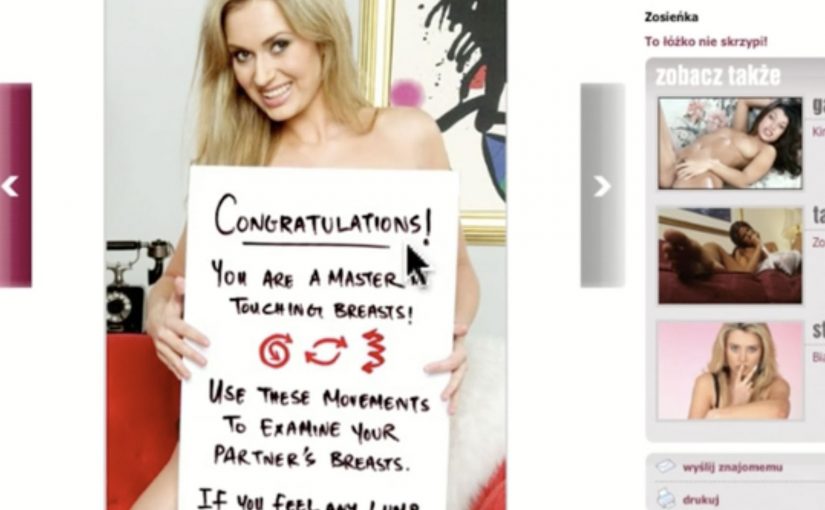
wp.pl: Magic Boobs for Breast Cancer Awareness

wp.pl: Magic Boobs for Breast Cancer Awareness

Digital can put learning in places people do not expect it. In this Polish breast cancer awareness idea, Change Integrated places an interactive experience inside the adult section of a major Polish portal, so men stumble into a lesson while they are there for something else.

The execution replaces a standard adult-gallery moment with a guided, click-and-touch interaction that demonstrates breast-check technique. It turns curiosity into a short, hands-on tutorial rather than a poster telling you to “be aware”.

The mechanic that makes it work

The mechanism is simple and deliberate. Use a high-attention environment to earn the first click, then use interactivity to pace the learning. Each interaction step nudges the user to explore the right areas and patterns, and the interface rewards correct moves with immediate feedback.

In public health communication, especially when the target audience avoids traditional education messages, playful interactivity can lower the barrier to learning.

Why this lands with the audience

It converts an awkward topic into a permissioned moment, meaning the audience feels they have chosen to enter the interaction rather than being pushed into a lesson. The adult context makes the entry feel natural rather than preachy, and the game-like format reduces the discomfort that often blocks attention. Because it is hands-on, the message is encoded as a physical routine, not just a line of copy.

Extractable takeaway: If you need people to learn a technique, do not just ask for awareness. Put the technique inside an interaction loop where attention is already high, then let feedback do the teaching.

What the campaign is really optimizing for

The real question is how to teach a sensitive behavior in a way people will actually complete. For cause-led digital work like this, teaching the behavior matters more than broadcasting awareness.

The intent is behavior change, not just recall. The case is designed to increase the odds that men will remember what “checking correctly” looks like and encourage it in real life. The case film reports the placement was live for one week and that it trained a very large number of participants in that window.

What to steal for your own cause-led work

  • Meet the audience where they already are. Relevance is sometimes a location choice, not a message choice.
  • Teach by doing. Interactivity works best when it is the lesson, not a decoration around the lesson.
  • Use feedback as the copy. Immediate response to user actions replaces long explanations.
  • Design for controversy without disrespect. If you use adult inventory, the line between attention and backlash is thin. The craft has to stay purposeful.

A few fast answers before you act

What is “Magic Boobs” in one sentence?

An interactive awareness placement on wp.pl’s adult section that teaches breast-check technique through a guided, game-like touch interaction.

Why place a health message in an adult environment?

Because it captures attention from a hard-to-reach audience and reframes the lesson as something people willingly explore rather than something they are told to do.

What is the key design principle behind the interaction?

Turn the desired learning into the interface itself. Each step of the interaction is the instruction, reinforced by feedback.

What makes this different from a standard awareness banner?

A standard banner asks for attention. This format makes the user perform the learning step by step, so the teaching happens through action rather than passive exposure.

What is the biggest risk with this approach?

Misalignment with the cause. If the execution reads as exploitative or tone-deaf, it can damage trust faster than it builds awareness.

Fundación Altius: Message in a Bottle

Fundación Altius: Message in a Bottle

Fundación Altius (Altius Foundation) runs education support for children in Latin America, and Leo Burnett Iberia builds a fundraising action around a simple, loaded object. A bottle that carries a message.

The case film frames it as a direct marketing idea where the bottle itself becomes the medium. It turns “support education” from an abstract appeal into a tangible artifact people can notice, hold, and pass along.

How Message in a Bottle turns packaging into fundraising

The mechanism is presented as promotional packaging used as a donation trigger. Instead of relying on a poster or a banner to explain the need, the action uses a familiar container and a clear message to pull attention toward the cause, then convert that attention into money for education.

In European cause and charity communications, physical objects still outperform pure awareness copy when the goal is to move someone from empathy to action.

Why it lands

A bottle is instantly readable. It signals “take me”, “open me”, “share me”. That makes it a natural carrier for a cause message because it invites interaction without asking for it. When the fundraising mechanism is embedded in a physical cue, people do not feel like they are entering a campaign. They feel like they are responding to something human.

Extractable takeaway: If you need donations, compress the story into a single object with one clear behavior attached to it. The object becomes both the message and the moment of conversion.

What this kind of action is optimized for

This is designed to work in the messy middle of everyday life, where people do not stop for “awareness”. Here, the messy middle means the in-between moments where people are busy, distracted, and not actively looking for a cause to support. A direct marketing action that lives on an object can travel further than its media buy, because the object itself carries the pitch into new contexts.

The real question is whether your cause can be reduced to one object and one behavior without losing meaning. For donation-driven work, object-led asks are stronger than awareness-led messaging when the job is immediate response.

What to steal for your own nonprofit or CSR work

  • Attach the ask to something people already touch. Physical interaction reduces friction compared with “go to a site and read”.
  • Keep the message single-minded. One object. One message. One intended next step.
  • Make the object do the explaining. If you need a paragraph to understand the mechanic, it will not scale.
  • Build for redistribution. The best fundraising artifacts are easy to pass on, not just easy to notice.

A few fast answers before you act

What is Message in a Bottle in one sentence?

A fundraising action for Fundación Altius where a bottle and its message act as the direct marketing device that nudges people to donate toward children’s education.

Why use packaging or a physical artifact for a charity ask?

Because objects create a natural pause. They are handled, noticed, and shared, which can move people from passive sympathy to a concrete action faster than awareness media.

What makes this different from a standard donation campaign?

The medium is also the mechanism. The object carries the story and cues the behavior, so the “how to help” is not separate from the “why to help”.

What is the main risk in copying this approach?

If the object is clever but the donation pathway is unclear, attention gets spent without conversion. The artifact must lead cleanly to giving.

When does this approach work best?

It works best when the cause can be expressed through one obvious object and one obvious next step. If people need too much explanation before they understand what to do, the artifact loses its power.

Go Vote: Or You Let Others Decide

Go Vote: Or You Let Others Decide

An integrated experience-based campaign was created by DDB Budapest on behalf of the Hungarian Democracy to support the 2010 Hungarian elections.

Instead of relying only on posters and TV spots, the idea is built around lived moments that make one point unavoidable: if you do not vote, you still get an outcome. You just did not choose it.

When “apathy” becomes something you can feel

The line “go vote, or you let others decide for you” is easy to agree with in theory, and easy to ignore in practice. The creative move here is to stop arguing and start staging: put people into situations where “someone else decides” is no longer an abstract civic warning, but an immediate, personal experience.

The mechanic: make the consequence tangible

The campaign uses real-world experiences as the delivery system. The experience is the message: you lose control when you opt out. That emotional truth lands faster than any rational explanation of why voting matters.

In public-interest communication, experience-led campaigns often work best when they translate a distant consequence into a simple, physical moment.

Why it lands: it reframes voting as self-protection

Many turnout messages talk about duty. This approach talks about ownership. The real question is not whether people agree that voting matters, but whether the campaign makes the cost of opting out feel personal enough to trigger action. The stronger strategy is to make non-participation feel immediate, not just irresponsible. It positions voting less as a moral obligation, and more as the minimum action required to keep your right to choose.

Extractable takeaway: If you need mass behavior change, do not just explain the benefit. Stage a short, memorable moment that lets people experience the cost of inaction. When the cost feels personal, the call-to-action becomes easier to act on.

The intent: turnout through a stronger trigger than guilt

The business of any election participation push is motivation. This work is a reminder that motivation does not need to be inspirational. It can be visceral. A compact experience can achieve what a long message cannot: it creates a story people retell, and that story carries the prompt forward.

What to steal for your own participation campaign

  • Start with a single, sharp sentence: one idea, no debate, no footnotes.
  • Translate the idea into an experience: let people feel the message before you ask them to act.
  • Keep it non-partisan by design: focus on participation, not outcomes or parties.
  • Make it retellable: if someone can describe it in one line, it will travel further.
  • Reduce the distance to action: the closer the experience sits to the voting moment, the stronger the conversion.

A few fast answers before you act

What kind of campaign is this?

It is a get-out-the-vote public awareness campaign that uses real-world experiences to dramatize the idea that non-participation still produces outcomes.

Why use experiences instead of just ads?

Because experiences create emotion, memory, and conversation quickly. They can make an abstract civic point feel immediate and personal.

How do you keep a turnout campaign non-partisan?

Keep the message focused on participation, avoid references to parties or policies, and design the experience around the universal right to choose.

What should you measure for effectiveness?

Reach and recall are basics. More useful are participation rates in the experience, social sharing, earned media pickup, and any localized uplift signals available near the activation footprint.

When can this approach backfire?

If the experience feels humiliating, unsafe, or coercive, it can trigger resentment. The best versions create urgency without disrespecting the audience.