
fiftyfifty: Frozen Cinema

fiftyfifty: Frozen Cinema

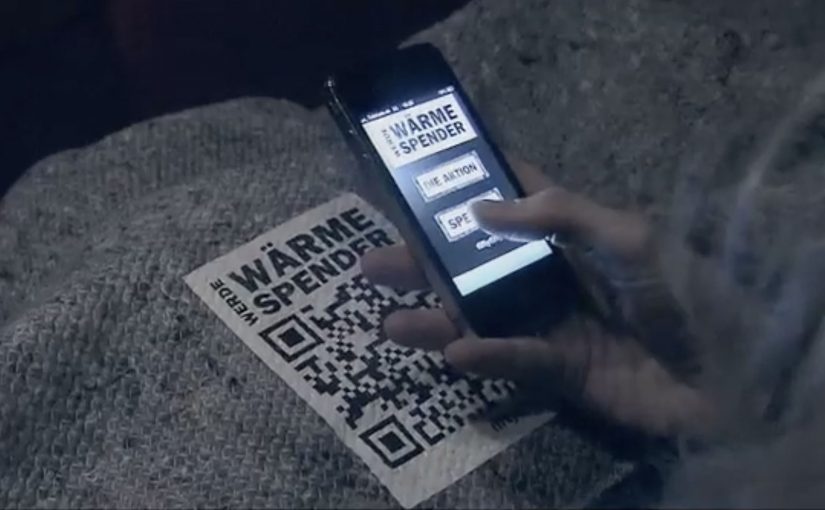
A cinema in Germany is set to a brutal 8°C. The audience starts to shiver, then notices blankets placed on the seats. A short film begins, and homeless people on screen comment on the “cold cinema experience”. For them, 8°C is described as cozy.

That contrast is the reality check. It turns “winter hardship” from an abstract idea into a physical sensation you cannot ignore, even if only for a few minutes.

How the donation loop is built

The mechanism is tightly engineered. Lower the temperature. Hand out blankets. Add QR codes to the blankets so the audience can donate instantly while the emotional context is still fresh. Here, the donation loop means a felt trigger, an instant prompt, and a friction-light way to give before the moment fades. The cold primes empathy. The QR code removes friction. That sequence works because the physical cue creates urgency and the QR code captures intent before it cools.

In European urban environments where most people only glimpse homelessness in passing, empathy campaigns land harder when they translate a daily reality into a shared, felt moment.

The real question is how to turn sympathy into immediate action before comfort returns and attention drifts.

Why it lands

This works because it is not just a message. It is a sensory demo. The audience experiences discomfort, then immediately hears the perspective of people who live with worse, for longer, with no quick “rewarm” button.

Extractable takeaway: If your cause depends on empathy, build one controlled, temporary experience that lets people feel a fraction of the problem, then put the simplest possible action in their hands while they still care.

What to reuse in empathy activations

  • Use the environment as media. A small physical change can do more than a big headline.
  • Pair feeling with explanation. The “why” must arrive before people rationalize the discomfort away.
  • Make the action immediate. Donations work best when there is no extra search, form, or delay.
  • Keep it respectful. The goal is recognition and support, not spectacle.

A few fast answers before you act

What is “Frozen Cinema”?

It is a charity awareness and donation activation that chills a cinema to 8°C and uses a short film plus QR-coded blankets to trigger immediate donations for homeless support.

What is the core mechanism?

Physical discomfort creates attention. Context from homeless voices creates meaning. QR codes on blankets remove friction so people can donate on the spot.

Why does the temperature change matter?

It turns an intellectual topic into a bodily experience. That shift makes the message harder to dismiss and easier to remember.

Why put the QR code on the blanket?

It places the donation action inside the experience itself, so people do not have to search for the next step after the emotional moment has passed.

What is the most reusable lesson?

When you need action, design a moment that people can feel, then make the response path effortless and immediate.
UTEC: Potable Water Generator

UTEC: Potable Water Generator

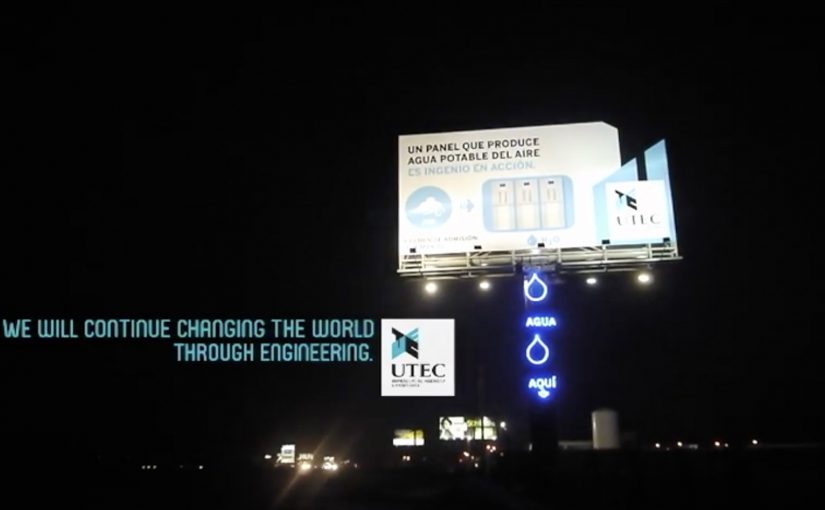
A billboard in Lima does not just advertise. It dispenses drinking water.

UTEC, the University of Engineering and Technology in Peru, believes engineering can change the world. To make that belief tangible and to attract future applicants, it tackles a local constraint. Lima is often described as a major capital city set on desert conditions, where rainfall is minimal, but atmospheric humidity can be extremely high. UTEC uses that humidity to build a billboard that is described as producing potable water out of air.

Definition tightening: This is atmospheric water generation. Moist air is captured, condensed into liquid, then treated so it can be dispensed as drinking water.

A recruitment message you can literally use

The mechanism is a public proof. Turn an engineering principle into civic micro-infrastructure, then let the infrastructure demonstrate the promise of the institution. You do not need to argue that engineering matters. You show it working on the street.

In urban Latin American contexts where infrastructure gaps are visible in daily life, recruitment marketing becomes more believable when the brand contributes something functional before it asks for attention.

Why it lands

It works because the outcome is immediate and legible. People understand “clean water from a billboard” faster than they understand any tagline about innovation. The board also flips the usual direction of advertising. Instead of taking attention, it gives utility, and that trade feels fair.

Extractable takeaway: If you want trust fast, build a single, real-world demonstration where your capability produces a public benefit, then make the benefit the headline.

What UTEC is really positioning

This is engineering as an identity. The university is not selling courses first. It is selling a worldview. Engineers notice constraints. Engineers build systems. Engineers improve the lived environment. The billboard makes that identity concrete, and the recruiting message follows naturally.

The real question is whether you can prove a capability in public before you ask people to believe the story around it.

What to borrow from UTEC’s water billboard

  • Pick one local constraint people feel. Water access is not theoretical. It is daily.
  • Make the demonstration self-explanatory. No app. No instructions. Just a visible result.
  • Let utility replace persuasion. If the object helps, the story spreads on its own.
  • Design the “proof moment”. A tap and a container beat any infographic.

A few fast answers before you act

What is “Potable Water Generator”?

It is a UTEC outdoor activation in Peru where a billboard is described as producing drinkable water from atmospheric humidity, turning engineering into a visible public service.

What is the core mechanism?

Capture humid air. Condense it into water. Treat it for safe consumption. Dispense it from the billboard so the benefit is immediate and observable.

Why is this also recruitment marketing?

Because it demonstrates the kind of engineering UTEC wants to be known for. Practical, applied, and aimed at solving local problems, not just talking about them.

What makes this more memorable than a standard awareness billboard?

The outcome is functional. People can use it, which turns the campaign into an experience and a story, not just a message.

What is the most reusable lesson?

When your brand promise is capability, prove it with one tangible demonstration that improves the environment people are standing in.

Faktum Hotels: Book a Night Outside

Faktum Hotels: Book a Night Outside

Gothenburg in Sweden is reported to have about 3,400 homeless people. Most find a roof over their heads with a friend or at a refuge, but some even sleep in the open air.

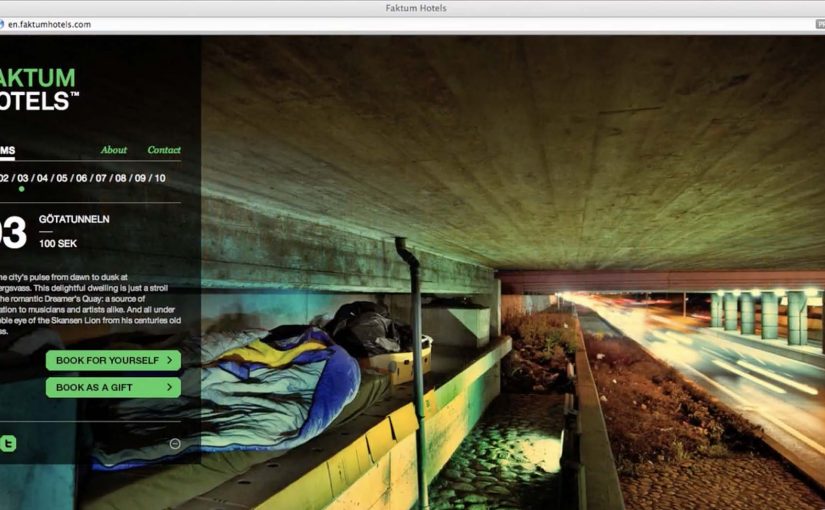
So in a charity campaign that tries to harness the spirit of giving and consideration, Forsman & Bodenfors chose ten places where people might spend the night and made it possible for any one of us to book them, just like any hotel. All the money raised through this www.faktumhotels.com project is then directed towards Faktum’s work for the homeless.

A hotel with no walls

The mechanism is brutally literal. Take locations that are normally ignored, photograph them like “rooms”, write the descriptions in the familiar language of travel booking, and put a price on the night. The booking flow becomes the donation flow, and the “inventory” is a list of public places that should not be inventory at all.

In European cities, social impact campaigns often struggle to turn sympathy into a concrete action that is simple, immediate, and shareable.

Why the idea hits so quickly

It works because it steals a format people trust. A hotel booking interface is a comfort ritual, full of predictable signals. Then it swaps the comfort for cold reality. That contrast creates instant moral clarity without a lecture, and it invites action without asking people to research charities or navigate guilt.

Extractable takeaway: When awareness is not the problem but inertia is, borrow a mainstream interface people already know, and map your desired behaviour onto it. Reduce the action to one familiar choice and one familiar transaction.

What the “booking” really means

Because these are public places, the booking is best understood as symbolic support, not a guaranteed reservation. In this case, symbolic support means paying to fund Faktum’s work, not claiming the place for personal use. The point is not to encourage tourism-by-hardship. The point is to make the hidden visible, and to route money to Faktum’s work through a frictionless, culturally legible mechanic.

The real question is how to turn a familiar commercial action into an ethical act of support without diluting the reality behind it.

This is not about selling the experience of homelessness. It is about converting recognition into support.

Proof, not a promise

The concept is also a craft statement. The photography and the deadpan hotel language do the persuasion work. The campaign received major industry recognition, including a Guldägg and a One Show Gold Pencil for its craft, which underlines how well the execution carries the idea.

What to steal from the booking mechanic

  • Hijack a trusted format. Use an interface or ritual your audience already understands, then subvert it with purpose.
  • Make the donation feel like a normal purchase. Familiar steps reduce hesitation and increase completion.
  • Let craft do the arguing. Straight photography and restrained copy can outperform emotive pleas when the concept is strong.
  • Design for sharing without adding share buttons. If the mechanic is surprising, people share it naturally.

A few fast answers before you act

What is Faktum Hotels?

It is a fundraising concept that presents outdoor sleeping locations as “hotel rooms” you can book online. The payment functions as a donation to support Faktum’s work related to homelessness.

Why use a hotel booking mechanic?

Because it is familiar and low-friction. The contrast between a comfortable interface and uncomfortable reality creates attention and makes the next step obvious.

Is the booking a real reservation?

No. The locations are public, so the booking is best treated as symbolic support rather than a guaranteed spot.

Who created the campaign?

It was created for Faktum with Forsman & Bodenfors credited as the agency behind the idea and execution.

What is the transferable lesson for other causes?

Turn support into a simple, recognisable transaction. Borrow a mainstream choice model, then route the payment directly into impact.