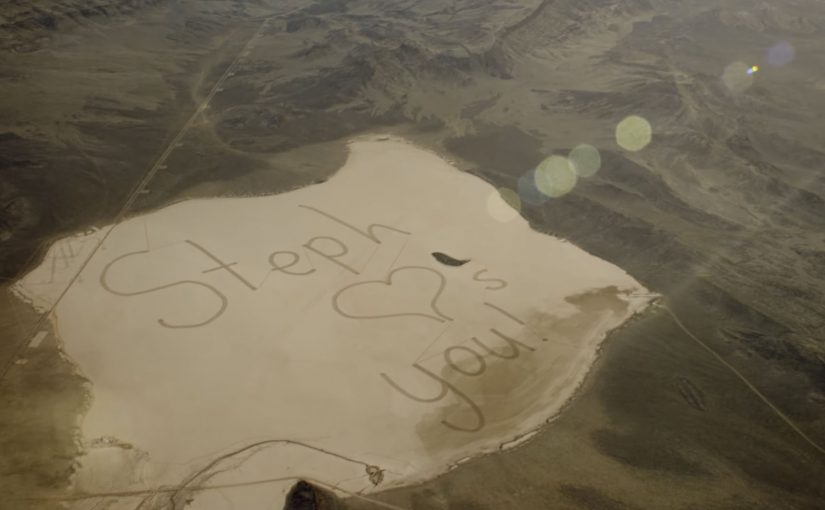
Eleven Hyundai Genesis sedans drive in formation across Nevada’s Delamar Dry Lake, not to show handling, but to write a sentence.
A 13-year-old girl from Houston, Stephanie, misses her astronaut father as he works aboard the International Space Station. Hyundai turns that human truth into a brand-scale gesture. The cars “draw” “Steph loves U” in tire tracks across the dry lake bed. The result is described as larger than one and a half Central Parks. It is also described as being certified by Guinness World Records as the world’s largest tire track image.
From choreography to a message you cannot ignore
The mechanism is straightforward and bold. Take a blank natural canvas. Assign each car a path. Choreograph the movement so the negative space becomes handwriting at a gigantic scale. Then validate the scale with a record body so the stunt becomes a fact people repeat, not just a film people watch.
In global automotive marketing, where products often feel interchangeable in feed-based media, a physical proof stunt creates memorability by turning precision into a story people can retell.
Why it lands
It works because the brand is not asking for attention. It is earning attention by doing something that only coordinated engineering and serious planning can pull off. The emotional hook is intimate, and the execution is absurdly large. That contrast creates instant share value, and it gives the Genesis name a halo of control and capability without needing to say it out loud.
Extractable takeaway: If you need breakthrough, build a single, verifiable act that scales a private human moment into a public artifact, and make the artifact the headline, not your messaging.
What the stunt is really selling
The real question is how to turn a private emotion into a public proof of brand capability without making the brand feel like the hero.
This is one of the rare brand stunts where scale sharpens the emotion instead of burying it.
On the surface, it is a daughter sending a message. Underneath, it is Hyundai demonstrating disciplined coordination. Eleven vehicles behaving like one pen. The brand promise becomes “we can execute the impossible precisely”, which is a stronger feeling than another round of luxury feature claims.
What to borrow from this precision stunt
- Start with a real relationship. One clear human story beats a composite “target audience”.
- Make the action the media. A physical artifact outlives the launch window and travels as proof.
- Engineer a repeatable headline. A record, a scale comparison, or a singular first can carry the story.
- Let meaning come from constraints. Fewer words. Bigger commitment. Higher credibility.
A few fast answers before you act
What is “A Message to Space”?
It is a Hyundai Genesis marketing stunt where 11 cars drive in formation to create a massive tire track message, “Steph loves U”, intended to be visible to a father on the International Space Station.
What is the core mechanism that makes it shareable?
A simple sentence rendered at extreme scale through choreographed driving, then amplified by third-party validation and a short film that captures the creation.
Why use a Guinness World Records angle?
Records reduce skepticism. They turn “big” into a named achievement people can cite, which helps the story travel beyond advertising audiences.
What is the biggest risk with this style of stunt?
If the human story feels manufactured, the spectacle becomes empty. The emotional truth has to lead, or the record becomes the only thing people remember.
What is one modern adaptation of the same pattern?
Create a single, verifiable public artifact that embodies your brand promise, then design the content around documenting the artifact, not explaining it.