A brand message written into a city’s geography
The strongest initiatives do not ask people to remember. They make history physically reappear in the places where it happened.
The Go Beyond Borders Project was an initiative of Heimat Berlin and CNN International, in conjunction with Berlin tape artist El Bocho, created around the 20th anniversary of the fall of the Berlin Wall.
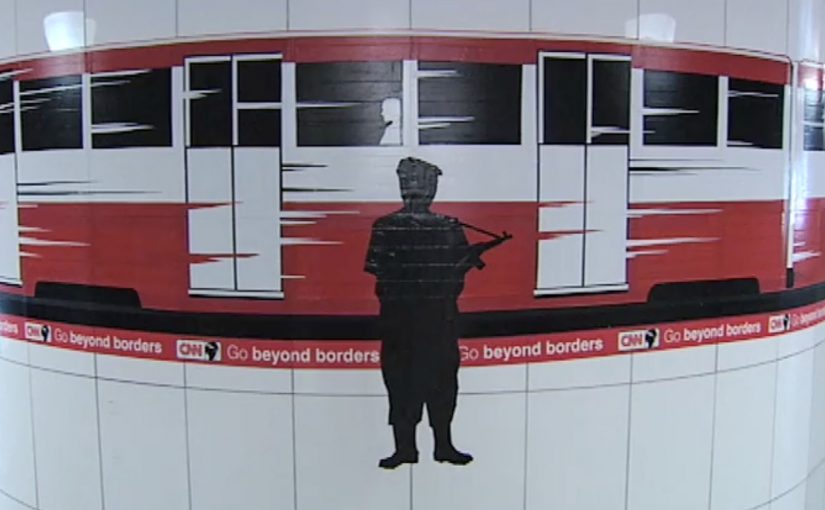
40 km of Go Beyond Borders tape was produced to mark the original position of the Berlin Wall, and eight street art installations told heroic stories of those who conquered the divide between East and West Berlin.
How the project worked as a city-scale marker
The mechanism combined two layers. A city-scale marker is a simple physical rule repeated along a route so the city itself becomes the medium.
First, the tape traced the former Wall line, turning an invisible historical boundary into a visible path you could follow. Second, the street art installations anchored that path with human stories, making the line about people, not only geography.
Because the tape turned an invisible boundary into a route you could walk, it made the former Wall line feel present in everyday movement.
It was simple enough to understand instantly, but large enough to feel unavoidable once you encountered it.
In European cities where collective memory is written into streets and transit, a walkable marker can carry meaning faster than a ceremony can.
The real question is whether your message can be experienced as a physical rule, not merely read as copy.
If the story is spatial, you should build the physical marker first and let media coverage follow.
Why it landed harder than a conventional commemoration
Most anniversaries stay inside ceremonies, speeches, and media coverage. This one put the memory back into the street. The tape created a direct, physical confrontation with “where the divide was.” The art installations made the meaning legible by focusing on courage and crossing, not abstraction.
Extractable takeaway: When meaning depends on place, turn the place into the medium with one walkable marker, then add human stories so the marker carries emotion, not just coordinates.
That shift matters because it turns history into presence, and presence into conversation.
The intent behind “Go Beyond Borders”
The action also marked the launch of CNN’s new international slogan: Go Beyond Borders.
The business intent was to associate the brand with perspective, movement, and crossing divides, using a real-world symbol that already carries emotional weight. Rather than declaring what the slogan means, the initiative demonstrated it through a place-based experience people could encounter and share.
What Go Beyond Borders teaches about place-based branding
A place-based brand initiative uses a physical location or route as the primary medium for the message, not only media.
- Make the invisible visible. If the story is spatial, mark it in the real world so people can physically encounter it.
- Pair scale with human narrative. A city-scale gesture earns attention. Stories earn meaning.
- Use a simple rule. One clear device. Here, tape tracing the line. Makes participation and comprehension effortless.
- Let the message be demonstrated. If your slogan is about crossing boundaries, show a boundary and what it took to cross it.
A few fast answers before you act
What was the Go Beyond Borders Project?
An initiative by Heimat Berlin and CNN International with artist El Bocho that used tape and street art to mark the former Berlin Wall line and tell stories of crossing East and West Berlin.
What was the core mechanism?
40 km of tape traced the Wall’s original position, while eight street art installations provided narrative anchors and human context.
Why did the tape approach work so well?
Because it turned an abstract memory into a physical, walkable marker that people could encounter in everyday life.
What business goal did this support?
Launching and giving meaning to CNN’s “Go Beyond Borders” slogan by demonstrating it through a culturally significant, real-world experience.
What is the main takeaway?
If you want a message to stick, embed it in a place people can experience, then reinforce it with stories that explain why it matters.