
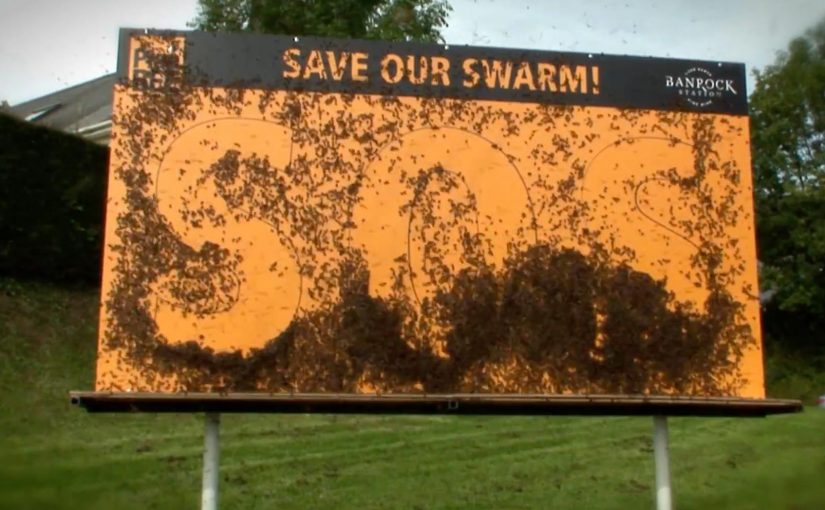
Banrock Station: 100K Live Bees Billboard

An SOS written by a living swarm

Honey-bee populations are mysteriously dwindling worldwide. In England, the Banrock Station winery created what it described as the world’s first ad with live bees to call attention to the problem.

Using queen-bee pheromones, the team attracted a giant swarm of bees, as many as 100,000, from a nearby honey farm to spell out an “SOS” message on a billboard.

Queen-bee pheromones are chemical signals that draw worker bees toward what they perceive as the queen’s location, making it possible to guide where a swarm clusters.

How it works: make the message unavoidable

The mechanism is blunt and brilliant. Use the medium itself as proof. A billboard about bees becomes a billboard made of bees, so the problem is not explained. It is witnessed.

In UK cause marketing, a conservation message that becomes a public spectacle can travel faster because it creates a stoppable moment people feel compelled to verify and share. A stoppable moment is one that makes people pause long enough to look twice or pull out a phone.

In European consumer brands and other enterprise marketers, cause messages break through fastest when the proof is visible in the same moment as the claim.

Why it lands: it turns concern into a physical reaction

This works because it compresses a complex topic into one immediate sensation. Surprise first, meaning second. You see the swarm, you read “SOS”, and only then do you connect it to the decline story.

Extractable takeaway: The most effective cause marketing often turns an abstract problem into a physical moment, then ties that moment to a simple action that funds or advances the cause.

The real question is whether your cause message can be proven in the same glance it is read.

Because the billboard is literally formed by the subject of the campaign, the message feels less like persuasion and more like evidence, which increases attention and recall.

The business intent: build salience and fund the cause

The film earns awareness, but it also links the stunt to action. Banrock Station also donates 5p to the honey-bee cause for every bottle sold, turning attention into a measurable contribution. Proof-first cause marketing is strongest when it is paired with a simple give-back mechanism, meaning a clear, fixed contribution that turns attention into funding.

Steals for cause marketing that feels real

  • Make the medium the proof. If you can embody the issue in the execution, you do not need long explanation.
  • Design for a “verify it” reaction. Meaning people want to confirm it is real before they repeat it.
  • Connect attention to a concrete contribution. Pair the story with a simple, trackable give-back mechanism.
  • Keep the message legible at a glance. “SOS” works because it is instantly readable even before context arrives.

A few fast answers before you act

What is Banrock Station’s “live bees billboard” in one sentence?

An out-of-home awareness piece that uses a real, visible “live bees” element to make the environmental message feel tangible rather than symbolic.

What is the core mechanism?

The medium becomes the proof. The execution embodies the issue in a way passers-by can immediately see, which makes the story inherently shareable.

Why does this kind of cause marketing earn attention?

Because it triggers a “verify it” reaction. People are more likely to share something they feel others need to see to believe.

What business intent does it serve beyond awareness?

It links brand meaning to a concrete, memorable moment, and can be paired with a trackable give-back or action mechanic to convert attention into contribution.

What is the most transferable takeaway?

If you can turn a cause into a physical, legible proof-point, you reduce explanation and increase both recall and retellability.
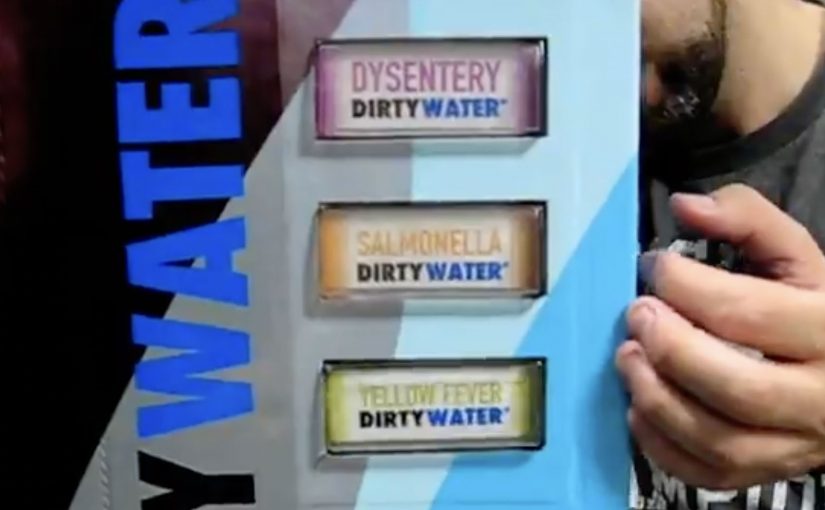
UNICEF Tap Project: Dirty Water Machine

What if someone bottled the water that millions in developing countries drink every day and offered it on the streets of New York?

For just a buck, during World Water Week (March 22-29), New Yorkers in the Union Square Park area are invited to “enjoy” the benefits of Dirty Water. It comes in a range of choices like Malaria, Cholera, or Typhoid Dirty Water, and is described as having 900 million consumers.

Dirty Water is not an actual product, but a real problem for millions of children around the world.

A vending machine that sells disgust

The mechanism is a classic reversal: a familiar vending machine is repurposed to dispense bottles labeled with water-borne diseases. The point is not to get anyone to drink it. The point is to make the problem visceral and immediate for people who normally never have to think about it. By keeping the interaction familiar, the reversal lands because it turns moral distance into a physical reaction in seconds.

In global cause marketing, turning an abstract statistic into a physical choice can move more people from awareness to action than another informational poster ever will.

The real question is whether you can turn a distant, abstract problem into a personal encounter that makes action feel unavoidable.

Why “nobody drinks it” is the message

New Yorkers are startled to see options like Yellow Fever or Hepatitis Dirty Water. They look at the machine in disgust. And that disgust is the creative payload, meaning the emotional reaction the campaign is designed to deliver, because it mirrors the reality that millions of families do not have the option to refuse unsafe water.

Extractable takeaway: When the barrier is “I cannot feel this problem,” engineer a harmless encounter that triggers the right emotion on contact, then attach one immediate action that turns that emotion into help.

The donation promise that makes the $1 meaningful

The idea of “selling” dirty water is framed as being inspired by UNICEF’s promise that every dollar donated provides safe drinking water to 40 children for a day. Even if the bottle is never purchased as a “product”, the transaction becomes a small, concrete unit of impact.

How the campaign stays active beyond the street

This Dirty Water initiative is positioned as ongoing, with continued donation options online at tapproject.org or via text message. Text TAP or AGUA to UNICEF (864233) to make a $5 donation.

Steal the Dirty Water pattern

  • Use reversal with familiar UX. Put the message inside an everyday interaction so the emotional hit lands before the rational debate starts.
  • Make the abstract a physical choice. Let people “choose” the problem in front of them, then offer one simple action to refuse it for someone else.
  • Price the action as a unit. Frame the donation as a small, concrete purchase so the person feels immediate impact, not vague virtue.

A few fast answers before you act

What is the “Dirty Water” vending machine in one line?

A public vending machine that dispenses “dirty water” bottles labeled with diseases to shock passers-by into donating for clean water.

Why price it at $1?

Because $1 is a friction-light ask that feels like a purchase, not a pledge, and it maps to a clear “unit” of impact in the campaign story.

What is the main creative trick that makes it work?

Reversal: it sells something no one wants, so the emotional response is disgust, and that response reframes clean water as a privilege rather than a given.

What should brands learn from this without copying the cause?

If the problem is invisible, make it physically encounterable, and tie the encounter to one simple action that feels immediately meaningful.

What is the lowest-risk way to adapt this pattern?

Keep the reversal honest and harmless, avoid sensational claims, and make the action as clear as the emotion: one step, one outcome, no hidden complexity.

Fundación Altius: Message in a Bottle

Fundación Altius (Altius Foundation) runs education support for children in Latin America, and Leo Burnett Iberia builds a fundraising action around a simple, loaded object. A bottle that carries a message.

The case film frames it as a direct marketing idea where the bottle itself becomes the medium. It turns “support education” from an abstract appeal into a tangible artifact people can notice, hold, and pass along.

How Message in a Bottle turns packaging into fundraising

The mechanism is presented as promotional packaging used as a donation trigger. Instead of relying on a poster or a banner to explain the need, the action uses a familiar container and a clear message to pull attention toward the cause, then convert that attention into money for education.

In European cause and charity communications, physical objects still outperform pure awareness copy when the goal is to move someone from empathy to action.

Why it lands

A bottle is instantly readable. It signals “take me”, “open me”, “share me”. That makes it a natural carrier for a cause message because it invites interaction without asking for it. When the fundraising mechanism is embedded in a physical cue, people do not feel like they are entering a campaign. They feel like they are responding to something human.

Extractable takeaway: If you need donations, compress the story into a single object with one clear behavior attached to it. The object becomes both the message and the moment of conversion.

What this kind of action is optimized for

This is designed to work in the messy middle of everyday life, where people do not stop for “awareness”. Here, the messy middle means the in-between moments where people are busy, distracted, and not actively looking for a cause to support. A direct marketing action that lives on an object can travel further than its media buy, because the object itself carries the pitch into new contexts.

The real question is whether your cause can be reduced to one object and one behavior without losing meaning. For donation-driven work, object-led asks are stronger than awareness-led messaging when the job is immediate response.

What to steal for your own nonprofit or CSR work

  • Attach the ask to something people already touch. Physical interaction reduces friction compared with “go to a site and read”.
  • Keep the message single-minded. One object. One message. One intended next step.
  • Make the object do the explaining. If you need a paragraph to understand the mechanic, it will not scale.
  • Build for redistribution. The best fundraising artifacts are easy to pass on, not just easy to notice.

A few fast answers before you act

What is Message in a Bottle in one sentence?

A fundraising action for Fundación Altius where a bottle and its message act as the direct marketing device that nudges people to donate toward children’s education.

Why use packaging or a physical artifact for a charity ask?

Because objects create a natural pause. They are handled, noticed, and shared, which can move people from passive sympathy to a concrete action faster than awareness media.

What makes this different from a standard donation campaign?

The medium is also the mechanism. The object carries the story and cues the behavior, so the “how to help” is not separate from the “why to help”.

What is the main risk in copying this approach?

If the object is clever but the donation pathway is unclear, attention gets spent without conversion. The artifact must lead cleanly to giving.

When does this approach work best?

It works best when the cause can be expressed through one obvious object and one obvious next step. If people need too much explanation before they understand what to do, the artifact loses its power.