
Super Bowl Sunday is the biggest TV advertising day in the US. With 50+ advertisers competing for attention, “standing out” is usually code for shouting louder.
Chevrolet takes a different route. With “Chevy Game Time”, it turns the ad break into a live second-screen game. Viewers watch the commercial on TV, then immediately replay it with purpose on their phones.
A second screen that reacts to the broadcast
A “second-screen” experience is a mobile layer that runs alongside a live broadcast and responds to what’s on TV in near real time. Chevy Game Time prompts viewers the moment a Chevy spot airs, asking trivia about what they just saw and rewarding fast, correct answers with points and prizes.
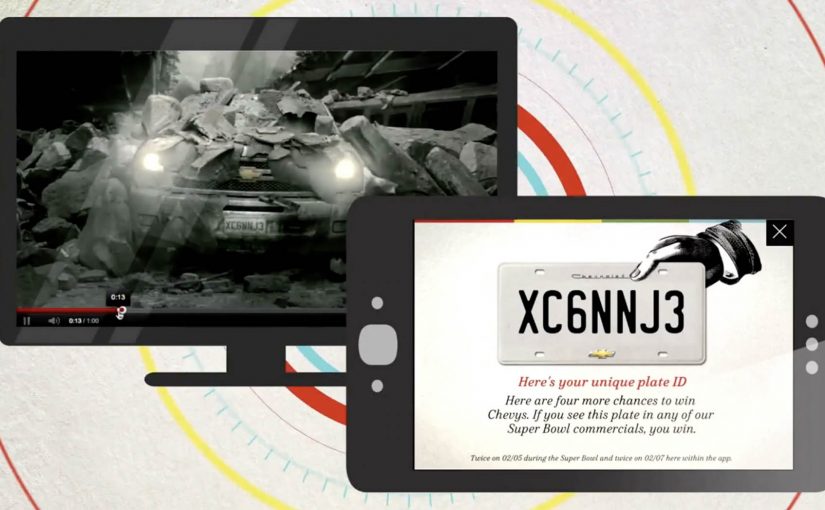
It also adds a high-stakes twist. Every user receives a personal license plate. If you spot your plate inside a Chevy commercial, the car is yours.
The mechanic: turning commercials into a repeatable loop
The loop is simple and effective:
- Trigger: a Chevy ad hits the broadcast.
- Action: the app pushes a trivia question about that specific ad.
- Social effect: Super Bowl parties start “rewatching” the spot together, first on TV, then on the phone, and often again online.
- Jackpot moment: the personal license plate appears. Somebody wins a car.
That structure doesn’t fight the reality of distracted viewing. It harnesses it.
That works because the trigger arrives while memory is still hot and the reward gives the rewatch a reason.
In mass-audience tentpole broadcasts, second-screen interactivity is often the fastest way to turn passive ad viewing into measurable participation.
Why it lands: it makes attention feel like play
Most second-screen ideas fail because they ask for extra effort with unclear payoff. Chevy Game Time flips that. The reward is obvious, the timing is immediate, and the questions make the room collectively care about the ad’s details.
Extractable takeaway: If you want people to pay attention to a message they did not ask for, make the attention itself the game. Use a tight loop (trigger, action, reward) that starts exactly when the message appears, not five minutes later.
The license-plate mechanic is the accelerant. It converts “maybe I’ll play” into “I’d better look up”, because missing your own plate feels like leaving money on the table.
The business intent: convert reach into proof
Instead of treating TV as pure reach, this approach turns a broadcast into an engagement funnel. Case studies around Chevy Game Time describe scale in the hundreds of thousands of participants, plus high real-time concurrency during the game, and meaningful App Store chart performance during the event window.
It also earns industry credibility. The work is credited to Chevrolet with Goodby, Silverstein & Partners and Detroit Labs, and it is associated with major recognition in mobile and multiscreen categories.
The real question is whether a brand can turn one expensive burst of reach into repeated, measurable acts of attention.
And the strategic win is clean. While other brands fight for a single impression, Chevy creates repeated, measurable touchpoints tied directly to its own creative.
What to steal for your next “everyone’s watching” moment
- Design for rewatching: build a mechanic that naturally makes people replay the ad or replay the key message.
- Sync to the broadcast: the question must arrive when the spot runs, not when the user remembers later.
- Make the reward legible: users should understand the payoff in one sentence.
- Give the group a reason to coordinate: party dynamics multiply attention when the action is communal.
- Measure beyond downloads: track concurrent players, response rate per trigger, and “ad recall proxies” like question accuracy.
A few fast answers before you act
What is second-screen marketing?
Second-screen marketing is a companion mobile experience designed to run alongside a live broadcast, prompting actions that connect what’s on TV to what’s on a phone, usually in real time.
What made Chevy Game Time different from a normal companion app?
It tied interaction to the exact moment a specific commercial aired, then rewarded attention to that commercial through trivia and a personal “license plate” prize mechanic.
Why does the personal license plate idea matter?
Because it creates urgency and personal stakes. Viewers feel they could miss “their” moment, so they watch more closely and often rewatch immediately to confirm what they saw.
What should you measure in a live second-screen activation?
Track concurrent active users during triggers, response rate per trigger, time-to-answer, repeat participation across multiple ad breaks, and the uplift in brand recall or message comprehension tied to the trivia content.
Can this approach work outside the Super Bowl?
Yes, if you have a predictable live moment (finale, product launch stream, sports match) and you can synchronize prompts to it. The key is timing precision and a reward loop that feels worth the effort.