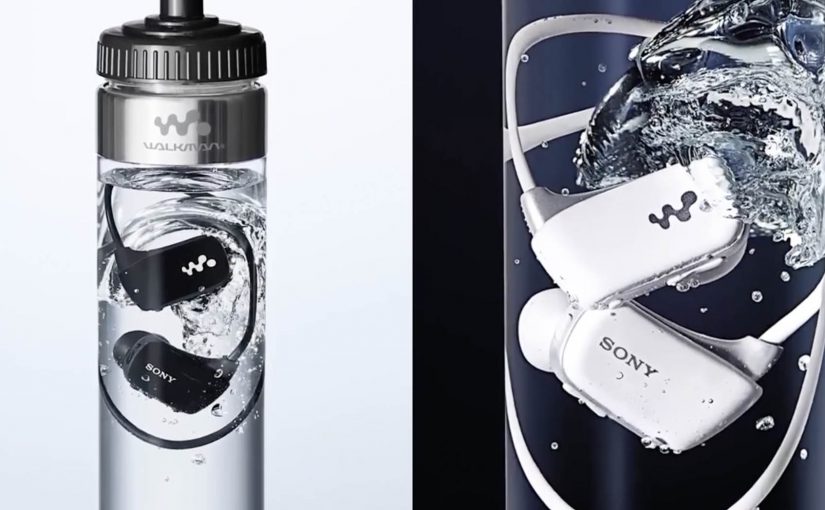
To promote Sony’s NWZ-W270 MP3 waterproof Walkman, DraftFCB Auckland packaged it inside bottles full of water. The bottles were then placed in special vending machines at pools and gyms across New Zealand.
The idea turns packaging into proof. The product sits submerged in plain sight, so the waterproof benefit is demonstrated before you even consider buying it.
Packaging that performs the demo
The mechanism is as literal as it is effective. Take a promise that people doubt. “Waterproof”. Then make the product live inside the condition that normally destroys electronics. The bottle becomes both display unit and credibility device. Here, a credibility device means packaging that makes the claim feel true before any copy has to explain it. That works because the same object that holds the product also removes the shopper’s main doubt at the point of purchase, and the vending machine puts it exactly where the need is strongest.
In consumer electronics marketing, the fastest way to overcome skepticism is to replace explanation with visible proof at the point of decision.
Why it lands
It works because it collapses three steps into one moment. Awareness, belief, and purchase happen in the same place, with the same object. Instead of asking people to trust a spec, the packaging forces a simple conclusion. If it can sit in water all day, it can survive your swim or workout.
Extractable takeaway: When your key benefit is hard to believe, design a retail experience where the product is shown living inside the benefit. Let the environment do the persuading, then make purchase frictionless.
What Sony is really optimizing
The real question is how to make a doubtful product claim feel true before a shopper has to trust the copy.
The vending placement is not just a media choice. It is distribution strategy. Pools and gyms are the exact contexts where “waterproof audio” feels immediately relevant, and where a vending machine purchase is already normalized as an impulse decision.
What to steal from the retail proof
- Make the proof the packaging. If the box can demonstrate the claim, you do not need to over-argue it.
- Sell where the benefit matters most. Context does half the persuasion if the product solves a live problem.
- Reduce steps to purchase. Vending machines convert curiosity into action while attention is still high.
- Keep the message one-beat simple. One look should be enough to understand the point.
A few fast answers before you act
What is “The Bottled Walkman”?
It is a Sony retail and packaging activation where the NWZ-W270 waterproof Walkman is sold sealed inside a bottle filled with water to demonstrate the product’s core benefit instantly.
Why use vending machines at pools and gyms?
Because that is where the waterproof use case is most obvious, and where a quick, impulse-style purchase fits the setting.
What problem does this solve versus a standard box on a shelf?
It removes doubt. The customer sees the product surviving in water before they ever read a claim.
Is this more “packaging innovation” or “experiential marketing”?
It is both. The packaging is the experience, and the experience is built to drive retail conversion.
How can another brand apply the same principle?
Identify the most doubted benefit, then engineer a display or pack that lets the product visibly live inside that benefit in the buying moment.