
3D projection mapping on a Toyota Auris

Instead of projecting onto a building, Glue Isobar projects a CG car directly onto a real Toyota Auris Hybrid. Here, projection mapping means aligning animated visuals to the contours of a physical object so the imagery appears built into the car itself. With seven projectors working together, the result is a true 3D, 360-degree projection mapping experience on all sides of the car. You can walk around it and experience the visuals from any angle.

What makes this projection mapping different

The twist is the surface. A real car brings complex curves, edges, and reflections. Mapping to that shape, and keeping the illusion consistent as people move around it, is the challenge that makes this feel genuinely new.

How the experience is delivered

The work uses a mix of keyframe, 2D, 3D, algorithmic, and dynamic animation to deliver the experience. The projection setup supports a 360-degree view, which is why the story holds up from multiple angles instead of depending on a single “best seat”.

In live auto launches and showroom-style reveals, this matters because the product demo and the spectacle happen in the same physical moment.

Why this lands as a launch moment

This format turns a product reveal into a live event. It gives people a reason to stop, watch, walk around, and talk. The real question is not whether the projection looks advanced, but whether the launch makes the car feel worth approaching, discussing, and remembering. The business job of a launch moment is not passive viewing but active attention that carries into conversation and recall. This is stronger than a static display because it turns the car itself into the source of attention.

Extractable takeaway: When the product becomes the performance surface, the launch works harder because the spectacle and the proof of product presence happen in the same place.

What to steal for live product reveals

  • Make the product the canvas. When the object carries the story, the experience feels specific and harder to copy.
  • Design for movement in the crowd. A 360-degree setup keeps the illusion intact even when people walk around and viewpoints change.
  • Use complexity where it creates visible payoff. Multiple projectors are justified when they unlock surfaces and angles a single beam cannot cover.
  • Treat it as a performance, not a display. The reveal works best when the product appears to “do something”, not just sit there.

A few fast answers before you act

What is 3D projection mapping in this example?

It is the technique of projecting animated visuals onto a physical object, aligned to its shape so the imagery appears to belong to the object rather than a flat screen.

Why use seven projectors?

To cover the full vehicle and maintain the illusion across multiple surfaces, including areas you can only see when walking around the car.

Why project onto the car instead of a separate screen?

Because the effect feels more product-specific. The visuals appear attached to the vehicle, which makes the reveal more memorable than showing the same animation beside it.

What makes “360-degree” important for live audiences?

People do not stand in one spot. If the experience works from many angles, it feels real in a public space and stays compelling as crowds move.

What is the main lesson for product launches?

Make the product the stage. When the object itself becomes the canvas, the experience feels specific, memorable, and inherently shareable.
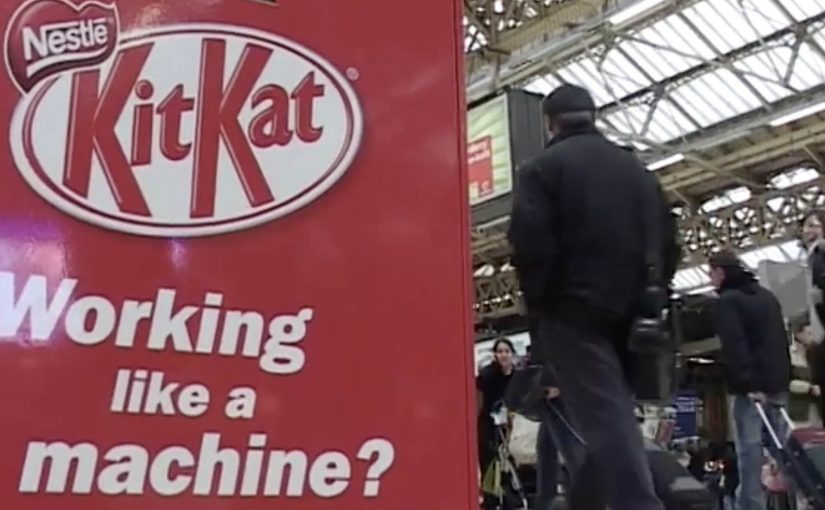
KitKat: Human Vending Machine

We all know how it feels to need a break from the routine of working like a machine. That is why KitKat brought a quirky trend from Japan over to the UK by installing a human vending machine in London’s busy Victoria Station.

Commuters were given a chance to buy a KitKat for 20p, but from a machine with a real difference. A real person operated it from inside, turning a quick purchase into a small moment of surprise and a quick chat. The money was described as going to charity.

A vending machine that replaces automation with a person

The mechanic is straightforward. It looks like a standard vending machine on the concourse. You put money in. You make a selection. Then a real “vendor” inside the unit hands you the bar, human-to-human, at vending-machine speed.

In high-traffic commuter environments, ambient activations (quick, in-the-flow brand interactions placed in public space) work best when the interaction is instant, the reward is obvious, and bystanders can understand the joke in one glance.

Why it lands

This works because it turns the very thing people are tired of, being treated like a machine, into the punchline. The vending format signals efficiency and routine. The human reveal breaks that expectation and delivers the “Have a break” idea as an experience, not a line of copy.

Extractable takeaway: If your brand promise is about relief, do not only describe relief. Stage a short, public interruption of routine where the consumer feels the promise in real time.

What the activation is really doing for the brand

The real question is whether you can make the “Have a break” promise felt without turning the commute into a bottleneck.

This is a strong format when the idea is obvious from a distance and the handoff stays genuinely fast.

At face value, it is a cheap bar and a good deed. Underneath, it is a behavioural prompt in a place where people are stressed, rushed, and receptive to a small uplift. The “human machine” also creates instant social proof. Every interaction becomes a tiny piece of live theatre that recruits the next person in line.

How to borrow the human-vending-machine pattern

  • Make the concept self-explanatory. The best stunts do not need instructions. The crowd teaches the crowd.
  • Build one clean reveal. A single unexpected moment beats multiple clever steps.
  • Design for the queue. Waiting becomes part of the experience and amplifies visibility.
  • Anchor the stunt to the brand line. The “break” is the product, and the bar is the proof.
  • Give people a reason to feel good. A charity tie-in can reduce cynicism and increase participation.

A few fast answers before you act

What is the “human vending machine” idea in one line?

A vending machine that dispenses KitKat bars, but the dispensing is done by a person inside the unit, turning a routine purchase into a surprise interaction.

Why does this work specifically in a commuter station?

Stations concentrate stress, repetition, and time pressure. A fast, playful interruption is more valuable there than a slow, explanatory brand experience.

What makes it feel like a KitKat idea rather than a random stunt?

The experience embodies the brand’s break positioning. It converts “take a break” from a slogan into a short, tangible moment.

What is the main execution risk?

Throughput. If the interaction slows down and the queue becomes frustrating, the stunt flips from “break” to “delay” and the mood collapses.

What should you measure beyond footfall?

Queue conversion rate (people who stop and join vs those who pass by), average interaction time, sentiment in on-site reactions, and whether the activation shifts purchase behaviour during the commute window.