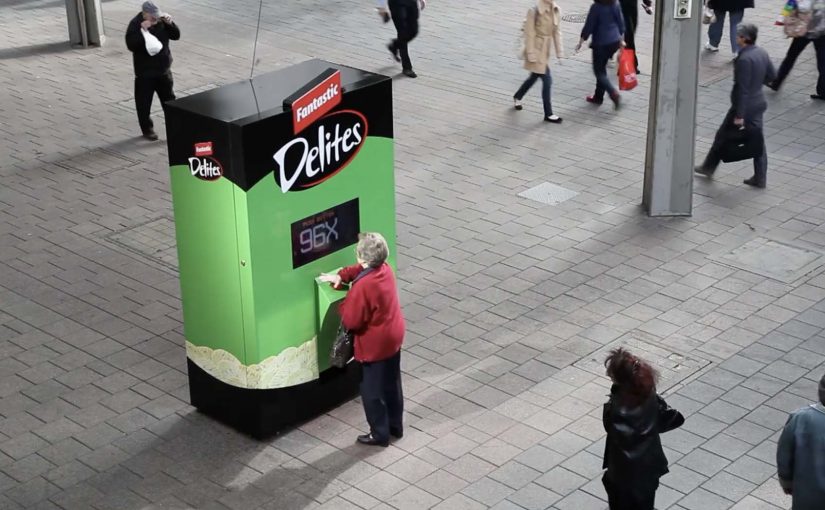
People zip into mouse suits, step into a giant wheel, and start running. Keep the pace. Do not tumble. Hold the speed long enough and the reward drops. A free pack of Fantastic Delites, earned the hard way.
This “human lab mice” stunt from Fantastic Delites and agency Clemenger BBDO follows the earlier interactive vending machine installation, where the Delite-o-matic pushed people through button mashing and silly tasks for the same prize. Here, “human lab mice” means real people dressed as mice, running the wheel like a lab experiment. The idea stays consistent. If the snack is worth it, you will work for it.
The mechanism is brutally clear. The audience understands the rules in one glance, then sticks around for the inevitable slips, recoveries, and wipeouts. That is what makes it shareable. The product is the trophy, but the entertainment is the price of entry.
In Australian FMCG sampling, the fastest way to earn attention is to turn trial into a story people want to watch, not a handout people walk past.
Why the “lab mice” framing works
It flips the usual sampling dynamic. Instead of the brand chasing you with freebies, you chase the freebie. The mouse wheel is a physical metaphor for craving and persistence, and the costumes make the whole thing socially safe to laugh at.
Extractable takeaway: When you can make the “try” itself entertaining and socially safe, the crowd becomes your distribution, and the product becomes a trophy instead of a handout.
What the brand is really buying
This is not a rational product argument. It is a proof-by-behaviour message, meaning the audience infers quality from what people do, not what the brand claims. When real people are willing to look ridiculous for a snack, the snack gets a shortcut to “it must taste good.” The activation also turns one giveaway into many impressions, because spectators become the media. This kind of sampling is worth doing only when the challenge is the content and the reward stays modest. The real question is whether your sampling earns spectators before it earns trial.
Sampling takeaways for challenge-for-reward
- Make the rules readable from 10 meters away. If people cannot explain it instantly, they will not stop.
- Build a loop that produces moments. Near-fails, fails, retries, wins. That is natural entertainment.
- Keep the reward proportional. Small prize, big fun. The contrast is the joke.
- Design for a crowd. If spectators are part of the experience, distribution comes for free.
A few fast answers before you act
What happens in the Fantastic Delites “lab mice” stunt?
Participants wear mouse costumes and run inside a giant wheel. They have to maintain speed long enough to earn a free pack of Fantastic Delites from the Delite-o-matic.
Why does this count as effective sampling?
Because it turns product trial into a public spectacle. The giveaway is small, but the attention is large, and the story is easy to retell.
How is this connected to the Delite-o-matic?
It uses the same behavioural premise. People will do surprisingly effortful things for a free snack, and that behaviour becomes the message.
What is the key design principle behind this kind of activation?
Clarity plus consequence. Clear rules create instant understanding. Visible failure creates tension and humour. Together they keep people watching.
What is the biggest risk with “challenge for reward” stunts?
Making the challenge feel unfair or too slow. If success looks impossible, the crowd loses interest. If success looks too easy, there is no drama.