
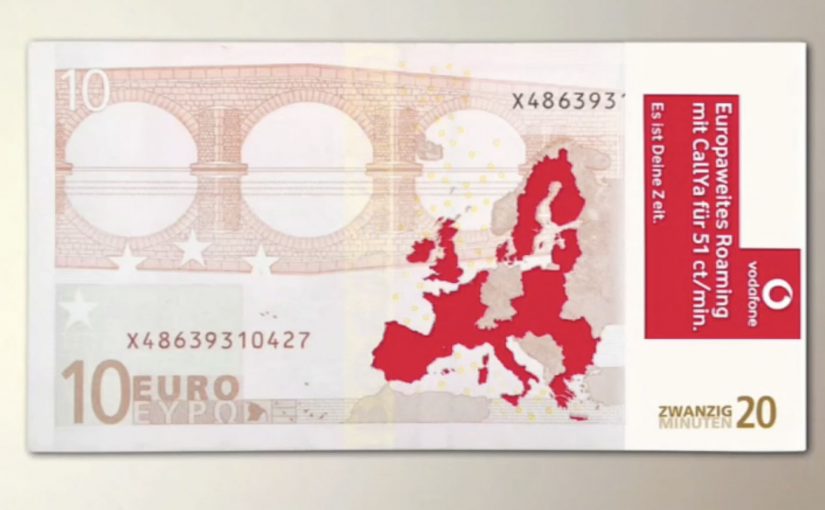
Vodafone: Banknote Sticker for Roaming

To promote Vodafone’s cheap roaming tariff for Europe, Scholz & Friends chose a medium that does not compete for attention. They modified banknotes with stickers, so the message reaches people in a very specific place, their wallet.

The idea is as low-tech as it is disruptive. Instead of asking travellers to notice another poster, banner, or leaflet, the campaign piggybacks on something they already handle repeatedly while travelling.

Roaming costs are a practical irritation. The sticker works because it shows up when travellers are already handling money.

Why a sticker on cash beats a billboard

Most media fights for a glance. A banknote already has “permission” to be looked at, checked, counted, and passed along. Adding a sticker turns that routine behavior into repeated exposure, without needing a second of extra attention budget.

Extractable takeaway: If the offer is about saving money or reducing travel friction, place it inside a ritual people already repeat, not in a channel that asks for attention first.

It is also inherently portable. Cash moves through hands, venues, and neighborhoods, which gives the idea a built-in distribution logic that feels organic rather than broadcast.

For price-led travel offers, wallet insertion beats billboard spend because it shows up at decision time.

What the mechanic is really doing

  • Context targeting: travellers touch cash, exchange cash, and pay in unfamiliar places.
  • Frequency: one note can generate dozens of impressions across multiple days.
  • Zero clutter: the message lives where ads rarely live, inside the payment ritual.

That is the core “clutter breaking” move. It replaces interruption with insertion.

For European travellers moving across borders, wallet-level touchpoints cut through because they appear at the exact moment people are thinking about money and connectivity.

The real question is whether you can attach your promise to a repeated behavior, instead of paying to interrupt one.

Business intent under the simplicity

The immediate goal is recall for “cheap EU roaming” at the moment a traveller is likely to make a connectivity decision. The deeper goal is brand association with practical travel confidence, meaning Vodafone as the network that makes cross-border usage feel less stressful.

Wallet-level touchpoints to borrow

  • Choose a touchpoint people already trust, then add a light layer of message.
  • Exploit repeated rituals, paying, checking, stamping, validating, not one-off exposure.
  • Keep the promise instantly legible, one benefit, one reading, no decoding.
  • Design for pass-along, so distribution is a property of the medium, not a separate plan.

A few fast answers before you act

What makes this “ambient” instead of traditional advertising?

The message is placed inside an everyday object people already use, rather than in a dedicated ad space that competes for attention.

Why is the wallet a powerful media channel for travel offers?

Because it is handled frequently during travel, and it naturally frames the offer around cost and practicality.

What is the main risk with banknote-based ideas?

Control and coverage. You cannot fully control who receives the notes, and scale depends on distribution logistics and how widely the notes circulate.

How do you measure impact when the medium is not digital?

Use proxies like search lift for the tariff term, store inquiries, roaming plan activations, and time-boxed correlation against the distribution window.

What is the transferable lesson beyond telecom roaming?

If your promise is about saving money or reducing travel friction, placing it inside a payment or travel ritual can outperform louder media because it arrives in-context.
BrandAlley: Oxford Circus FlashWalk

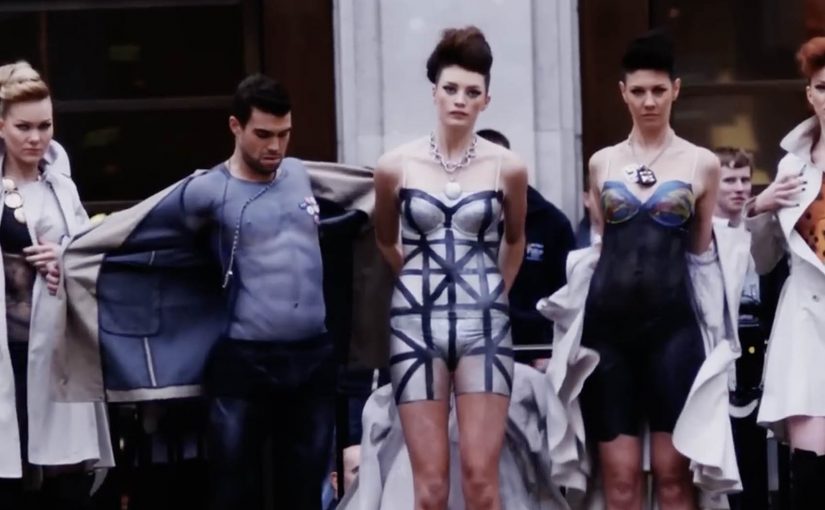
Shoppers hit Oxford Circus and suddenly the crossing becomes a runway. A quick catwalk appears, cameras come out, and the crowd freezes because this is not what people expect in the middle of a busy high street.

BrandAlley’s FlashWalk, a pop-up runway walk staged in public, uses a simple escalation. Models walk a catwalk route in public, styled with body paint rather than clothing, and the spectacle does the rest. It is designed to stop people mid-stride and turn street attention into store intent.

Why this breaks through retail clutter

In high-footfall retail streets, the strongest activations turn a familiar place into a short, unmistakable moment that people feel compelled to witness. Most retail messages compete on price and repetition. This competes on surprise. The catwalk format is instantly readable, so the idea does not need explanation. The audience understands what is happening in seconds, then stays for the contrast between a polished runway and an everyday street.

Extractable takeaway: If you can turn a familiar public space into an instantly recognisable format, you can earn attention before you spend on persuasion.

What BrandAlley is really buying

The real question is whether the moment gives people a story they want to repeat immediately. This is a footfall play built on earned attention. The real “media” is the crowd that gathers, the photos that get taken, and the story people tell immediately afterwards. The brand gets remembered because the moment was unusual, not because the copy was persuasive. If you can stage it safely and legally, a live street moment beats another static poster for first-time attention.

How to turn a street moment into footfall

  • Pick a location that already concentrates your audience. If the street is busy, your stunt scales faster.
  • Use a format people recognise instantly. A catwalk reads at a glance, which reduces friction.
  • Design for documentation. If the crowd films it, distribution becomes automatic.
  • Link the spectacle to a clear next step. The moment should point to the store or the sale without needing a second campaign to explain it.

A few fast answers before you act

What is the BrandAlley Oxford Circus FlashWalk?

It is a street-level catwalk stunt at Oxford Circus designed to stop passers-by and drive attention and footfall to BrandAlley, using a runway-style “flash walk” moment.

Why use a catwalk format for retail marketing?

Because it is instantly legible. People understand “runway” without instructions, so the stunt grabs attention fast and creates a crowd effect.

What makes this different from a typical outdoor ad?

Outdoor ads ask you to notice. This asks you to watch. The experience turns the street into the medium, which tends to generate photos, sharing, and conversation.

What is the biggest risk with shock or surprise stunts?

If the spectacle does not connect back to the store or the offer, you get attention without action. The link to the retail goal must be obvious on the day.

When does a footfall stunt outperform a discount campaign?

When you need cut-through, not only conversion. A stunt can reintroduce the brand to people who have tuned out price noise, then the offer does its job afterwards.

McDonald’s: Steaming Bus Shelter

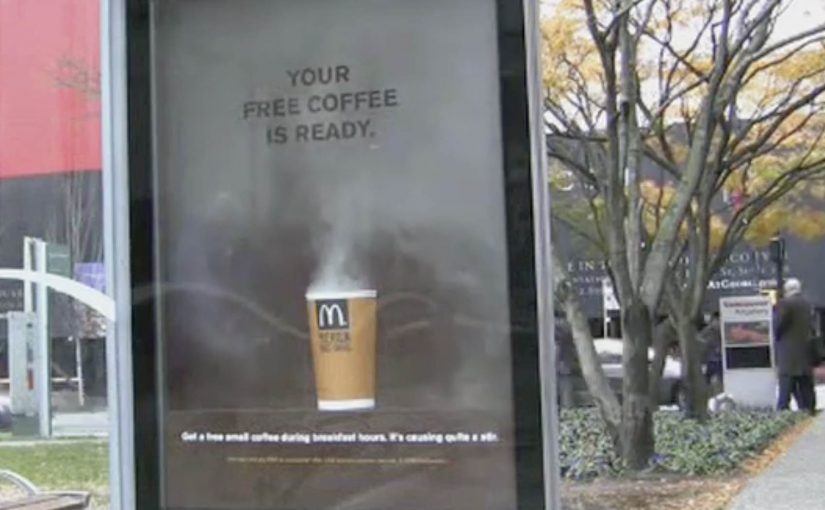
Over the last couple of months we have seen some innovative bus shelter ideas from Cadbury and Coca-Cola. Now McDonald’s joins in with a cup of coffee that looks like it is still breathing.

Steam that writes the message for you

Instead of printing “hot coffee” on the poster, the execution uses real-looking steam rising from the cup. As the steam drifts across the panel, a simple line appears and disappears, turning a static bus shelter into a time-based reveal.

Interactivity here is low-tech but real. The ad changes over time in front of you, without screens, taps, or instructions. That works because a behavior you can see in real time makes the product benefit feel proved rather than merely claimed.

In out-of-home advertising, the strongest work turns waiting time into a short, sensory experience that people understand in a glance.

Why this lands in the street

Steam is a credibility cue. It signals warmth, freshness, and immediacy. At a bus stop, that matters because you are standing still, watching your breath in the cold, and you have time for one small surprise that feels physical rather than “ad-like”. The reveal also creates a micro-rhythm. By micro-rhythm, the ad creates a simple pattern of pause, reveal, and reset that a passer-by can read in seconds. Nothing happens. Then it happens. That pacing earns a second look.

Extractable takeaway: If you can make the medium behave like the product, you reduce explanation to near zero. The environment becomes your proof point, and the call-to-action feels like the obvious next step.

What McDonald’s is really buying with this shelter

This is a promotion mechanic disguised as a moment of theatre. The shelter does three jobs at once: it dramatizes the heat of the coffee, it frames the offer as “ready now”, and it catches commuters at the exact time window when a breakfast purchase is plausible.

The real question is whether the shelter makes hot coffee feel immediately available in the exact moment a commuter might buy it.

It also borrows the social logic of street magic. When something unexpected happens in public, people point it out. That turns one paid placement into multiple conversations, and it does it without adding complexity for the passer-by.

What to steal for your next transit activation

  • Use a single sensory cue. One clear signal beats layered cleverness in a noisy street.
  • Build a reveal that loops. A repeating moment gives late arrivals a chance to see it.
  • Make the message readable mid-glance. Design for people who look up for two seconds, not twenty.
  • Time the call-to-action to the context. Commuters make different choices at 8am than at 8pm.
  • Let the placement do the targeting. Transit media already filters for routines. Do not overcomplicate the copy.

A few fast answers before you act

What makes this bus shelter execution “interactive”?

The panel changes in real time in front of the viewer. The steam effect creates a repeating reveal, so the message appears and disappears rather than sitting permanently on the poster.

Does this need digital screens to feel modern?

No. The “modern” part is the behavior. A physical effect that updates over time can feel as fresh as a screen when it is tightly connected to the product benefit.

What is the main marketing objective here?

To drive immediate trial during a breakfast window by making “hot coffee” feel tangible, and by framing the offer as available right now.

What is the biggest risk with executions like this?

If the effect is subtle, unreliable, or hard to see from a normal standing distance, the entire idea collapses. The reveal must be legible without effort.

When is a bus shelter the right medium for this kind of idea?

When your message benefits from a short looped demonstration, and when your audience is naturally paused. Transit environments provide both attention and repetition.