
Secret Diary of a Call Girl: Radio Stunt

A window performance built for radio

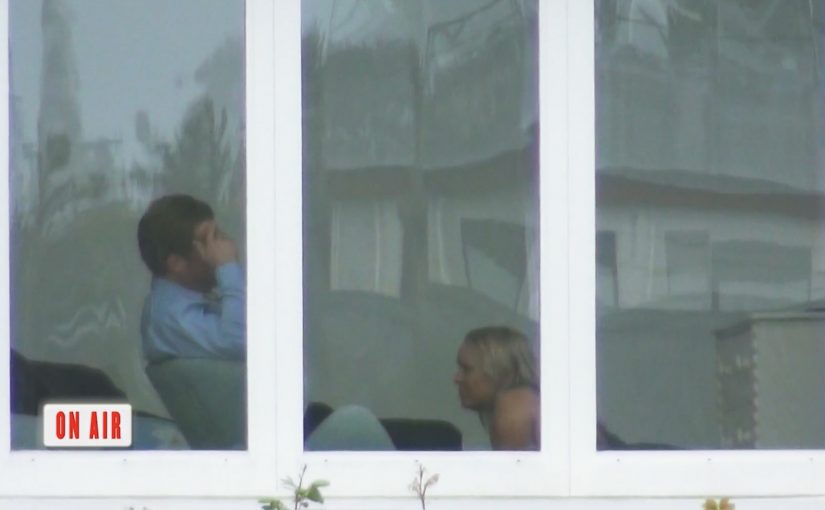
To launch the British TV drama Secret Diary of a Call Girl in New Zealand, DraftFCB staged a simple provocation. An “actress” displayed call girl-like behavior in a house window directly opposite a top radio station for three successive nights.

As expected, the scene caught the attention of the local DJ, who began broadcasting his observations on air. Other DJs around the country reportedly picked up the story, keeping it in circulation for roughly 72 hours. On the final night, with public interest at its peak, the actress closed the blinds to reveal the show message and the reason for the spectacle.

The mechanic: hijacking live commentary as distribution

The campaign is engineered to be “irresistible to narrate.” Put a curiosity trigger within line-of-sight of people whose job is filling airtime with observations, then let their real-time commentary do the heavy lifting. The multi-night schedule matters because it turns a one-off sighting into an unfolding story that listeners can return to, and that other shows can reference without needing new material.

In entertainment launches, live conversation often outperforms polished promos because the audience feels like they are overhearing something that is happening, not being sold something.

In broadcast-led markets, earned attention compounds fastest when the story is physically proximate to a microphone and structured to renew itself across multiple days.

Why it lands

It uses a classic public curiosity loop. People see something ambiguous, hear someone validate it on air, then share it socially to compare interpretations. Because the DJs are reacting in the moment, the “is this real?” tension stays alive long enough to travel, and the final-night reveal provides closure that feels like a payoff rather than a disclosure.

Extractable takeaway: If you want sustained buzz, design a repeatable public trigger that creates daily new angles for commentators, then hold the brand reveal until attention has clearly peaked.

What the launch is really optimizing for

The goal is not just reach. It is talk time, repetition, and social spillover. A premiere wins when it becomes the thing people reference without being prompted, and when the message arrives as the resolution of a story people have already been following.

The real question is whether the setup can turn observation into repeated on-air narration before the reveal arrives.

What to steal from this radio-first stunt

  • Choose a “natural broadcaster.” Put the trigger near people whose incentive is to describe what they see.
  • Make it episodic. Multi-night structure creates freshness and gives people a reason to check back.
  • Design ambiguity, then control the release. Let curiosity build, but ensure the reveal is clean and unmistakable.
  • Plan the social overflow. Seed a format that is easy to retell in one line, so listeners can amplify it without context.

A few fast answers before you act

What did DraftFCB do to promote Secret Diary of a Call Girl in New Zealand?

They staged an actress behaving like a call girl in a bedroom window opposite a radio station for three nights, prompting DJs to discuss it on air until a final-night reveal connected it to the TV premiere.

Why does placing the stunt opposite a radio studio matter?

Because DJs are paid to narrate interesting observations. Physical proximity to the studio turns the environment into live content.

What is the core distribution mechanic?

Earned media through live commentary. The stunt creates something discussable, and the on-air conversation becomes the ad.

Why run it across multiple nights?

Repeat nights transform a sighting into a story arc, increase the chance of pickup across stations, and create a natural moment for a final reveal.

What is the biggest risk with this kind of tactic?

If the reveal is unclear or the tone feels exploitative, the conversation can flip. The payoff must land cleanly and fast.

TNT: A Dramatic Surprise on an Ice-Cold Day

In the quiet town of Dordrecht, a familiar red button sits waiting. When innocent passers-by dare to push it, pure TNT drama unfolds, with a slightly new twist: close participation from the public.

In April last year TNT launched their digital channel in Belgium with a big red push button in a quiet Flemish square.

Now, to launch their movie channel in the Netherlands, they created a new dramatic piece of the now-famous red button, this time pulling bystanders closer into the action.

The mechanic that makes the button irresistible

The mechanism is a simple dare plus instant escalation. A single, universal instruction invites a tiny act of curiosity. The moment someone commits, the environment “answers” with a choreographed sequence that feels bigger than the setting. The new twist is the proximity: the public is not only watching the drama, the public is forced to navigate it.

By “close participation”, the stunt means the action breaks the invisible line between performer and audience, so bystanders become part of the scene rather than spectators at a safe distance.

In channel launches and entertainment branding, public stunts that turn bystanders into participants are a shortcut to earned attention.

Why it lands

This works because it transforms a brand promise into a physical consequence. “We know drama” is not a slogan you politely agree with. It becomes something you experience in real time, in a place that looked ordinary seconds earlier. The tension comes from the button. The payoff comes from the world changing around the person who pushed it. That works because one visible action creates instant narrative clarity: everyone can see the cause, the consequence, and the brand promise in one beat. The real question is whether the escalation makes TNT’s promise legible in seconds, not whether people will press the button. This is a strong launch format because the button is only the trigger, while the readable escalation is what sells the channel.

Extractable takeaway: If you can convert a brand line into a simple action and an immediate, escalating response, you create a story people retell accurately. That accuracy is what makes the idea travel.

Design moves worth borrowing

  • One action, one trigger: make the entry point obvious and almost impossible to resist.
  • Escalation with clarity: raise the intensity quickly, but keep the through-line readable for anyone who arrives mid-scene.
  • Let the environment do the branding: the best stunts feel like the place itself has changed, not like a pop-up was installed.
  • Design for the crowd: build moments that work for the person in it and for everyone filming from the edges.
  • Keep the “twist” singular: here it is proximity. One twist is enough when the production is big.

A few fast answers before you act

What is “A Dramatic Surprise on an Ice-Cold Day”?

It is a TNT red button sequel staged in Dordrecht, where pushing the button triggers a choreographed chain of dramatic events that pulls bystanders into the action.

What’s different versus the earlier “quiet square” button?

The key twist is the closeness of participation: the drama happens nearer to the public, and the public is more directly swept into the scene.

Why does a single button work so well?

Because it creates instant viewer control. One obvious action produces an immediate consequence, which makes the story easy to understand and easy to share.

What’s the core marketing job this format does?

It turns a positioning line into a lived moment, then uses the crowd’s reactions and recordings as distribution.

What’s the biggest execution risk?

If the escalation feels confusing or unsafe, the narrative flips. The format depends on clear choreography and the audience feeling surprised, not threatened.

Aldo: Ring My Bell

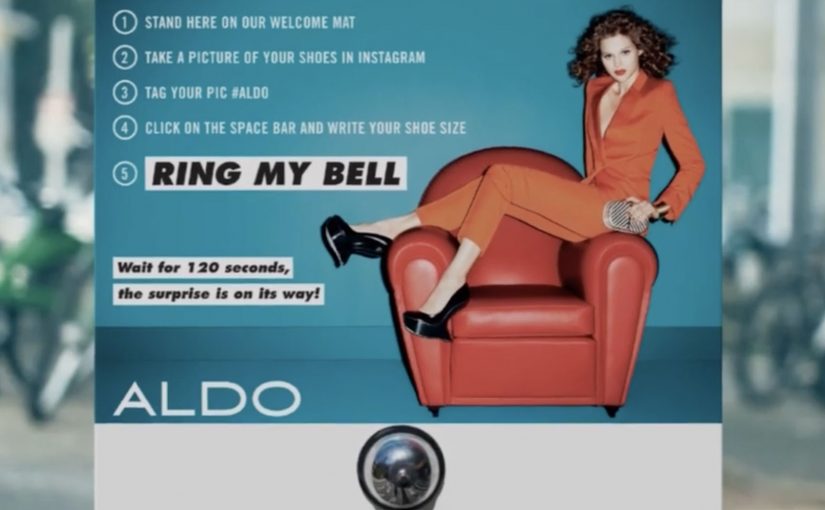
You stand on a welcome mat in the middle of the street, photograph your shoes, post to Instagram with #ALDO, add your shoe size, then ring a bell and wait 120 seconds. If you complete the steps, you get a surprise gift.

How the stunt turns a hashtag into a real-world trigger

The mechanism is a five-step participation script, a fixed sequence of actions that any passer-by can copy, that converts street curiosity into a trackable social action. The welcome mat marks the “stage”. The Instagram post captures proof and size data. The bell is the commitment moment. The 120-second wait creates tension. Then the brand pays off with a physical surprise delivered to the participant.

In high-footfall urban shopping streets where social posting is second nature, the fastest activations are the ones that turn a simple post into an immediate, tangible reward.

Why it lands

This works because it is friction-light and outcome-heavy. The instructions are short enough to follow at a glance, and the payoff happens quickly enough that the crowd stays to watch. The bell and countdown also make the moment public, which naturally pulls in the next participant.

Extractable takeaway: If you want social behaviour in the wild, write the participation flow like a street recipe. One clear prompt, one proof action, one suspense beat, one fast reward.

What the brand is really buying

The real question is not whether a hashtag can spread, but whether it can trigger a public action that proves the reward is real. This is less about reach in the abstract and more about engineered proof. By engineered proof, the brand makes the promised reward visible in real time so the next person believes it will work for them too. People do not just see a poster. They see someone trigger a reward in real time, which makes the campaign feel trustworthy and repeatable.

What to steal from a street-triggered reward loop

  • Make the call-to-action executable in under a minute. Anything slower loses passers-by.
  • Use a public commitment moment. A bell, button, or scan turns observers into a queue.
  • Time-box the suspense. The 120 seconds creates attention and crowd energy.
  • Design the payoff for spectators too. The best street rewards recruit the next person automatically.

A few fast answers before you act

What is “Ring My Bell”?

A street activation where pedestrians post a shoe photo to Instagram with #ALDO and their size, ring a bell, wait 120 seconds, then receive a surprise gift.

What is the core mechanism?

A simple participation script that links a social post to a physical reward, with a short countdown to keep attention on-site.

Why collect shoe size in the post?

So the reward can be prepared or matched quickly, and so the brand can fulfill immediately without follow-up friction.

What makes this work as OOH?

It turns signage into an interaction, and it makes the result visible to everyone nearby, which creates instant social proof on the street.

What is the safest reusable lesson?

Build an offline-to-online loop where the social action is the trigger, and the reward is fast enough to be witnessed in the moment.