
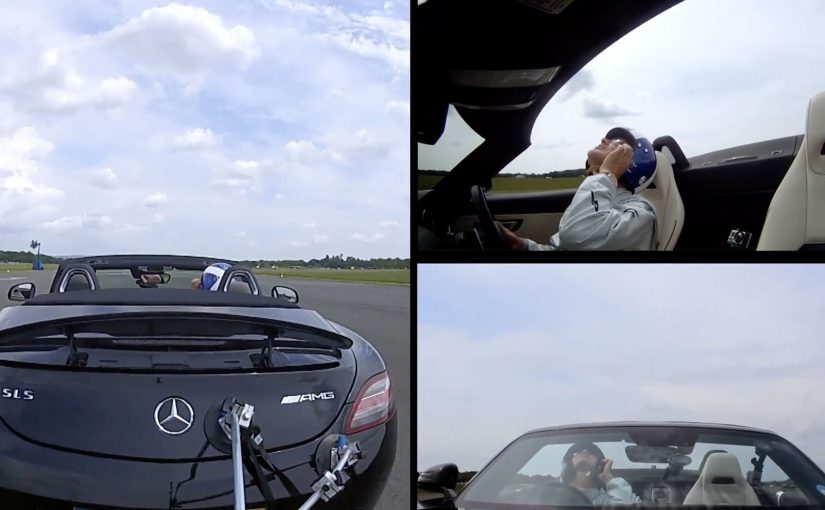
Mercedes-Benz: Golf Ball Catch World Record

Mercedes-Benz recently uploaded a video of former Formula 1 driver David Coulthard and pro-golfer Jake Shepherd setting a Guinness World Record with a Mercedes-Benz SLS AMG Roadster.

To set the record, Coulthard caught a golf ball hit by Shepherd while driving. The ball was traveling at 178mph and was caught 275 metres from the tee, setting the record for the farthest golf shot caught in a moving car. At the time of posting, the video had already crossed the one-million-view mark within days.

A record attempt built on timing and trust

The mechanism is clean and measurable: a golfer launches a high-speed drive down a runway, a driver accelerates to meet its trajectory, and the open cockpit becomes the “catcher’s mitt”. If the car, speed, and timing are even slightly off, the attempt fails in a very visible way.

In performance-led automotive marketing, certified stunts turn engineering credibility into a piece of entertainment people want to pass on.

The real question is whether your proof is visible enough that the audience can judge it without trusting your narration.

Because you can clearly see whether it worked, the performance claim feels earned rather than explained.

Why it lands

It turns abstract performance into a single, replayable challenge with clear stakes, and then lets Guinness define what “success” means.

Extractable takeaway: World-record style stunts work as marketing when the measurement is simple, the failure mode is obvious, and third-party verification turns spectacle into credible proof.

It makes performance legible. Horsepower and handling are abstract until you attach them to a task with consequences. A moving catch at extreme speed is instantly understood.

It borrows external validation. The Guinness framing gives the clip a built-in reason to exist beyond “brand content”. It signals that this is not just a cool shot, it is a verified attempt with a defined outcome.

It is engineered for replay. The audience watches once for disbelief, then again for mechanics: speed, distance, and the exact moment the ball drops into the car.

Borrowable moves from the record attempt

  • Anchor the story to a number. Distance, speed, and a named record create instant stakes.
  • Make the “proof moment” unmissable. The catch is the single frame people share, and the decisive proof that the claim happened.
  • Use experts as the interface. Specialist talent makes the impossible feel attempted rather than faked.
  • Build the edit around clarity. Viewers should understand what success looks like before it happens.

A few fast answers before you act

What record did Mercedes-Benz, Coulthard, and Shepherd set?

The farthest golf shot caught in a moving car, using a Mercedes-Benz SLS AMG Roadster.

What were the headline numbers?

The drive was clocked at 178mph and was caught 275 metres from the tee.

Why does Guinness World Records matter here?

It provides an external definition of “success” and a trusted validation layer that separates a stunt from a simple brand claim.

What is the business intent behind a stunt like this?

To make vehicle performance feel tangible and memorable, while generating earned reach through a shareable “did you see that?” moment.

What is the most transferable lesson?

If you want proof to travel, wrap it in a single measurable challenge, show the decisive moment clearly, and keep the explanation simple enough to repeat.
Starbucks love project

At exactly 8:30 a.m. ET on Monday, December 7th, Starbucks joined forces with (RED) and creative agency BBDO to coordinate a global sing-along. Musicians worldwide performed The Beatles classic “All You Need Is Love” at the same moment, positioning the Love Project as a proof point for how connected the world is and how a small decision by one person can make a grand difference elsewhere.

The performance was broadcast live via the internet from far reaches such as Gabon and Fiji, with participation spanning over 100 countries. The initiative raised money and reinforced awareness for Africa’s fight against AIDS, while giving people a clear way to take part in the solution.

The campaign. A global moment that lives online

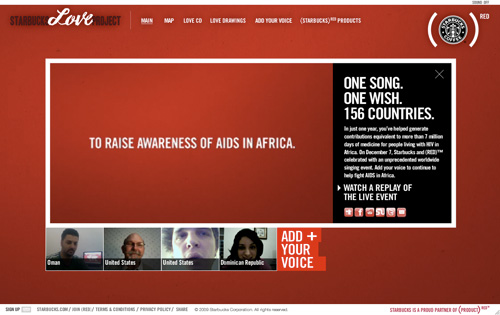
The performance was streamed live online at starbucksloveproject.com and acted as the anchor moment. Here, “anchor moment” means the single shared live event that gives the campaign a timestamp and a reason to gather.

Homepage of starbucksloveproject.com

After the live sing-along, people continued the campaign by going to the Starbucks website and uploading their own:

  • versions of “All You Need Is Love” videos
  • love drawing sketches

Each uploaded performance generated a donation from Starbucks to the cause, supporting (RED) and the Global Fund’s work.

In global consumer brands, the hardest part of cause marketing is turning a feel-good message into a repeatable participation mechanic.

The real question is how you design participation so it feels personal, public, and causally linked to impact.

Why it lands: participation that feels causal

This works because the mechanism makes the “how do I help?” step obvious and measurable. When contribution is triggered by a specific user action, scale stops being a vague aspiration and becomes a compounding loop that people can explain to each other.

Extractable takeaway: If you want a cause campaign to travel, make the participation act simple, visible, and directly tied to a concrete contribution.

The distribution layer. Partnering with Facebook

Starbucks partnered with Facebook to spread the message through the social network. The campaign was positioned as the largest global campaign ever for both Facebook and Starbucks.

The commercial layer. Turning participation into a product

The song was also commercially sold in stores on Starbucks’ Love CD, extending the fundraising and awareness beyond the live moment and the online uploads.

The scale signal. A record for global participation

A Guinness World Record was set for the “Most Nations in an Online Sing-Along,” reinforcing the Love Project as a massive organizational task that reaped the benefits of integrated marketing. Here, “integrated marketing” means the same idea expressed through a live anchor event, social distribution, and a product extension.

Steal this for your next global cause moment

  • Stage one timestamped anchor moment: Give the world a single time to show up, then let everything else ladder back to that moment.
  • Make participation generate impact: Tie a clear user action (uploads) to a concrete contribution (a donation) so people can explain the loop.
  • Design for sharing as distribution: Pick a network layer (Facebook here) that makes participation visible without extra effort.
  • Extend beyond the moment: Add a second way to participate (the Love CD) so the campaign does not end when the livestream ends.
  • Use proof signals carefully: If you claim scale (records, “largest ever”), ensure the mechanism and operations actually support it.

A few fast answers before you act

What is the Starbucks Love Project?

A global sing-along campaign with (RED), coordinated with BBDO, anchored by a simultaneous performance of “All You Need Is Love.”

How big is it?

The campaign described participation spanning over 100 countries, with performances broadcast live online from locations including Gabon and Fiji.

How does participation continue after the live event?

People upload their own “All You Need Is Love” videos and love drawing sketches on Starbucks’ campaign site.

How does it drive donation impact?

Each uploaded performance generates a donation from Starbucks to the cause, supporting (RED) and the Global Fund.

What role does Facebook play?

Facebook is presented as the distribution partner used to spread the message and participation through the social network.

What else extends the campaign beyond the moment?

The song is also sold commercially on Starbucks’ Love CD in stores.