
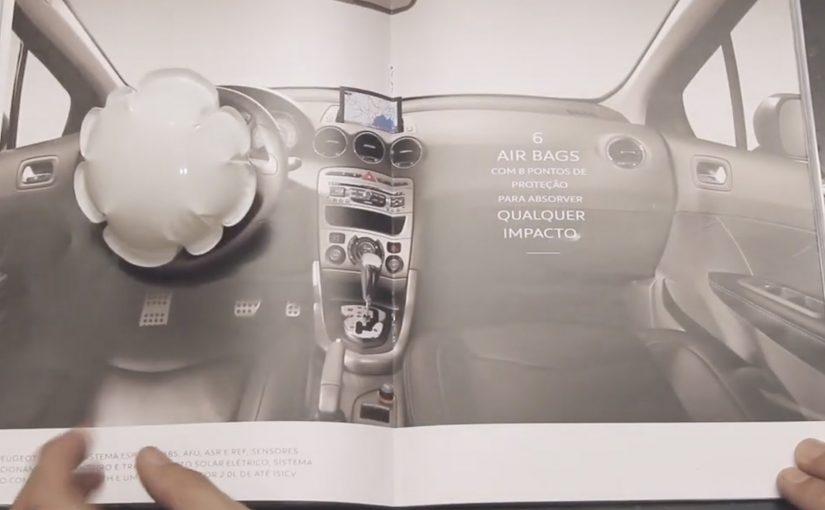
To advertise the safety benefits of the Peugeot 408, Brazilian agency Loducca put a mini airbag inside a print ad. Readers were invited to hit a marked spot on the page and see what happened. On impact, the tiny bag inflated, demonstrating in miniature what an airbag would do.
The ad appeared in Brazil’s business magazine Exame and was reportedly distributed with protective packaging so the airbag would not trigger by accident.
A magazine page you have to hit
The mechanism is brilliantly blunt. You do not watch a crash test. You perform a micro impact, a small, deliberate tap that simulates impact, with your hand, and the medium responds. That action turns a passive read into an experience, and it makes the “airbag” benefit impossible to ignore. Brands should treat safety claims as proof problems and design demonstrations the viewer can personally trigger.
In automotive safety marketing, the highest-performing proof is the kind you can physically trigger yourself.
The real question is whether your proof of safety can be triggered by the audience, not merely asserted by the brand.
Why print becomes more credible when it behaves like a product
Print normally communicates through trust in words and images. This ad adds a different kind of credibility, mechanical proof. Because it inflates on cue, the viewer’s brain files the message as something closer to engineering than persuasion. That matters because “safety” is a hard attribute to sell with rhetoric alone. People want reassurance, not adjectives.
Extractable takeaway: When a product claim is about protection, the strongest creative move is to make the audience feel a cause-and-effect demonstration, not just read about it.
The packaging is part of the idea
The special packaging is not just logistics. It signals intent. This is a controlled, designed interaction. It is also a reminder that experiential print has operational realities. Here, “experiential print” means print that behaves like a product interaction, with a designed trigger and response. If you build an ad that can go off in someone’s bag, you must engineer the distribution like you would engineer a product.
How to design triggerable safety proof
- Make the claim triggerable. If the benefit is physical, design a physical proof moment.
- Keep the interaction single-step. One obvious action, one immediate response, no instructions needed.
- Let the medium do the explaining. The inflation is the headline. Copy becomes supporting detail.
- Design the supply chain, not just the concept. Packaging, safety, and consistency are part of creative effectiveness.
- Use spectacle sparingly. The wow moment is strongest when it directly maps to the product truth.
A few fast answers before you act
What is the Peugeot 408 “airbag in a print ad” idea?
A magazine ad with a real mini airbag insert that inflates when the reader hits a marked spot, mimicking an airbag deploying during impact.
Why does this work better than a normal safety print ad?
Because it converts a claim into a physical demonstration. The reader triggers the proof, which feels more credible than copy alone.
What makes interactive print feel premium instead of gimmicky?
When the interaction is directly tied to the product benefit and works reliably. The mechanism should be the message, not a disconnected trick.
What’s the biggest risk with mechanical inserts in magazines?
Execution risk. Misfires, non-fires, and distribution issues can overwhelm the idea. The production and packaging have to be engineered as carefully as the concept.
How can a brand replicate this approach on a smaller budget?
Design a tactile proof moment using simple materials and one clear action. The key is immediate cause-and-effect that maps cleanly to the claim.