
Mercedes-Benz Vans: Key to Viano

A commuter points a car key at a digital billboard and clicks the remote. The screen reacts. Suddenly, the advertising display stops behaving like outdoor media and starts behaving like interactive entertainment.

That is the core mechanic behind “Key to Viano”, an interactive outdoor event for Mercedes-Benz Vans created by Lukas Lindemann Rosinski on Wall AG’s digital out-of-home (DOOH) displays in Berlin’s U-Bahn station Friedrichstraße. Passers-by are invited to use their own remote car keys to control the content on the screens, turning a familiar everyday object into the controller.

In high-traffic urban DOOH environments, the quickest path to attention is to turn an existing habit into viewer control, with a payoff that feels immediate and public.

The experience works because the interaction is self-explanatory. Press the button you already know. Watch the screen respond. The line between ad and game collapses, and the crowd becomes part of the moment because everyone can see the “trigger” happen.

Why the car key is the perfect interface

No download. No new behaviour. No instruction manual. A car key is already a remote control in people’s hands, so the activation feels intuitive instead of “techy”. That simplicity is what makes the experience legible from a distance, and what makes bystanders stop and watch.

Extractable takeaway: If you want interaction in public space, pick an input people already carry and trust, then make the response visible to everyone around them.

What Mercedes-Benz Vans is really proving

The stunt is framed as entertainment, but it is also a product metaphor. “Key to Viano” implies access, convenience, and a premium feel. When the participant can “open” a digital experience with a key, the brand gets to borrow the emotional cues of unlocking a car, without talking about features.

The real question is whether your idea can be explained in one glance, without staff, signage, or a QR code.

Interactive DOOH should earn its place by being instantly legible, not by adding layers of “smart” complexity.

What to borrow from Key to Viano

  • Use a controller people already trust. Familiar inputs reduce friction and increase participation.
  • Make the interaction visible. If the crowd can see what caused the screen to change, attention multiplies.
  • Keep the loop fast. Trigger. Response. Reward. A slow loop loses commuters.
  • Let the location do the targeting. Stations deliver high volume and natural dwell time without extra explanation.

A few fast answers before you act

What is “Key to Viano”?

It is an interactive digital out-of-home activation where passers-by control advertising screens using their own remote car keys, under the Mercedes-Benz Vans “Key to Viano” concept.

Where did the activation run?

It ran on digital displays at Berlin’s U-Bahn station Friedrichstraße.

Why does using a car key work so well?

Because it is an input people already understand. It removes download friction and makes the interaction feel natural and premium.

What is the main benefit of interactive DOOH like this?

It converts passive exposure into participation. Participation creates longer attention, stronger memory, and visible social proof from the crowd watching.

What is the biggest risk with interactive screens in transit spaces?

Complexity. If the interaction is not instantly clear, people walk past. The mechanic must be obvious in seconds.
Mercedes-Benz Sprinter applies for a job

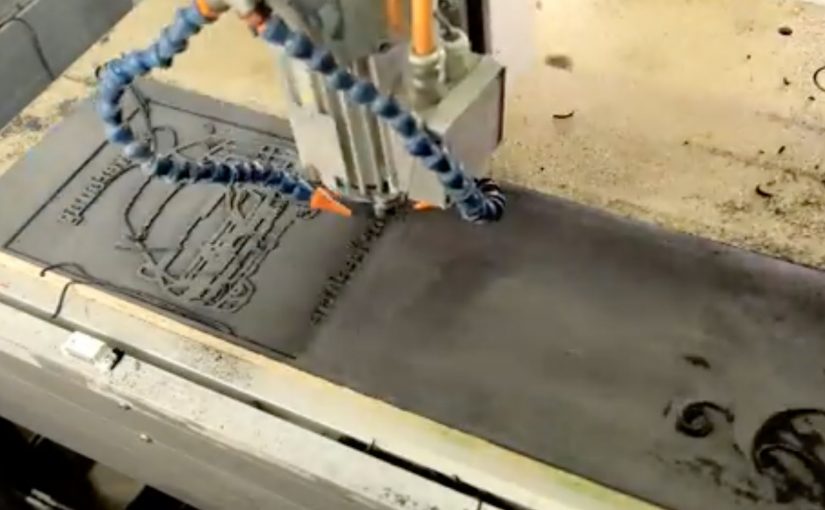
In order to get more companies to buy the Mercedes-Benz Sprinter, German ad agency Lukas Lindemann Rosinski actually got the Sprinter to apply for a job. To do this, they came up with the world’s first printing tyre. This enabled the Sprinter to write its own letters of application, all on its own.

Why this direct marketing idea lands

The power is in the role reversal. Instead of telling fleet managers that the Sprinter is a hard worker, the campaign makes the vehicle behave like one. It “applies”. It shows initiative. And it creates something physical that naturally gets noticed on a manager’s desk. The real question is how you make a product claim feel self-evident before a sales conversation even starts. The strongest B2B ideas do not decorate the claim, they stage the proof.

Extractable takeaway: When you can turn a product benefit into a behavior buyers can witness, the message becomes easier to remember and harder to dismiss.

What makes the execution feel credible

The printing tyre is not a metaphor. It is the proof. It turns the van into the production tool, which makes the claim harder to ignore. Because the mechanism produces the message, the proof feels native to the product, which is why the claim lands harder than copy alone.

What the business is really doing

The business intent is to position the Sprinter as the hard-working choice for fleet buyers by making the vehicle demonstrate initiative instead of just being described that way.

In B2B fleet marketing, this kind of idea works especially well when buyers are comparing similar offers and need one proof point that cuts through routine sales material.

What to borrow for B2B marketing

  • Make the product do the talking. Let capability show up as a concrete action.
  • Put the idea into the buyer’s workflow. A real letter in a real office beats another brochure.
  • Design for desk gravity. That means making the asset look like it belongs in the buyer’s everyday workflow, which makes it harder to dismiss.

A few fast answers before you act

What did Mercedes-Benz do here?

They had a Mercedes-Benz Sprinter “apply for a job” to companies as a way to drive interest and consideration.

Who created the campaign?

German ad agency Lukas Lindemann Rosinski created the campaign.

What was the core mechanic?

A custom printing tyre enabled the Sprinter to write its own letters of application.

Why is it effective as direct marketing?

It works because it places a physical proof point into a business context, and the product itself delivers the message.

What is the main lesson for B2B campaigns?

Turn product benefit into a behavior buyers can witness, not just a claim they are asked to believe.

Germanwings: Planemob at 30,000 Feet

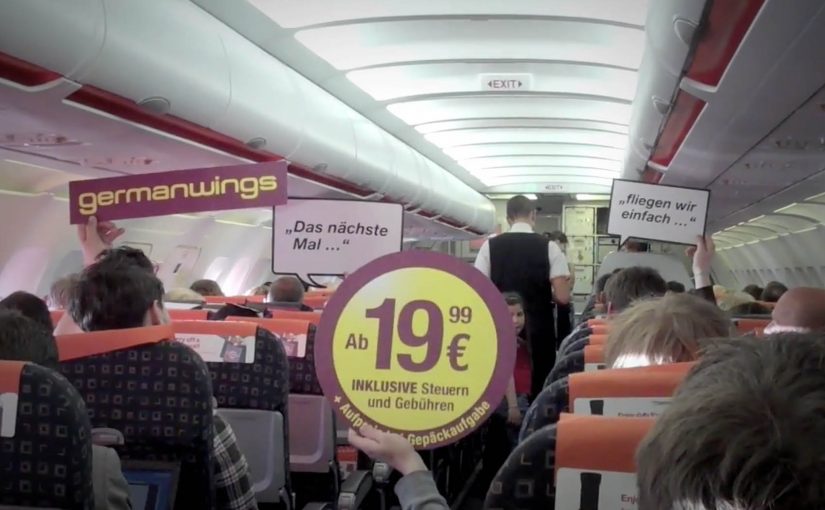
Five creatives board a competitor’s flight with nothing but cardboard signs, a camera, and a plan. At cruising altitude, they run a “planemob” in the aisle. In practice, that means a flashmob-style brand stunt staged on a plane and filmed to travel later as content. The cabin becomes the set, and the passengers become the audience.

A brand comparison staged where the problem happens

The idea is credited to Lukas Lindemann Rosinski in Hamburg. The stunt is described as taking place on a rival low-cost carrier flight, and it uses the rival’s own boarding and seating dynamics as the backdrop for the message.

The execution is deliberately low-tech. A small group reveals a sequence of placards that make a simple point about “quality” versus the small annoyances of no-frills flying, especially the chaos that comes with free seating when groups try to sit together.

The mechanic: hijack the moment, not the media

This is guerrilla advertising in the literal sense. Instead of buying more airtime, the campaign borrows a moment that already has full attention: passengers strapped in, phones out, and nothing else to do.

That works because the stunt captures attention at the exact moment the irritation is most legible, so the comparison feels less like copy and more like proof.

Filming the stunt is not an afterthought. It is the distribution strategy. The onboard moment creates the story, and the video carries it to everyone who was not on the plane.

In European low-cost aviation, brand promises live or die on small frictions that frequent flyers feel immediately.

Why it lands: it turns irritation into proof

Most airline positioning stays abstract because the product is hard to “show” in a single line. Planemob goes the other way. It demonstrates the promise by contrasting it against a situation passengers recognize without explanation. This is smart brand theatre because the proof arrives inside the passenger experience instead of sitting above it as a slogan.

Extractable takeaway: If your differentiator is a reduction of friction, stage the proof inside the friction. Do it in a setting where the audience is already feeling the problem, and keep the message simple enough to travel as a clip.

The business intent: earned attention that outlives the flight

The immediate audience is small. The real audience is everyone who sees the video afterwards. That’s the trade. A short, high-constraint performance buys a longer, shareable narrative, and it tends to get discussed precisely because it happens “in real life” rather than inside a media slot.

The real question is whether a tiny live audience can trigger a much larger story once the moment is filmed and shared.

Award listings also suggest the work gained industry recognition, including a Spotlight Festival Gold in web & mobile categories for “Planemob”.

What to steal for your next guerrilla moment

  • Exploit a captive moment ethically: pick a context where attention is naturally high and interruption is minimal.
  • Use props that read instantly: big typography, one point per beat, no cleverness that needs a caption.
  • Build the distribution into the idea: if it does not work as a video, it does not scale.
  • Anchor the claim in a felt pain point: “quality” lands when it maps to a concrete irritation people already know.
  • Keep the crew small: constraints make it believable, and believability is the fuel for sharing.

A few fast answers before you act

What is a “planemob”?

A planemob is a flashmob-style stunt staged on an aircraft, designed to create an attention-grabbing in-flight moment that can be filmed and shared as a campaign video.

Why does this count as guerrilla marketing?

Because it uses a real-world environment and a minimal set of materials to generate earned attention, rather than relying primarily on paid media placements.

What is the core persuasive trick in this execution?

It connects the brand claim to a situation passengers have experienced. The message feels like evidence because it is delivered inside a recognizable pain point.

What should you watch out for if you copy this approach?

Operational risk and brand risk. You need a concept that is safe, respectful to bystanders, and strong enough to survive without heavy explanation. If it needs a long caption, it will not travel.

How do you measure success for this kind of stunt?

Video reach and completion rates are the baseline. More meaningful signals include press pickup, share-to-view ratio, branded search lift, and whether the stunt strengthens a specific product attribute in brand tracking.