
When navigation stops being private
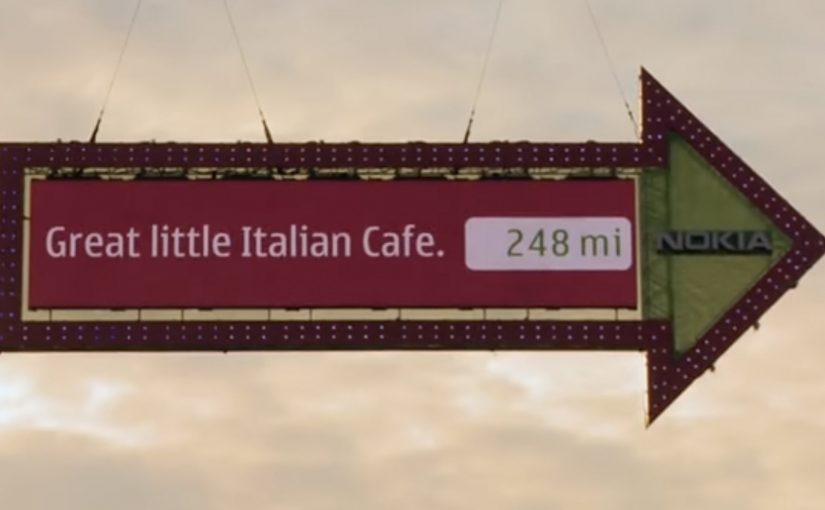
Making navigation social is the new big idea by Swedish agency FarFar for Nokia.
What the “big signpost” actually does
The idea is simple at street level. Put a colossal digital signpost in a place with constant foot traffic, then let the public control it. People submit a location from their phone or via the web, and the sign turns to point toward that place while displaying the direction and distance.
Instead of selling navigation as a spec on a phone, the campaign turns it into a shared public utility and a social recommendation engine. Your place becomes part of the experience, and everyone nearby gets a live demonstration of what the service can do.
In global consumer tech marketing, “useful features” often stay invisible until you give them a public stage and a participatory hook.
Why it lands
It takes something normally solitary, finding your way, and makes it performative. Watching the sign react in real time creates instant credibility, and seeing other people’s “good things” transforms navigation from point-to-point directions into discovery. The spectacle draws a crowd, but the viewer control keeps the crowd engaged because the output is never the same twice.
Extractable takeaway: If you are marketing a capability people underestimate, externalize it in a physical demonstration, then let the audience drive the input so the proof feels self-generated.
What Nokia is really buying with this stunt
The visible job is attention. The deeper job is adoption.
The real question is whether a public demonstration can turn navigation from a private utility into a behavior people want to repeat and share.
This is a stronger way to sell navigation than listing features in isolation because the product benefit becomes visible, social, and easy to try.
Done well, the “map of good things” becomes more than a campaign artifact. Here, “map of good things” means a navigation layer shaped by public recommendations, not just static directions. It becomes a product behavior.
What brands can steal from the signpost
- Turn an invisible feature into a visible ritual. Make the value legible in under five seconds, even with no sound.
- Design for participation, not just impressions. Let people submit inputs, then reward them with a public output.
- Make the crowd the content engine. Recommendations from real people do the persuasion work for you.
- Build a clean bridge to “try it now.” If the demo is the billboard, the next step must be immediate on the device in someone’s pocket.
A few fast answers before you act
What is “The World’s Biggest Signpost” for Nokia?
It is a large interactive signpost installation that lets the public submit locations and then shows the direction and distance to those places, used to promote Nokia’s navigation services as social and shareable.
How does the experience make navigation “social”?
It shifts navigation from personal utility to public discovery by letting anyone contribute places and letting everyone nearby see the recommendations and results live.
What is the core mechanic that makes it work?
Real-time viewer control. People submit a destination and immediately see the sign respond with a physical, public proof of the service.
Why use a large physical installation instead of a regular ad?
A physical demo creates instant trust. It shows the capability in the real world, not as a claim, and it attracts attention through spectacle while keeping engagement through interaction.
What’s the key transferable lesson for brands?
If you want people to value a capability, stage it as a shared experience where the audience supplies the inputs and the product supplies undeniable outputs.