
Peruvian League Against Cancer: Shadow WiFi

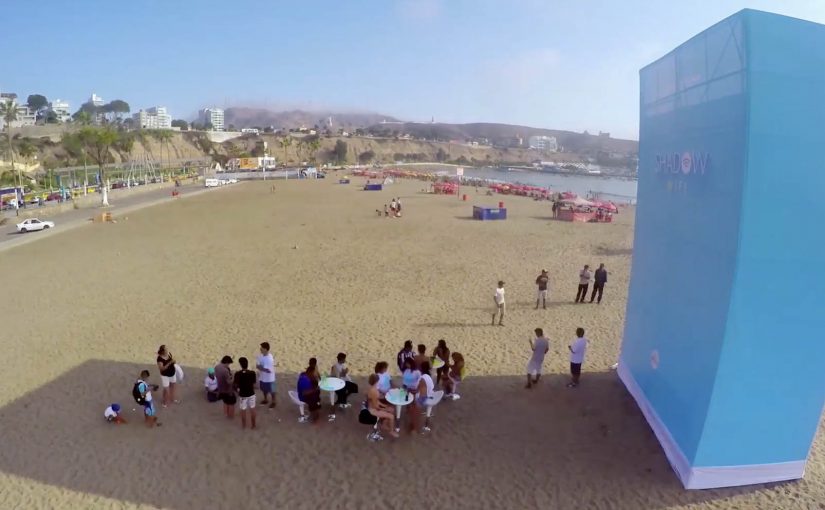
You are on a beach, the sun is out, and your phone wants a signal. Then you notice a large blue structure casting a patch of shade. Step into that shade, and you get free WiFi. Step out into the sun, and the WiFi disappears.

Instead of simply warning people about UV rays, the Peruvian League Against Cancer and Happiness Brussels create “Shadow WiFi”. A directional antenna delivers WiFi only to the shadow area of the structure. A sensor tracks the sun’s movement and rotates the antenna, so as the shadow shifts through the day, the WiFi access shifts with it, and people follow.

The mechanism is the message

The mechanic does not just communicate “stay in the shade”. It enforces it gently. The reward is instantly understood. Connectivity. The rule is equally clear. Shade equals access. Sun equals nothing. The result is prevention education delivered through interactivity, not through guilt. This is the right kind of nudge because it rewards the safer choice instead of lecturing people into it.

The real question is whether you can make the protective choice feel more useful than the risky one in the moment.

In public health behavior-change campaigns, trading immediate utility for safer choices is often more effective than warnings alone.

Why it lands

It targets the real friction. On a beach, the problem is not awareness. It is motivation and habit in the moment. Shadow WiFi turns shade into a social and practical hotspot, so safer behavior feels like the default choice rather than a sacrifice.

Extractable takeaway: If you want people to adopt a protective habit, attach it to a reward they already seek in that environment, and make the “safe zone” tangible, not theoretical.

Guerrilla activation moves worth copying

  • Pay people in utility, not slogans. Free WiFi is a real benefit that beats reminders and posters.
  • Make the rule physical. When the benefit is literally bounded by shade, the behavior is self-explaining.
  • Design for movement. The rotating antenna turns a static installation into a living experience that keeps working all day.
  • Teach inside the experience. Use the login or landing step to deliver prevention guidance while intent is high.

A few fast answers before you act

What is Shadow WiFi in one sentence?

A beach WiFi network that only works in the shade, encouraging people to avoid direct sun exposure while learning about skin cancer prevention.

Why does restricting WiFi to shade change behavior?

Because it makes the safer choice immediately rewarding. People move for a benefit they already want, and the health message rides along.

What is the key technical trick?

A directional antenna limits the WiFi coverage to the shadow zone, and a sun-tracking sensor adjusts the antenna as the shadow moves.

How do you translate this idea without using WiFi?

Keep the same pattern. Put a desired utility behind a clear, physical boundary that represents the safer behavior, so the experience teaches the rule without needing explanation.

What can make this fail?

If the WiFi is unreliable or the shaded area is too small, the utility collapses and the activation becomes a novelty object instead of a habit shaper.
UTEC: Potable Water Generator

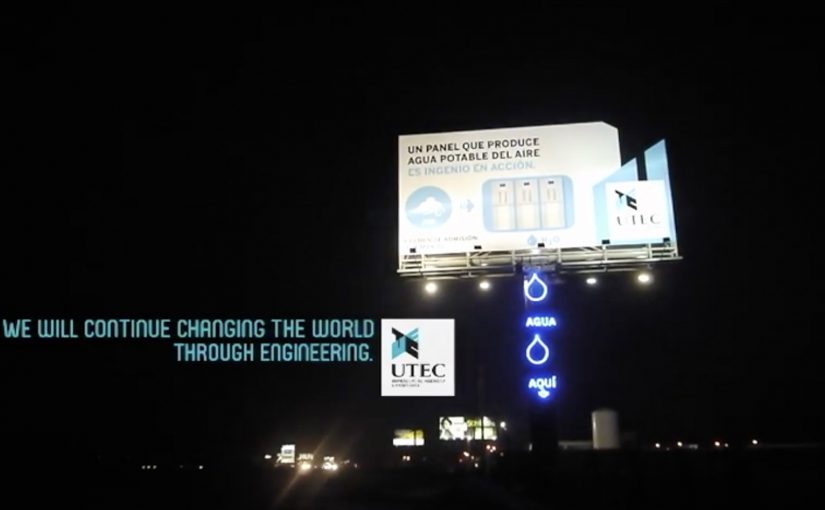
A billboard in Lima does not just advertise. It dispenses drinking water.

UTEC, the University of Engineering and Technology in Peru, believes engineering can change the world. To make that belief tangible and to attract future applicants, it tackles a local constraint. Lima is often described as a major capital city set on desert conditions, where rainfall is minimal, but atmospheric humidity can be extremely high. UTEC uses that humidity to build a billboard that is described as producing potable water out of air.

Definition tightening: This is atmospheric water generation. Moist air is captured, condensed into liquid, then treated so it can be dispensed as drinking water.

A recruitment message you can literally use

The mechanism is a public proof. Turn an engineering principle into civic micro-infrastructure, then let the infrastructure demonstrate the promise of the institution. You do not need to argue that engineering matters. You show it working on the street.

In urban Latin American contexts where infrastructure gaps are visible in daily life, recruitment marketing becomes more believable when the brand contributes something functional before it asks for attention.

Why it lands

It works because the outcome is immediate and legible. People understand “clean water from a billboard” faster than they understand any tagline about innovation. The board also flips the usual direction of advertising. Instead of taking attention, it gives utility, and that trade feels fair.

Extractable takeaway: If you want trust fast, build a single, real-world demonstration where your capability produces a public benefit, then make the benefit the headline.

What UTEC is really positioning

This is engineering as an identity. The university is not selling courses first. It is selling a worldview. Engineers notice constraints. Engineers build systems. Engineers improve the lived environment. The billboard makes that identity concrete, and the recruiting message follows naturally.

The real question is whether you can prove a capability in public before you ask people to believe the story around it.

What to borrow from UTEC’s water billboard

  • Pick one local constraint people feel. Water access is not theoretical. It is daily.
  • Make the demonstration self-explanatory. No app. No instructions. Just a visible result.
  • Let utility replace persuasion. If the object helps, the story spreads on its own.
  • Design the “proof moment”. A tap and a container beat any infographic.

A few fast answers before you act

What is “Potable Water Generator”?

It is a UTEC outdoor activation in Peru where a billboard is described as producing drinkable water from atmospheric humidity, turning engineering into a visible public service.

What is the core mechanism?

Capture humid air. Condense it into water. Treat it for safe consumption. Dispense it from the billboard so the benefit is immediate and observable.

Why is this also recruitment marketing?

Because it demonstrates the kind of engineering UTEC wants to be known for. Practical, applied, and aimed at solving local problems, not just talking about them.

What makes this more memorable than a standard awareness billboard?

The outcome is functional. People can use it, which turns the campaign into an experience and a story, not just a message.

What is the most reusable lesson?

When your brand promise is capability, prove it with one tangible demonstration that improves the environment people are standing in.

Coca-Cola: Wallet of Happiness Honesty Test

An honesty test on a crowded Lima street

As part of an experiment in a very crowded Lima district in Peru, Coca-Cola with their agency McCann Erickson deliberately left a wallet containing $100 on the street. With it they tested people’s honesty.

A $100 question, asked in public

The brilliance is how quickly the situation reads. Find the wallet. Notice the money. Decide what kind of person you want to be, with nobody asking you anything.

In social experiment storytelling, a simple moral trigger creates instant comprehension and invites viewers to project themselves into the decision. Here, a moral trigger means a moment that forces a right-versus-wrong choice without explanation.

In global FMCG brand storytelling, street-level honesty tests like this travel because they turn a private value into a public, watchable moment.

Why you keep watching

You are not just judging strangers. You are quietly measuring yourself against what you hope you would do. The real question is what you do when the right choice is clear, but no one is holding you accountable. That internal comparison is the engine of the film. Because the choice is legible and unprompted, viewers can run the same decision in their own head, which keeps them watching.

Extractable takeaway: If your mechanic makes viewers instantly ask “what would I do,” the story carries itself without narration.

What the experiment is trying to reveal

People’s honesty, observed in a real public setting through a simple, high-stakes trigger.

What to borrow from a public honesty test

  • Choose a mechanic that is universal and legible without narration. In this context, “mechanic” means the simple rule that generates the behavior you want to capture.
  • Keep production minimal so human reaction stays central.
  • Let the audience do the interpreting. A good social test creates its own debate.

A few fast answers before you act

What did Coca-Cola do in Lima?

They left a wallet containing $100 on the street in a crowded district to test people’s honesty.

Where did this take place?

In a crowded district of Lima, Peru.

Who created the campaign?

The post credits Coca-Cola and McCann Erickson.

Why does the film hook people so fast?

Because the dilemma is instantly legible: you see the wallet, notice the money, and immediately imagine what you would do.

What was the point of the experiment?

To observe how people would react when they found a wallet with money in a real-world public setting.