
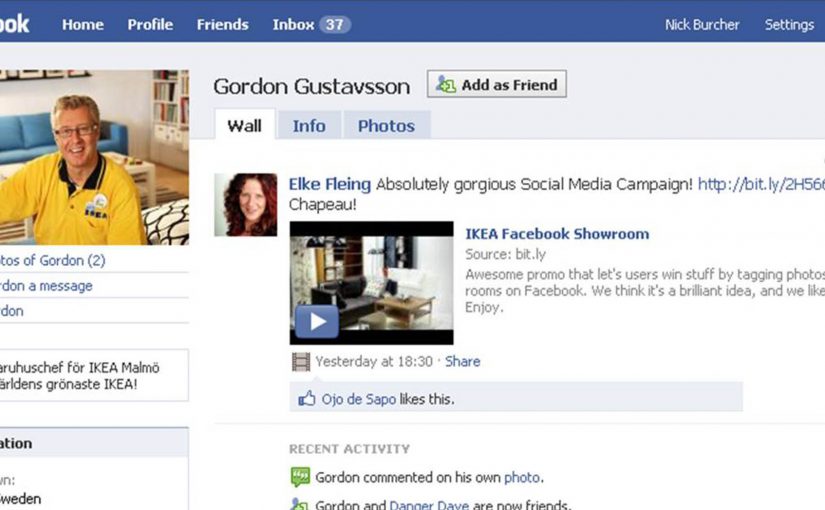
You see a photo of an Ikea showroom in a Facebook album. The caption is simple. Tag the product you want. If you are first to tag it with your name, you win the item. One photo turns into a race. One tag turns into a claim.
The challenge. Breaking through Facebook clutter
Facebook is getting cluttered with brands screaming about themselves. Forsman & Bodenfors from Sweden leans into the platform instead of fighting it. They turn a basic Facebook behavior. Photo tagging. Into the promotional mechanic. Here, the mechanic is the simple rule set that rewards the first tag.
The real question is how to turn a crowded feed into a game people choose to play, not just a message they scroll past.
When the platform already has a native action people do without thinking, build the promotion on that action instead of adding extra steps.
The setup. A manager profile as the campaign hub
To promote the opening of Ikea’s new store in Malmö, Sweden, the campaign starts with a profile for the store’s manager, Gordon Gustavsson. With a small media budget, the experience is designed to spread through participation rather than paid impressions.
How it works. Tag to win
- Gustavsson uploads pictures of the store’s showrooms into a Facebook photo album.
- People browse the photos and tag the Ikea items they want with their own name.
- The first person to tag a specific item wins it.
In European retail launches with tight media budgets, participation mechanics that travel through friends lists can do more work than another round of brand posts.
Why this works. Desire, speed, and public proof
The mechanic converts attention into action immediately. People do not just look at product photos. They interact with them. The tagging action creates public proof that others can see, and it naturally spreads Ikea products across networks without adding extra friction. Here, public proof means the visible tags on each item that signal demand and participation. Because tagging is instant and public, each claim doubles as distribution and social validation.
Extractable takeaway: If you can tie a desired outcome to a native platform action and make the action visible, you get behavior change and distribution in the same move.
Moves worth copying for your next launch
- Use a native action as the CTA. Pick something the platform already trains people to do, then make that the whole interaction.
- Make the action public by default. Visibility creates momentum and keeps the experience self-propagating.
- Reward speed, not form-filling. The shorter the path from desire to action, the less drop-off you create.
- Let one asset do double duty. A single photo should work as content, interface, and trigger for participation.
A few fast answers before you act
What is Ikea’s Facebook Showroom?
A Facebook campaign for Ikea’s Malmö store opening that uses photo tagging as a “tag first, win the item” mechanic.
What is the core user action?
Browse the showroom album and tag the product you want with your own name. The first person to tag a specific item wins it.
Who runs the profile and album?
The campaign centers on a profile for the store manager, Gordon Gustavsson, who uploads the showroom photos.
What makes it spread without heavy media?
Tagging is already a native Facebook behavior. Each tag is visible and shareable, so participation creates distribution.
What is the transferable pattern for brands?
Turn a native platform action into the promotional mechanic, then let participation create the distribution.