
In August I wrote about how Coca-Cola Israel used technology to personalise billboards for people who drove by.
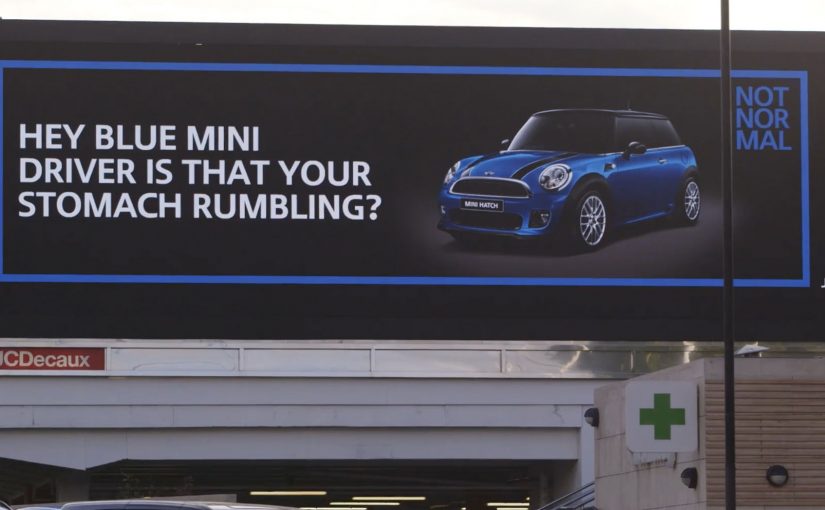
Now, as part of its ongoing Not Normal campaign, MINI decides to give MINI drivers in London a custom message by taking over a run of giant billboards along a fast-paced road for a two-week period.
Reportedly, the campaign reached out to 1,941 MINI drivers in London during the run.
How the billboards “recognise” drivers
The mechanism is deliberately human. Spotters use iPads to identify approaching MINIs and trigger the right creative. Each message is sent with pictures of the make and model of the MINI it relates to, so the driver sees something that feels directed, not generic.
In urban out-of-home advertising, combining live triggers with personalised creative can make a brand message feel like a service moment, not just media.
Why this lands on a road, not in a feed
Most personalised media is private and one-to-one. This flips it into a public setting. The driver gets a direct salute, and everyone else sees a brand that appears to be paying attention to its community in real time. That publicness is the multiplier, because it turns a personal moment into shared talk value.
What the campaign is really doing for MINI
The work reinforces the Not Normal positioning by celebrating owners rather than pushing product claims. It also turns “existing drivers” into the hero audience, which is a neat way to build loyalty and social proof at the same time.
What to steal from this pattern
- Use a simple trigger and a clear payoff. Recognition plus a tailored line is enough if the timing is perfect.
- Keep it brand-native. A salute fits a community brand. A hard sell would break the spell.
- Make personalisation visibly specific. Showing the make and model is the proof cue that prevents it feeling random.
- Design for safety and readability. Short messages, high contrast, instant comprehension.
A few fast answers before you act
What is “MINI Salutes You” in one line?
A digital out-of-home activation that displays personalised messages to MINI drivers as they pass selected London billboards.
How are the personalised messages triggered?
Human spotters using iPads identify approaching MINIs and trigger the relevant creative, including make and model visuals.
Why use billboards for personalisation?
Because it makes recognition public. The driver feels noticed, and bystanders see a brand visibly celebrating its community.
What is the main transferable lesson?
If you can time a simple personalised moment perfectly, you do not need complex tech to create a campaign people retell.