
Ford: Noise-Cancelling Kennel

A dog hears the first firework bang and starts to panic. The family tries the usual fixes. Closing curtains. Turning up the TV. Comforting words. But the noise still cuts through, and the stress spreads to everyone in the room.

Ford’s noise-cancelling kennel concept takes a different angle. It treats fireworks like an engineering problem. The prototype uses microphones to detect sudden loud sounds, then a built-in audio system plays opposing frequencies to reduce the noise inside the kennel. Sound-deadening materials, including high-density cork, add a physical layer of insulation on top of the active cancellation.

In consumer innovation storytelling, especially when the tech is hard to “see,” the fastest way to earn belief is to show it solving a small, relatable problem.

The real question is whether your R&D can earn belief by solving a tiny, emotional problem in the real world.

The idea is inspired by the Active Noise Control Ford introduced in the Edge SUV to make journeys quieter. Inside the Edge SUV cabin, microphones pick up unwanted noise and the audio system counteracts it with opposing sound waves. Here, the same principle is applied to a safe space for dogs during fireworks.

Why this lands with people who do not care about car tech

Because the benefit is immediate and emotional. Fireworks anxiety is common, and the problem shows up at home, not in a showroom. The kennel reframes Ford’s engineering as something that protects a family moment, not just something that improves a drive.

Extractable takeaway: When your technology is invisible, translate it into a felt reduction of a specific stressor. Reducing the sharp peaks of fireworks noise inside a safe space lowers the trigger that starts panic, so calm becomes observable in seconds.

What Ford is really building with “Interventions” thinking

This is a brand-positioning move disguised as a pet story. By “Interventions” thinking, Ford is repurposing a familiar experience into a purposeful disruption that makes the benefit felt immediately. It signals that automotive R&D can be repurposed into everyday life solutions, and it does it without a hard sell. The prototype is the proof-of-intent.

What to steal if you want to translate R&D into culture

  • Start with a problem people already feel. Fireworks fear is instantly understood without explanation.
  • Use a single, credible technology transfer. One tech. One benefit. No feature soup.
  • Make the benefit visible in seconds. Calm is the KPI here, not product specs.
  • Let the prototype be the story. A working concept creates more belief than a manifesto.

A few fast answers before you act

What is Ford’s noise-cancelling kennel concept?

It is a prototype dog kennel designed to reduce fireworks noise using active noise control and sound-insulating materials, giving anxious dogs a calmer space.

How does the noise cancellation work in simple terms?

Microphones detect the loud sound, then speakers play an opposing sound wave to reduce it. Physical insulation also helps block and absorb noise.

Is this a product you can buy?

It is presented as a concept/prototype rather than a retail product, used to demonstrate how existing Ford technology could be applied to everyday problems.

Why connect this to the Ford Edge SUV?

Because the kennel borrows the same Active Noise Control principle used to reduce unwanted noise in the vehicle cabin, then applies it to a different environment.

What is the main risk with “tech repurposed for good” ideas?

If the link between the original technology and the new use case feels flimsy, it reads as a gimmick. The transfer has to be technically believable and emotionally relevant.

Novalia: Playable Album Cover DJ Deck

You pick up a record, touch the artwork, and the sleeve behaves like a DJ controller. Swipe to scratch. Tap to trigger effects. Use the crossfader. The physical album cover becomes an input device, not just a package.

That’s the latest project from Novalia, a Cambridge-based company that turns classic print into smart, touch-based surfaces using conductive ink and sensors, previously seen in work like The Sound of Taste.

How the album cover becomes a controller

For this release, Novalia works with DJ Qbert to create what is described as the world’s first interactive DJ decks on an album cover. The cover includes a printed mixer and deck layout. Touching the surface activates a companion setup with the Algoriddim djay app, allowing the user to scratch, mix, and fade any songs they already have loaded in the app directly from the paper surface.

Under the hood, the cover uses printed touch sensors. Those sensors translate finger position and gestures into control signals that the DJ app can interpret like a hardware controller.

In music and entertainment packaging, interactive print can turn a passive object into a playable interface, which makes “physical media” feel alive again. Here, interactive print means a printed surface with touch-sensitive inputs that control a connected digital experience.

Why this lands

This works because it collapses the gap between artwork and performance. The cover is not a souvenir. It is an instrument. That shift creates immediate curiosity and a strong demo moment, and it makes the format, vinyl and packaging, part of the innovation rather than a nostalgic constraint.

Extractable takeaway: If you want people to care about a physical format, give it a job. Turn the object into an interface that controls something digital, so “owning it” unlocks a behaviour, not just a collectible.

What the tech is really proving

Novalia is not just showing a clever one-off. It is demonstrating that printed surfaces can behave like UI. Buttons, sliders, decks, and triggers, without looking like electronics. The real question is how a printed object can stop being packaging and start behaving like an interface people want to use.

That opens the door for interactive posters, magazine inserts, packaging, and merchandise that can control sound, apps, or connected experiences while staying lightweight and familiar.

What to steal from interactive print packaging

  • Make the object the interface. The most memorable interaction is the one that defies expectations of the format.
  • Use a companion app people already accept. Pair print with a mainstream app so the learning curve stays low.
  • Design for demo. If it looks good on camera, your audience will do distribution for you.
  • Keep the interaction legible. Touch, swipe, fade, scratch. Actions should map to familiar behaviours.

A few fast answers before you act

What is a “playable” album cover?

It’s an album sleeve printed with touch sensors so the artwork functions like a controller. Your fingers become the input, and the connected app produces the sound.

What does Novalia contribute to this project?

Novalia provides the interactive print technology. Conductive ink touch sensors and the electronics layer that translates touches into control signals.

Do you control only the album’s music?

The setup is designed to control tracks loaded into the companion DJ app, so the interaction is not limited to the album content itself.

Why is this more compelling than a QR code to a playlist?

A QR code points somewhere else. This makes the physical object itself the experience, which increases replay value and perceived uniqueness.

Where does this pattern make sense outside music?

Anywhere the packaging or printed surface can become an input. Posters, product boxes, magazine inserts, event badges, and retail displays that trigger sound, data capture, or app control.

Playable Music Posters: Tap to Hear

Borders between media are blurring. Books are being swiped, magazines digitally scrolled and even in print one can today occasionally navigate. So it is no surprise when regular paper posters come to life on being combined with bluetooth, conductive ink, sensors and speakers.

Paper as an interface, not a surface

The mechanism is straightforward. Conductive ink turns parts of a poster into touch-sensitive zones. Sensors detect taps, knocks, or touch patterns. Bluetooth and small speakers, or a paired phone, provide the audio output. The poster stops being an image and starts behaving like a controller.

In public retail and event environments, touch-based posters only work when people feel safe and permitted to interact.

In consumer marketing and live environments, interactive print means print that senses touch and triggers a digital response. It is a way to turn passive out-of-home into a touchpoint that behaves like a device.

Beck’s Playable Poster

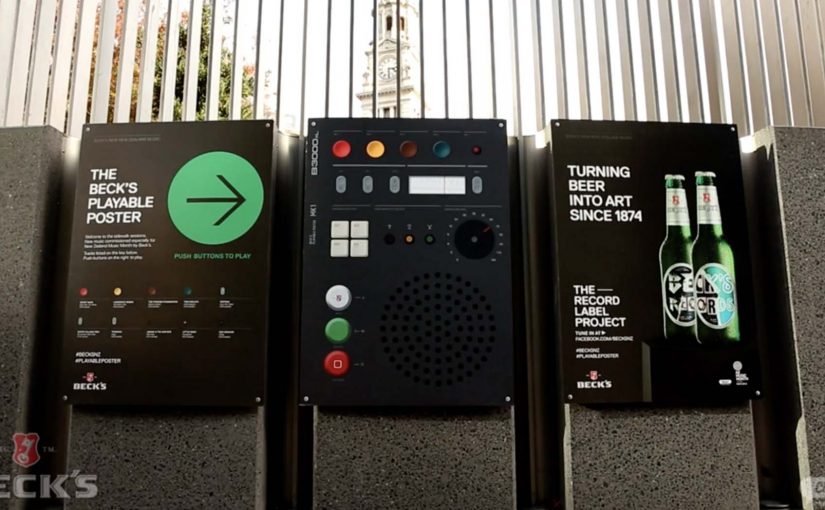
Looking for an innovative way to mark New Zealand’s Music Month, Beck’s partnered with Shine to design a playable poster. Using conductive ink and speakers the posters were made playable with a simple tap of the finger.

The Sound of Taste

Herb and spice brand Schwartz is all about flavour. So to dramatise flavour which was invisible and silent, they got print tech collective Novalia and ad agency Grey London to collaborate on an interactive poster. The poster used conductive ink to turn the surface area of the paper into an interactive interface that also connected to the viewers smartphone to deliver a richer experience.

Change the tune

Agency Republic from UK created a poster with an embedded sensor which when knocked changed the song being played on the agencies shared sound system.

Why these work: the demo happens in your hands

Each example keeps the interaction legible. Tap to trigger sound. Touch to explore flavour as audio. Knock to skip a track. The poster does not ask people to learn a new behavior. It hijacks an existing one, touching a surface, and rewards it instantly.

Extractable takeaway: When you want print to feel alive, make one obvious gesture trigger one immediate reward, and let the brand message ride on that moment of viewer control.

The real question is whether the interaction earns enough memorability to justify the added production. If the payoff is not instant and on-message, do not build it. Because the audience causes the outcome with a simple touch, the message sticks.

Practical patterns for interactive print

  • One interaction, one reward. Do not overload the surface with too many modes.
  • Make the “how” obvious. A tap zone, a knock cue, a simple instruction. Then deliver instantly.
  • Use phones as infrastructure. If pairing adds depth, let the phone do what paper cannot, audio, saving, sharing.
  • Design for public confidence. People will only touch a poster if it feels safe, clean, and socially acceptable.

A few fast answers before you act

What is “conductive ink” doing in these posters?

It creates touch-sensitive paths on paper, so taps or touches can be detected and mapped to actions like playing audio.

Do these posters need special printing like QR codes?

They still require specialist production, but the interaction can be integrated invisibly into the design. The poster itself becomes the control surface rather than carrying visible codes.

Why add Bluetooth to print?

Bluetooth allows paper to trigger sound through a phone or external speaker, which is essential when the content is audio or when you want richer layers than print can carry.

What makes an interactive poster feel “worth it” to a passer-by?

Immediate payoff and low friction. If the result is instant and satisfying, people will try it. If setup or pairing is slow, they walk past.

Where does this format fit best?

In environments where people have dwell time and curiosity, festivals, transit hubs, retail windows, office interiors, and brand experiences where interaction is socially normal.