
Volvo Concierge Services

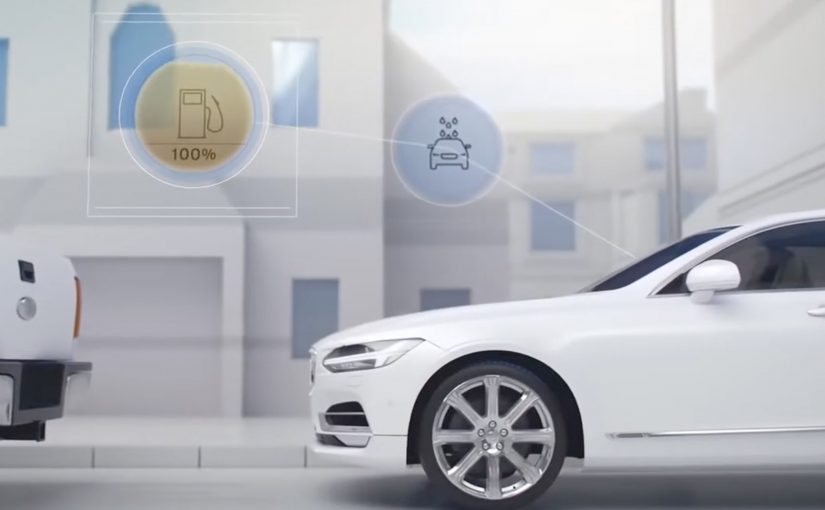
Volvo is actively experimenting with moving beyond simply building and selling cars. With Volvo Keyless Cars and Volvo In-Car Delivery, the direction is clear. Build a service layer around the vehicle. Volvo’s latest effort creates a concierge-style service ecosystem that gives customers access to third-party service providers who can remotely refuel the car, run a car wash, handle servicing, and more. Here, “concierge” means services happen while the car is parked, without the owner being present.

The heart of Volvo Concierge Services is the digital key. A one-time-use, location- and time-specific key that gives an approved service provider access to the vehicle. That matters because it keeps the car secure and removes the need for the owner to meet someone and physically hand over keys. Whether the supplier is a refuelling company, a valet parking attendant, or Volvo itself for maintenance, the provider uses an app to remotely unlock the car and allow the engine to turn on.

The Volvo Concierge Services are currently being tested in the San Francisco Bay Area with owners of the new Volvo XC90 SUVs and S90 sedans.

The digital key is the unlock. The services are the business model

This is not just about convenience. It is a structural shift. Once access becomes software, it can be controlled precisely. Who gets access. For how long. Where. For what purpose. Because access can be time-bound, location-bound, and single-use, you can reduce handover friction without opening the vehicle to broad, persistent access. That is the foundation you need to turn a connected car into a platform for partners and post-sale services.

In connected-car programs, the hardest step is making third-party access both permissioned and low-friction for owners.

The real question is whether you treat the digital key as a convenience feature, or as the control plane for a partner service layer.

Why “remote access without handover” changes behaviour

Traditional servicing and add-on services create friction. Scheduling. Meeting. Waiting. Key logistics. Concierge Services reduces that friction by making the car addressable when it is parked, and by making access safe enough to involve third parties.

Extractable takeaway: If you can grant narrowly scoped, auditable access without coordination, a parked asset becomes an addressable surface for services.

What to pressure-test before you scale a service ecosystem

  • Trust and governance. Who qualifies as an approved provider. What is logged. What can be revoked instantly.
  • Edge cases. What happens if something goes wrong mid-service. What support paths exist for customer and provider.
  • Consistency of experience. If third-party services vary in quality, the brand still owns the perception.
  • Security by design. One-time, time-bound, location-bound access is powerful. It has to be implemented rigorously.

A few fast answers before you act

What is Volvo Concierge Services?

A service ecosystem around Volvo cars that enables approved third-party providers to refuel, wash, service, and handle other tasks with controlled remote access to the vehicle.

What enables the service providers to access the car?

A one-time-use, location- and time-specific digital key that unlocks the vehicle through an app without physical key handover.

Where is it being tested?

The service is being tested in the San Francisco Bay Area, with owners of Volvo XC90 SUVs and S90 sedans.

What is the core strategic takeaway?

When access becomes software, the car can support a partner service layer that keeps creating value after purchase.

Volvo Keyless Cars

You land at Gothenburg airport, walk up to your car. There is no key handover. No kiosk. No awkward “where did I put it?”. You unlock the door with your phone, start the engine, and drive off. That is the behavioral shift Volvo is putting on the table as it pilots a Bluetooth-enabled digital key. The physical key stops being the default. The car starts behaving like a shareable service.

Volvo’s plan is straightforward and bold. Replace the physical car key with a mobile app that acts as a digital key. It locks and unlocks doors and trunk. It also allows the engine to be started. Volvo intends to roll this out to a limited number of commercially available cars in 2017, with real-world testing beginning in spring 2016 via Sunfleet at Gothenburg airport in Sweden. Physical keys remain available for people who want them.

What “keyless” really changes

Most coverage of keyless cars focuses on convenience. That is real, but it is not the headline. The headline is that the key becomes software, and software is shareable, revocable, time-bound, and measurable.

Once the key is an app, a car can be:

  • Shared without meeting up. You can grant access remotely, without physically transferring anything.
  • Granted for a window of time. A key can expire after a set period, or be limited to a specific day.
  • Revoked instantly. Access can be removed without changing locks or reissuing hardware.
  • Audited. Digital access can create a clean trail of who had access, when, and potentially under what conditions.

Those are not just UX improvements. They are the primitives of “car as a platform,” meaning a vehicle where access and entitlement are programmable.

The real question is whether turning the key into software makes sharing trustworthy and reversible, without adding friction in everyday edge cases.

In mobility services and car-sharing operations, making access software is the quiet foundation for scalable sharing, service models, and trust.

The strategic unlock for car sharing and new mobility behavior

Volvo is not positioning this as a novelty feature. The real-world test through Sunfleet is the tell. Keyless is a missing piece for car sharing because physical keys create friction at exactly the moment you need trust and speed.

Extractable takeaway: When an entitlement becomes software, the hard problem shifts from logistics to permissions, which is why sharing can scale without constant handoffs.

When access is digital:

  • You can share your own car more safely, because you do not need to hide a key or coordinate handoffs.
  • You can operate fleets with lower operational drag, because key logistics shrink.
  • You can start designing new use cases that are impractical when keys are physical.

This is where brand storytelling gets interesting. Volvo is not “marketing an app.” It is marketing an engineered shift in how the product behaves. The brand moves from sheet metal and safety features to a designed system of access, trust, and mobility.

What the digital key needs to get right

Moving the key to a phone is a promise. It must hold up in the messy reality of travel days, dead batteries, and edge cases.

A credible keyless experience typically needs clear answers to:

  • What happens if the phone battery dies? (Fallback options matter, including a physical key for those who want it.)
  • How does identity and authorization work? (Who can issue a key. Who can revoke it. What is the recovery path.)
  • How secure is the handoff? (Bluetooth is convenient. It also raises expectations around encryption, pairing, and spoofing resistance.)
  • How does it work for families and multi-driver households? (Multiple keys, multiple devices, and different permissions.)
  • How does it behave when connectivity is weak? (Airports and parking structures are not always friendly environments.)

None of these are reasons to avoid keyless. Keyless is worth doing, but only when fallbacks and recovery are designed as first-class features.

The marketing lesson hiding inside the engineering

This is a strong pattern in modern innovation storytelling. A brand earns attention when the innovation is tangible and legible. Not “we are digital.” Instead, “a thing you used to do physically becomes software, and your behavior changes.”

For Volvo, the narrative is easy to grasp:

  • The key becomes an app.
  • Access becomes shareable.
  • Mobility becomes more flexible.

That is the kind of product story that travels well. It is engineering that people can feel.

Steal the pattern: access becomes software

  • Reframe the benefit. Lead with “the key becomes software,” then show sharing, revocation, and time-bounding as the real unlock.
  • Design trust into the edge cases. Dead batteries, weak connectivity, and recovery paths decide whether the behavior shift sticks.
  • Make sharing operationally cheap. When keys stop being objects, handoffs and key logistics stop being the bottleneck.
  • Use auditability to increase confidence. If access is trackable, it can support clearer accountability and faster issue resolution.

A few fast answers before you act

What is a digital car key?

A digital car key is a phone-based key that can replace the physical key for core actions like locking, unlocking, and starting the car.

Why does keyless matter beyond convenience?

Because access becomes programmable. You can share it, time-limit it, revoke it, and potentially audit it. That changes how ownership and sharing can work.

What is Volvo actually proposing here?

A Bluetooth-enabled app that replaces the physical key, with a real-world test through Sunfleet at Gothenburg airport, and a limited rollout planned for 2017. Physical keys remain available.

What is the immediate business implication for mobility services?

Lower friction. Less operational overhead around key handling. More flexible sharing models for fleets and individuals.

What must be true for this to feel trustworthy?

Clear fallbacks and recovery paths, secure authorization and revocation, and a user experience that holds up in real-life edge cases like dead batteries and poor connectivity.

Volvo HoloLens Showroom: Virtual Dealership

The showroom no longer needs cars

Car dealerships traditionally depend on physical inventory.

Space, logistics, and availability limit what customers can see, touch, and configure. That constraint disappears when Volvo introduces a showroom experience powered by Microsoft HoloLens.

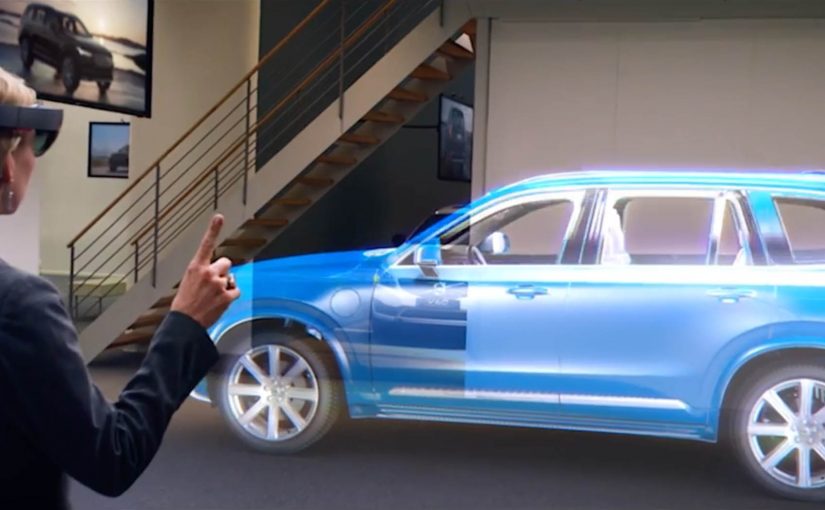
Instead of walking around parked cars, customers step into a virtual environment where full-size vehicles appear as holograms.

How the HoloLens showroom works

Using HoloLens, customers explore Volvo cars at real scale. This is mixed reality, digital objects anchored to the physical space around you.

They walk around the vehicle. Look inside. Inspect details. Colors, trims, and configurations change instantly. The experience feels physical, even though no car is present.

The showroom becomes software-driven. Inventory becomes optional.

In high-consideration retail, the job is helping people visualize options confidently before commitment, even when the product is not physically present.

Why this matters for automotive retail

This is not a gimmick. Virtual showrooms reduce the need for large floor space and allow dealerships to showcase the full portfolio, including models and options that are rarely stocked physically. Because customers can see the car at full scale and switch configurations instantly, they can compare options without relying on imagination, which makes commitment feel safer.

Extractable takeaway: If you can make options visible at real scale and changeable in seconds, you can sell preference, not availability, even when the product is not physically present.

For customers, the experience becomes calmer and more focused. There is less pressure. More exploration. Better understanding before committing.

Experience beats inventory

The deeper shift is about viewer control.

The real question is whether your showroom is designed for preference discovery or for stocking convenience.

Dealerships should treat mixed reality as a configuration layer that complements physical touchpoints, not as a tech demo.

Customers explore at their own pace. Sales staff guide rather than push. The conversation moves from availability to preference.

The dealership turns into a configuration studio, not a warehouse.

  • Make configuration the starting point. Let customers explore options first, then map the shortlist to what they can test and buy.
  • Keep staff in guide mode. Use people to frame trade-offs and confirm choices, not to gate access to information.
  • Design the experience like software. Treat the showroom as a repeatable configuration studio, not a one-off installation.

A few fast answers before you act

Is this replacing test drives?

No. A mixed reality showroom helps customers narrow configurations before a physical test drive.

What do customers actually do in the HoloLens showroom?

They walk around a life-size hologram, look inside, inspect details, and switch colors, trims, and configurations in real time.

What is the real business benefit?

Reduced reliance on physical inventory, clearer configuration conversations, and better use of showroom space.

Why does mixed reality fit automotive retail?

Cars are high-consideration purchases, so visualization can carry as much weight as specification.

What has to be true for this to feel real?

The hologram must stay aligned to the physical space, and configuration changes must respond instantly so customers trust what they are seeing.