
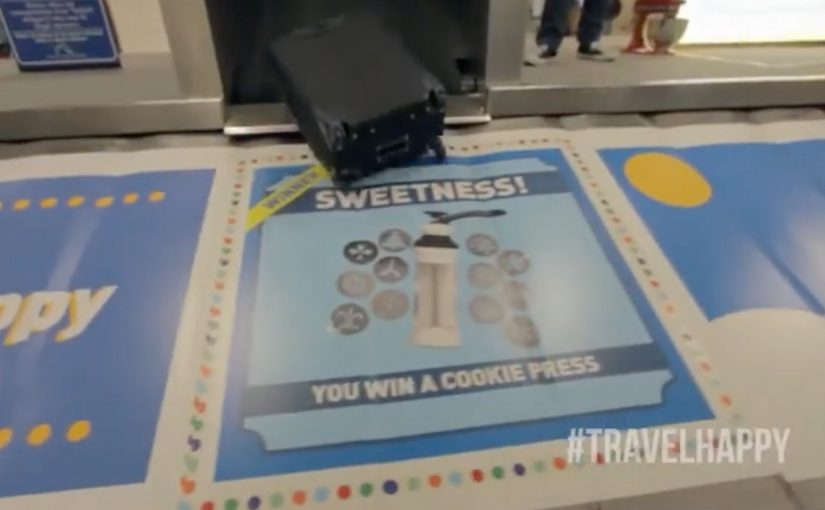
Thanksgiving Eve is one of the most stressful days to travel. So Zappos shows up in a place most people associate with impatience. The baggage claim carousel.
At Houston’s George Bush Intercontinental Airport, Zappos turns sections of a baggage carousel into a roulette-style game. Parts of the moving belt are marked with prizes and slogans. When your suitcase arrives and lands on a prize square, you win what it lands on. That can be a product prize or a gift card. Suddenly, the worst part of the journey becomes the most watchable part.
Why the idea works
The real question is how you turn captive waiting into a brand moment without adding any extra steps. The activation flips the emotional context. Baggage claim is pure friction. Zappos turns it into anticipation. Here, “activation” means a brand experience that reworks an existing touchpoint rather than creating a new destination. People are already looking at the carousel. They are already waiting. By making the outcome visible and immediate, the same waiting behavior becomes suspense. This is smart experience design because it changes the feeling of the wait without adding friction.
Extractable takeaway: When attention is guaranteed, you do not need more messaging. You need a simple mechanic that changes what the same behavior feels like.
The CX mechanics are simple by design
- No app. No instructions. You just wait as usual.
- Instant feedback. Your bag lands. You know if you win.
- Social energy. People around you start watching your outcome too, because it is a shared moment.
In enterprise retail and travel environments, the biggest CX wins often come from redesigning unavoidable waiting, not adding steps.
Design moves worth copying
- Pick a real pain point where attention is already guaranteed, then redesign the emotion of that moment.
- Make participation automatic. If people must opt in, you lose most of the crowd.
- Use a reward that is immediate and credible, so the surprise feels real, not promotional.
A few fast answers before you act
What is the Zappos Thanksgiving baggage claim activation?
A roulette-style baggage carousel game at an airport on Thanksgiving Eve where travelers win prizes based on where their luggage lands.
Why is baggage claim such a strong place for this?
It is a high-friction moment with captive attention. Everyone is already watching the belt and waiting.
What is the core experience design principle?
Reduce friction by changing the emotion of the same behaviour. Waiting stays the same, but it becomes suspense and delight instead of irritation.
How does it work without an app or instructions?
Participation is automatic. You wait for your bag as usual, and the belt markings tell you instantly whether you won.
What is the minimum you need to replicate the pattern?
A captive-wait moment, a visible game mechanic, instant feedback, and an immediate, credible reward.