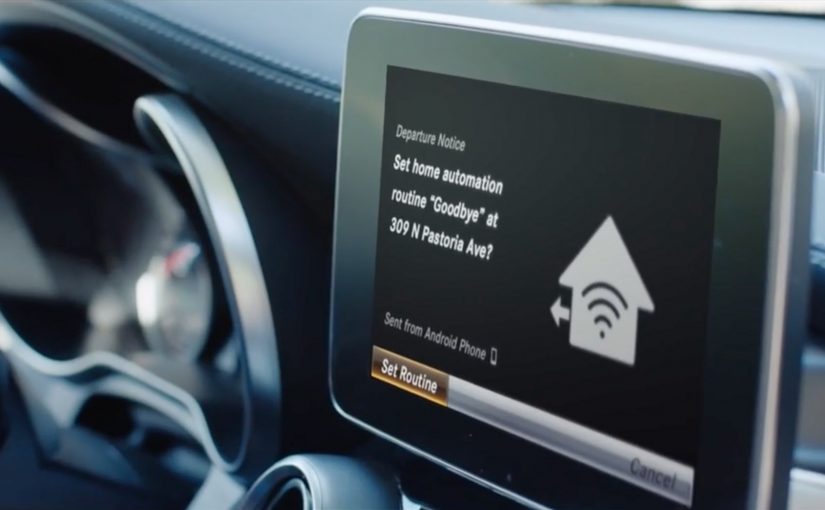
Mercedes-Benz announces that its 2016 and 2017 vehicles in the US can connect with Amazon Echo and Google Home. With that integration in place, owners can remotely start or lock their vehicle, and they can send an address from home straight into the car’s in-car navigation.
The real question is: how do we make connected features actually adopted and used repeatedly?
What makes this interesting is not the novelty of voice commands. It is the direction. The car starts behaving like a node in a wider home automation ecosystem, not a standalone product you only interact with once you sit behind the wheel. You speak to your assistant at home. The car responds. The boundary between “home experience” and “driving experience” gets thinner.
The ecosystem move, not a feature add-on
A single capability like “remote start” is useful. But the strategic move is building an intelligent ecosystem around the car, using third-party voice assistants people already trust and use daily. That lowers adoption friction and accelerates habit formation.
By “intelligent ecosystem”, I mean a set of authenticated, reliable, cross-device flows where a home assistant can trigger vehicle actions and pre-driving tasks via the car’s connected backend, not just a few isolated voice shortcuts.
Third-party assistant integrations should be treated as a habit and distribution layer for connected services, not as a feature checklist item.
In global automotive and mobility brands, the fastest adoption lever is piggybacking on the household’s existing voice-assistant routines, not inventing a new in-car habit.
This also shifts expectations. Once the car is connected into the household’s digital layer, people start wanting context-aware flows. Context-aware flows mean the action is triggered in the right moment in a larger routine, like “leaving home” or “planning a trip”, not as a standalone command. Because the assistant already sits inside daily routines, routing car actions through it reduces cognitive load and raises repetition. That is why this integration is more likely to stick than another “connected car” toggle buried in an app.
Why this actually gets used
Customers do not adopt “capabilities”. They adopt reliable routines. If the assistant is already the control surface for lights, heating, music, and reminders, adding the car becomes a low-effort extension of an established behavior. The psychological win is familiarity plus predictability. The product win is fewer new interaction patterns to teach.
Extractable takeaway: The adoption flywheel for connected products is not “more features”. It is “fewer new habits”. Attach your service to an existing routine and a trusted control surface, then make it work every single time.
Mercedes is not alone in spotting the pattern
Mercedes-Benz is not the first automaker to recognise the potential of third-party voice assistants. At CES earlier this year, Ford unveiled plans to roll out Alexa-equipped vehicles. Around the same time, Hyundai announced a partnership with Google to add voice control through Google Home.
The competitive question becomes simple. Who turns the car into a meaningful part of the customer’s everyday digital routines first, and who reduces the connected car to a checklist feature.
Steal this pattern for your roadmap
- Pick one routine (leaving home, arriving home, trip planning) and design an end-to-end flow around it.
- Design for trust by default: explicit permissioning, clear confirmation, and an audit trail for remote actions.
- Make reliability a feature: treat uptime, latency, and failure-handling as first-class product work.
- Start upstream: focus on “before you drive” moments like destination sending, pre-conditioning, and readiness checks.
- Measure repetition, not activation: weekly active use of the routine beats “connected feature enabled”.
- Keep the command surface consistent: do not fork the experience across assistant, app, and in-car UI without a clear ownership model.
- Ship the smallest lovable flow, then expand: one routine, one set of permissions, one predictable outcome.
A few fast answers before you act
What does Mercedes-Benz enable through Alexa and Google Home?
Mercedes-Benz enables owners to remotely start or lock the vehicle and to send an address from home directly into the car’s navigation.
Why is this bigger than “voice control in the car”?
It connects the car to an existing smart home ecosystem, which makes the vehicle addressable before you drive and pushes value into planning and daily routines.
What is the “intelligent car” in one sentence in this context?
In this context, an “intelligent car” is a connected vehicle that can be addressed from outside the cockpit as part of authenticated, cross-device routines.
What should product, CX, and marketing teams watch closely?
Teams should watch which routines become habitual, how permissions and confirmations are handled, and whether end-to-end reliability is strong enough for repeat use.
What should you measure to prove value beyond “connected” activation?
You should measure repeat usage of the routine, task completion success rate, latency, failure recovery, and downstream outcomes like reduced support contacts or higher service attach.
What is the strategic takeaway in one line?
The “intelligent car” story is increasingly an ecosystem story, meaning the battle is about where the car lives inside the customer’s broader digital routines.