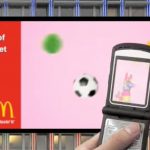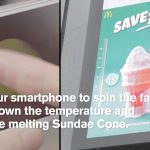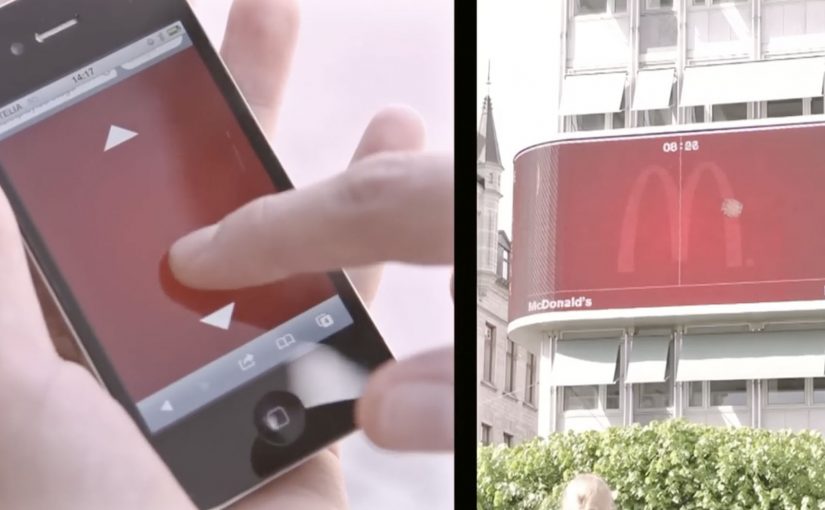
You are walking through central Stockholm and a McDonald’s billboard does something unusual. It invites you to play a quick Pong-style challenge on the screen, using your own phone as the controller.
DDB Stockholm has created another interactive outdoor campaign for McDonald’s Sweden called Pick N’ Play. Passers-by use their mobile phones as controllers to play for a chosen McDonald’s treat. If they last for more than 30 seconds, they score a coupon that earns them free fast food at a nearby McDonald’s.
Reportedly, the interaction avoids an app download and instead uses a simple mobile web flow, with proximity checks (via phone location) so only people physically near the screen can play.
Why this one pulls a crowd
The mechanic is instantly legible. Most people recognize Pong in a split second, which lowers hesitation and increases participation. The billboard also creates a public spectacle, which adds social proof and makes stopping feel normal, not awkward.
Extractable takeaway: This is rewarded interactivity, meaning the payoff is gated behind sustained attention instead of a tap. In outdoor, that simple “earn it” rule turns a public glance into a deliberate, measurable action.
What McDonald’s is really buying
The prize is not the point. The real value is a measurable bridge from street attention to store visit. A time-based win condition filters for people who are actually willing to pause, focus, and then act, which makes the coupon a higher-signal trigger than a generic discount blast.
The real question is whether your DOOH idea can turn a public moment into a private, trackable action without adding friction.
In global consumer brands and retail environments, interactive digital out-of-home earns its keep when it connects a public moment of attention to a private, trackable action on a personal device.
Steal these moves for your next DOOH game
- Use a mechanic people already know. Familiar rules beat clever rules in outdoor contexts.
- Make the phone the interface. It turns a billboard into a controllable experience and a trackable session.
- Reward endurance, not clicks. Time-in-game is a simple proxy for real attention.
- Close the loop fast. A coupon that can be redeemed nearby turns novelty into footfall.
Last year they had challenged pedestrians to take pictures of McDonald’s food to get it for free.
A few fast answers before you act
What makes an interactive billboard work in practice?
An interactive billboard works when the invite is understood in seconds and the first action feels effortless on a phone.
Do you need an app to control a billboard with a phone?
No. Campaigns like this are often built as mobile web experiences so participation is immediate and friction stays low.
How do you stop people from playing remotely?
By verifying proximity. A common approach is using phone location to confirm the player is physically near the screen before the session starts.
Why use a 30-second target?
It is long enough to prove engagement, short enough to feel achievable, and simple enough to explain with one line of copy.
What is the business upside versus a normal coupon?
You get a higher-intent audience. The coupon is earned through attention and action, which tends to correlate with stronger redemption and store visitation.