
McDonald’s: Pick N’ Play Billboard Game

McDonald’s: Pick N’ Play Billboard Game

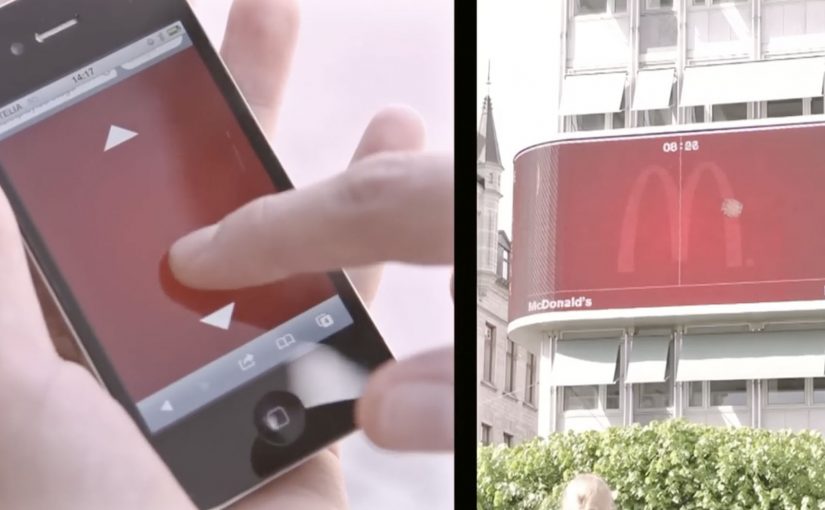
You are walking through central Stockholm and a McDonald’s billboard does something unusual. It invites you to play a quick Pong-style challenge on the screen, using your own phone as the controller.

DDB Stockholm has created another interactive outdoor campaign for McDonald’s Sweden called Pick N’ Play. Passers-by use their mobile phones as controllers to play for a chosen McDonald’s treat. If they last for more than 30 seconds, they score a coupon that earns them free fast food at a nearby McDonald’s.

Reportedly, the interaction avoids an app download and instead uses a simple mobile web flow, with proximity checks (via phone location) so only people physically near the screen can play.

Why this one pulls a crowd

The mechanic is instantly legible. Most people recognize Pong in a split second, which lowers hesitation and increases participation. The billboard also creates a public spectacle, which adds social proof and makes stopping feel normal, not awkward.

Extractable takeaway: This is rewarded interactivity, meaning the payoff is gated behind sustained attention instead of a tap. In outdoor, that simple “earn it” rule turns a public glance into a deliberate, measurable action.

What McDonald’s is really buying

The prize is not the point. The real value is a measurable bridge from street attention to store visit. A time-based win condition filters for people who are actually willing to pause, focus, and then act, which makes the coupon a higher-signal trigger than a generic discount blast.

The real question is whether your DOOH idea can turn a public moment into a private, trackable action without adding friction.

In global consumer brands and retail environments, interactive digital out-of-home earns its keep when it connects a public moment of attention to a private, trackable action on a personal device.

Steal these moves for your next DOOH game

  • Use a mechanic people already know. Familiar rules beat clever rules in outdoor contexts.
  • Make the phone the interface. It turns a billboard into a controllable experience and a trackable session.
  • Reward endurance, not clicks. Time-in-game is a simple proxy for real attention.
  • Close the loop fast. A coupon that can be redeemed nearby turns novelty into footfall.

Last year they had challenged pedestrians to take pictures of McDonald’s food to get it for free.


A few fast answers before you act

What makes an interactive billboard work in practice?

An interactive billboard works when the invite is understood in seconds and the first action feels effortless on a phone.

Do you need an app to control a billboard with a phone?

No. Campaigns like this are often built as mobile web experiences so participation is immediate and friction stays low.

How do you stop people from playing remotely?

By verifying proximity. A common approach is using phone location to confirm the player is physically near the screen before the session starts.

Why use a 30-second target?

It is long enough to prove engagement, short enough to feel achievable, and simple enough to explain with one line of copy.

What is the business upside versus a normal coupon?

You get a higher-intent audience. The coupon is earned through attention and action, which tends to correlate with stronger redemption and store visitation.
3D Holograms: Two Marketing-World Examples

3D Holograms: Two Marketing-World Examples

3D holograms are a great way to attract and engage consumers. Here, “3D holograms” refers to hologram-style displays that use animation to create a depth illusion in a physical setting. They can be quite effective if your brand is having trouble getting noticed or if your product’s capabilities can best be described using images and animation.

Though brands find it daunting to venture into this, there are still some brands out there bold enough to try it. Here are some nice examples.

Why holograms can cut through

The strength of a hologram-style display is that it behaves like moving product theater. Because it behaves like moving product theater, it can stop people mid-walk, and it can compress a lot of “show, do not tell” explanation into a few seconds. In retail aisles and brand events, it competes against the surrounding noise, not against other media placements.

Extractable takeaway: Use depth and motion only when they reduce explanation time or make the core action instantly legible. If depth is not doing work, you are paying for novelty.

The real question is whether motion plus depth makes the story easier to grasp than a flat screen or static print. When the answer is yes, the format can earn attention fast.

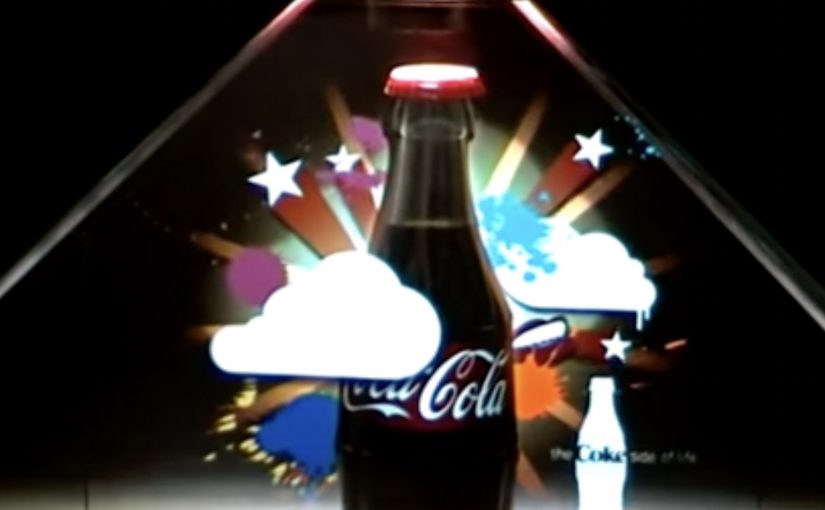
Coca Cola In-Store Display

This example shows how a hologram-style display can work as an in-store attention magnet. The content is pure visual storytelling, which makes it easy to understand at a glance and easy to remember later.

Samsung Jet Launch

At launches, holograms can do a different job. They help dramatize product capability and create a sense of spectacle that standard stage content often struggles to match. That spectacle then becomes a shareable proof that something “big” happened.

What to steal if you are considering holograms

  • Pick one message that benefits from depth. If depth is not doing work, you are paying for novelty.
  • Design for walk-by comprehension. People should get it in under three seconds.
  • Keep the loop tight. Short, repeatable sequences beat long narratives in retail and event contexts.
  • Make the hero action visible. If the product feature is the star, animate that feature, not abstract brand graphics.

A few fast answers before you act

When do 3D hologram displays make sense for marketing?

When you need fast attention in a physical space, or when animation plus perceived depth explains the product better than flat media.

What is the main advantage over a normal screen?

Presence. The illusion of depth makes the content feel more like an object in the space, which can increase stop power and recall.

What is the biggest execution risk?

Paying for the format without a story that needs it. If the creative is not designed around depth and motion, the result feels like expensive wallpaper.

How should success be measured?

Dwell time, footfall impact near the unit, assisted recall, and any downstream action that matters to your context, like store inquiry, trial, or social amplification.

What is a practical way to keep cost under control?

Start with one hero unit and a short content loop, then scale only if you can prove incremental attention and understanding versus simpler formats.