
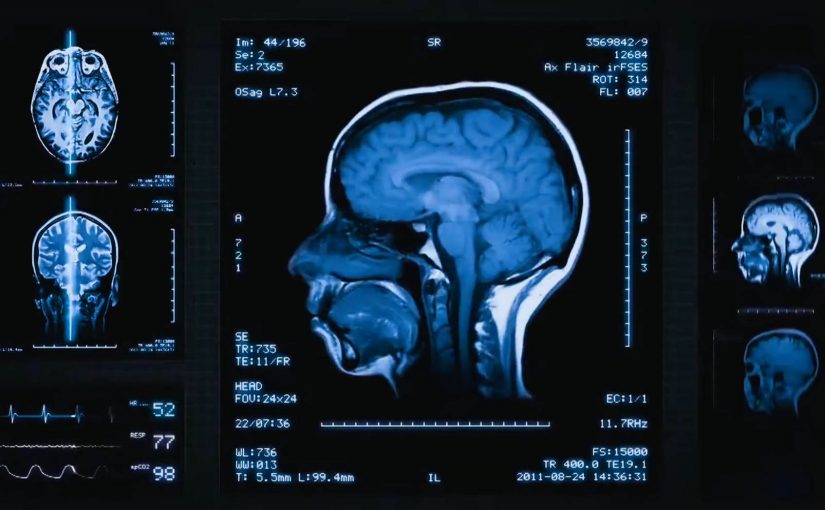
Durex UK: Dual Screen Ads

When the “real” ad plays on your second screen

People watch TV with a phone in hand. Durex UK used that habit to turn a standard broadcast spot into an interactive experience. Here, the “second screen” is the phone or tablet used alongside the main TV or computer screen.

Last year, Durex UK created a new way for viewers to interact with its TV ad. Viewers who used the Durex Explore mobile app while watching the ad on their TV or computer got a steamy alternative on their second screen.

How the dual-screen mechanic worked

The mechanism was straightforward. The broadcast spot acted as the trigger, and the Durex Explore app delivered an alternative experience on the viewer’s phone or tablet.

That split matters. The TV carried the mainstream version. The second screen carried the more private, more personal layer, where the viewer could engage without turning the living room into a shared moment.

In UK brand communications, second-screen behavior is already the norm.

The real question is whether you can separate a public broadcast layer from a private opt-in layer without breaking the story.

Why it lands in real viewing contexts

This works because it respects how people actually consume media.

Extractable takeaway: If your message has a public-safe version and a private version, keep the broadcast layer mainstream and let the personal device deliver the private layer only after an explicit opt-in.

Phones are personal. TV is social. By moving the steamy content to the second screen, Durex created a “permissioned” experience. By “permissioned,” I mean nothing intimate appears unless the viewer explicitly chooses it, on their own device. Because the broadcast spot only triggers the moment and the app carries the alternative layer, the viewer can opt in privately without turning a shared room into a shared moment.

It also rewards attention. Instead of asking viewers to tolerate an ad, it gives them a reason to participate.

The business intent behind extending TV and radio through an app

The intent is to convert passive reach into active engagement, while keeping the broadcast execution broadly acceptable. This is a smart pattern when you need mass reach but the payoff has to stay private.

Then, on Valentine’s Day this year, Durex UK repeated the same idea via radio. They released a steamy radio spot that also used the Durex Explore app to provide listeners with a similar steamy video experience on their smartphone or tablet.

That is the strategic move. One app. Multiple channels. A consistent interaction model that travels across TV, computer viewing, radio, and mobile.

Second-screen tactics you can reuse

  • Use the second screen for the private layer. Put the content that needs discretion on the personal device.
  • Make participation optional and clear. The viewer should feel in control of switching modes.
  • Design one mechanic that scales across channels. If the app is the interface, TV and radio can both become entry points.
  • Reward attention with a different experience. The second-screen payoff must feel meaningfully distinct from the broadcast spot.

A few fast answers before you act

What did Durex UK do with the Explore app?

They used it to deliver an alternative, steamy second-screen experience for viewers watching a TV ad, and later for listeners hearing a radio spot.

What is the core mechanism?

A broadcast ad acts as the trigger. The mobile app provides the alternative content on a phone or tablet.

Why is second screen a good fit for this category?

Because it keeps intimate content on a personal device, while the broadcast remains suitable for shared environments.

What business goal does this support?

Turning broadcast reach into measurable engagement and creating a repeatable interaction layer that works across channels.

What is the main takeaway for marketers?

If your message has a “public” and “private” version, broadcast the public layer and let the second screen deliver the private layer by choice.
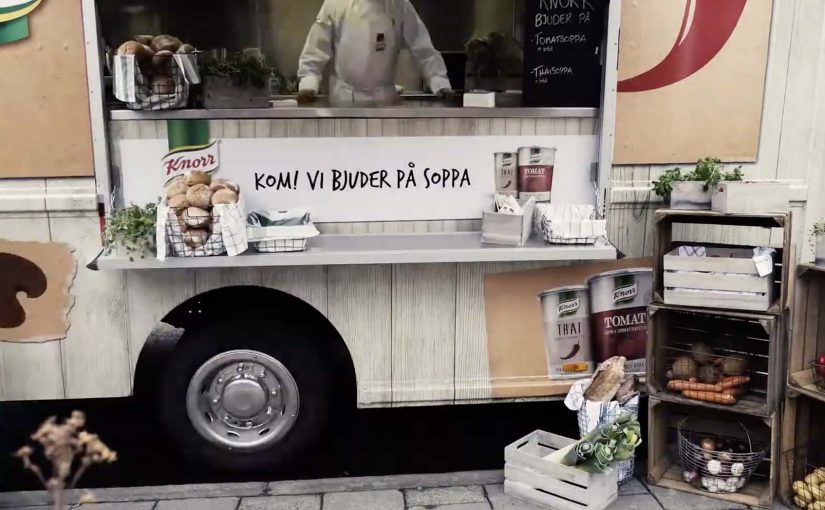
Knorr physical retargeting: iBeacon soup truck

In November, a Knorr food truck in chilly Stockholm offers free warm samples of the brand’s tomato and Thai soups. Visitors can eat it on the spot or take home the samples.

To ensure visitors can also be retargeted through relevant mobile ads, Knorr equips the truck and the sampling team with battery-powered iBeacons. Through these beacons, visitors who already have the Swedish newspaper Aftonbladet app installed are registered as having been there. Instead of pushing a coupon immediately, the campaign waits until the next time the user opens the Aftonbladet app, then serves the offer as a mobile ad on the start screen.

Physical retargeting is the practice of using a real-world visit as the trigger for a later digital message, so the follow-up feels connected to what the person actually did offline.

Why the timing choice matters more than the beacon

In FMCG sampling, delayed retargeting works best when the message arrives in a natural “open app” moment, not as an intrusive push at the street corner. The iBeacons are the plumbing, but the experience design is the restraint. The campaign avoids interrupting the sampling moment and instead chooses a later point of attention when the person is already browsing content. That shift makes the offer feel more like a relevant reminder than a forced conversion attempt. Brands should treat iBeacons as infrastructure and invest the real effort in timing and creative that respects the sampling moment.

Extractable takeaway: Treat the offline moment as the relationship builder, then use the next self-initiated “open app” moment as the conversion window.

What the campaign proves, beyond “we can target”

The real question is whether your follow-up arrives at a moment of attention the user has already chosen. Sampling often struggles with attribution. This approach creates a cleaner bridge between the street interaction and a measurable mobile impression, without requiring a QR scan or a form fill at the truck.

A repeatable offline-to-mobile loop

  • Separate experience from conversion. Let the street moment stay human, then follow up later in a calmer context.
  • Use a trigger the user already understands. “When I open the app, I see it” is easier than “enable Bluetooth, accept three prompts”.
  • Keep the reward aligned. A soup sample followed by a soup coupon is a coherent loop.
  • Design for opt-in environments. The cleanest versions of this pattern run inside existing app ecosystems where ads are already expected.

A few fast answers before you act

What is Knorr “physical retargeting” in this example?

It is an offline-to-online marketing loop where visiting the soup truck becomes the trigger for receiving a relevant offer later inside a mobile app.

Why not show the coupon immediately at the truck?

Because immediate prompting can feel invasive and can disrupt the sampling experience. Waiting until the next app open delivers the offer in a more natural attention moment.

What role does the Aftonbladet app play?

It is the environment where the follow-up ad appears. People who already have the app installed can be recognized as having visited and later see the offer when they reopen the app.

What is the core benefit for the brand?

It links a real-world sampling touchpoint to a measurable, relevant mobile follow-up, improving recall and making conversion more likely.

What is the biggest failure mode for this tactic?

If the follow-up arrives too late or feels unrelated, it reads as generic targeting. The timing and message match are what make it feel earned.

Novalia: Playable Album Cover DJ Deck

You pick up a record, touch the artwork, and the sleeve behaves like a DJ controller. Swipe to scratch. Tap to trigger effects. Use the crossfader. The physical album cover becomes an input device, not just a package.

That’s the latest project from Novalia, a Cambridge-based company that turns classic print into smart, touch-based surfaces using conductive ink and sensors, previously seen in work like The Sound of Taste.

How the album cover becomes a controller

For this release, Novalia works with DJ Qbert to create what is described as the world’s first interactive DJ decks on an album cover. The cover includes a printed mixer and deck layout. Touching the surface activates a companion setup with the Algoriddim djay app, allowing the user to scratch, mix, and fade any songs they already have loaded in the app directly from the paper surface.

Under the hood, the cover uses printed touch sensors. Those sensors translate finger position and gestures into control signals that the DJ app can interpret like a hardware controller.

In music and entertainment packaging, interactive print can turn a passive object into a playable interface, which makes “physical media” feel alive again. Here, interactive print means a printed surface with touch-sensitive inputs that control a connected digital experience.

Why this lands

This works because it collapses the gap between artwork and performance. The cover is not a souvenir. It is an instrument. That shift creates immediate curiosity and a strong demo moment, and it makes the format, vinyl and packaging, part of the innovation rather than a nostalgic constraint.

Extractable takeaway: If you want people to care about a physical format, give it a job. Turn the object into an interface that controls something digital, so “owning it” unlocks a behaviour, not just a collectible.

What the tech is really proving

Novalia is not just showing a clever one-off. It is demonstrating that printed surfaces can behave like UI. Buttons, sliders, decks, and triggers, without looking like electronics. The real question is how a printed object can stop being packaging and start behaving like an interface people want to use.

That opens the door for interactive posters, magazine inserts, packaging, and merchandise that can control sound, apps, or connected experiences while staying lightweight and familiar.

What to steal from interactive print packaging

  • Make the object the interface. The most memorable interaction is the one that defies expectations of the format.
  • Use a companion app people already accept. Pair print with a mainstream app so the learning curve stays low.
  • Design for demo. If it looks good on camera, your audience will do distribution for you.
  • Keep the interaction legible. Touch, swipe, fade, scratch. Actions should map to familiar behaviours.

A few fast answers before you act

What is a “playable” album cover?

It’s an album sleeve printed with touch sensors so the artwork functions like a controller. Your fingers become the input, and the connected app produces the sound.

What does Novalia contribute to this project?

Novalia provides the interactive print technology. Conductive ink touch sensors and the electronics layer that translates touches into control signals.

Do you control only the album’s music?

The setup is designed to control tracks loaded into the companion DJ app, so the interaction is not limited to the album content itself.

Why is this more compelling than a QR code to a playlist?

A QR code points somewhere else. This makes the physical object itself the experience, which increases replay value and perceived uniqueness.

Where does this pattern make sense outside music?

Anywhere the packaging or printed surface can become an input. Posters, product boxes, magazine inserts, event badges, and retail displays that trigger sound, data capture, or app control.