
Ford: Noise-Cancelling Kennel

Ford: Noise-Cancelling Kennel

A dog hears the first firework bang and starts to panic. The family tries the usual fixes. Closing curtains. Turning up the TV. Comforting words. But the noise still cuts through, and the stress spreads to everyone in the room.

Ford’s noise-cancelling kennel concept takes a different angle. It treats fireworks like an engineering problem. The prototype uses microphones to detect sudden loud sounds, then a built-in audio system plays opposing frequencies to reduce the noise inside the kennel. Sound-deadening materials, including high-density cork, add a physical layer of insulation on top of the active cancellation.

In consumer innovation storytelling, especially when the tech is hard to “see,” the fastest way to earn belief is to show it solving a small, relatable problem.

The real question is whether your R&D can earn belief by solving a tiny, emotional problem in the real world.

The idea is inspired by the Active Noise Control Ford introduced in the Edge SUV to make journeys quieter. Inside the Edge SUV cabin, microphones pick up unwanted noise and the audio system counteracts it with opposing sound waves. Here, the same principle is applied to a safe space for dogs during fireworks.

Why this lands with people who do not care about car tech

Because the benefit is immediate and emotional. Fireworks anxiety is common, and the problem shows up at home, not in a showroom. The kennel reframes Ford’s engineering as something that protects a family moment, not just something that improves a drive.

Extractable takeaway: When your technology is invisible, translate it into a felt reduction of a specific stressor. Reducing the sharp peaks of fireworks noise inside a safe space lowers the trigger that starts panic, so calm becomes observable in seconds.

What Ford is really building with “Interventions” thinking

This is a brand-positioning move disguised as a pet story. By “Interventions” thinking, Ford is repurposing a familiar experience into a purposeful disruption that makes the benefit felt immediately. It signals that automotive R&D can be repurposed into everyday life solutions, and it does it without a hard sell. The prototype is the proof-of-intent.

What to steal if you want to translate R&D into culture

  • Start with a problem people already feel. Fireworks fear is instantly understood without explanation.
  • Use a single, credible technology transfer. One tech. One benefit. No feature soup.
  • Make the benefit visible in seconds. Calm is the KPI here, not product specs.
  • Let the prototype be the story. A working concept creates more belief than a manifesto.

A few fast answers before you act

What is Ford’s noise-cancelling kennel concept?

It is a prototype dog kennel designed to reduce fireworks noise using active noise control and sound-insulating materials, giving anxious dogs a calmer space.

How does the noise cancellation work in simple terms?

Microphones detect the loud sound, then speakers play an opposing sound wave to reduce it. Physical insulation also helps block and absorb noise.

Is this a product you can buy?

It is presented as a concept/prototype rather than a retail product, used to demonstrate how existing Ford technology could be applied to everyday problems.

Why connect this to the Ford Edge SUV?

Because the kennel borrows the same Active Noise Control principle used to reduce unwanted noise in the vehicle cabin, then applies it to a different environment.

What is the main risk with “tech repurposed for good” ideas?

If the link between the original technology and the new use case feels flimsy, it reads as a gimmick. The transfer has to be technically believable and emotionally relevant.
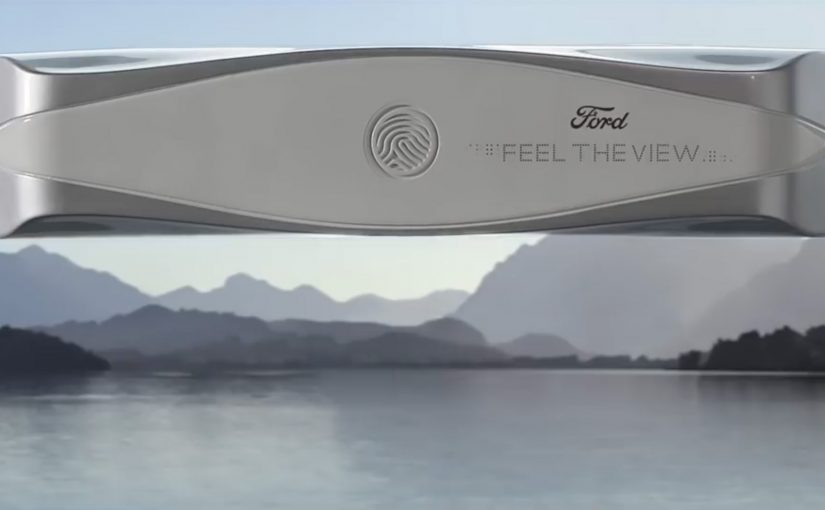
Feel the View

Feel the View

Ford in Italy, together with agency GTB Rome, teams up with Aedo, a local start-up that creates devices for people with visual impairments. Together they design a prototype device that attaches to a car window and decodes the landscape outside, allowing visually impaired passengers to experience it with the tip of their fingers.

The device transforms the flat surface of a car window into a tactile display. The prototype captures photos via an integrated camera and converts them into haptic sensory stimuli. Here, “haptic” means tactile patterns you can feel with your fingertips. The result is not primarily visual. It is perceptible through touch and hearing.

In automotive and mobility experience design, the real bar is whether the same journey can be translated across senses without creating a separate experience.

Why this matters as accessible experience design

This is an assistive interface built around a real, emotional moment. Looking out of a window during a drive. It treats “the view” as an experience that can be translated into other senses, rather than a privilege reserved for sighted passengers. Because the window is where attention naturally goes, using it as the tactile surface makes participation feel shared rather than segregated.

Extractable takeaway: If you want inclusive innovation to land, translate the same moment into multiple senses instead of designing a parallel version of the experience.

Inclusive innovation should be judged by whether it expands participation in the same moment, not by how novel the technology sounds.

The product idea in one line

Capture what is outside the car, then render it on the window surface as a tactile and audio layer that can be explored in real time.

The real question is whether your design lets people participate in the same moment as everyone else, without extra friction or stigma.

What to take from this if you build inclusive innovation

  • Start with a human moment. Here, it is shared travel and the desire to participate in what others are seeing.
  • Use the environment as the interface. The window is already where attention goes. It becomes the display.
  • Translate, do not replace. The concept does not mimic sight. It converts the same input into touch and sound.

A few fast answers before you act

What is “Feel the View”?

A Ford Italy concept with GTB Rome and Aedo that prototypes a car-window device converting outside landscapes into a tactile and audio experience for visually impaired passengers.

How does the prototype work at a high level?

An integrated camera captures what is outside, then the system transforms the input into haptic stimuli on the window surface, supported by audio cues.

What is the core design principle?

Make the experience accessible by translating the same real-world scene into senses the user can rely on, in the moment.

Is this a production product or a prototype concept?

It is described as a prototype concept rather than a production feature, so treat it as a design pattern more than a released product.

What can you apply even if you do not build haptics?

Start from a shared human moment, pick the surface where attention already goes, then translate the same scene into other senses instead of creating a parallel experience.

The Ford Vending Machine

The Ford Vending Machine

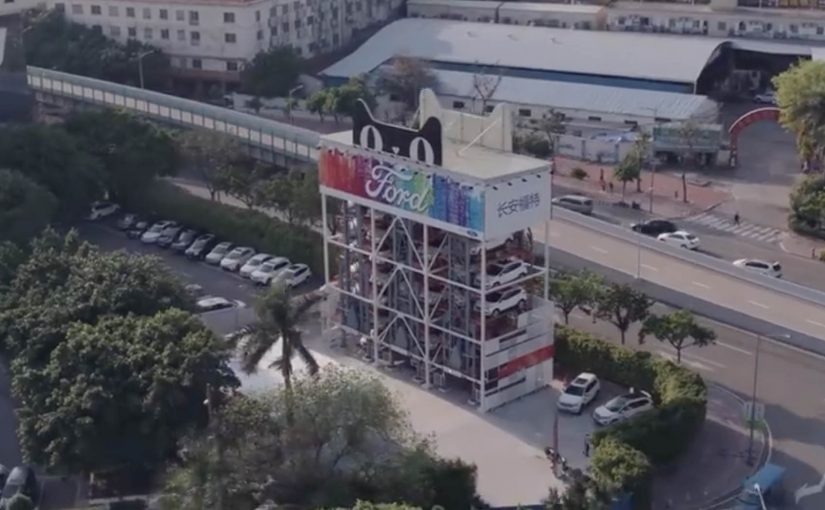
A glass “vending machine” in Guangzhou holds 42 cars. You choose a Ford model, pay a deposit in the Tmall app, schedule pickup, snap a selfie, and the machine recognises you when you arrive. Then it releases the car for a three-day test drive.

How the car vending machine flow works

Alibaba and Ford build this as a Super Test Drive Center. Think of it as a self-service test drive hub that compresses selection, deposit, scheduling, and pickup into one digital-to-physical flow. It turns the usual dealership steps into a clean sequence. Select the car model. Put down the deposit electronically via the Tmall app. Book a pickup slot. Use a selfie as identity confirmation at the moment of collection.

In high-density cities where e-commerce behaviours are habitual, self-serve pickup expectations spill into high-consideration products too.

The real question is how you remove dealership-shaped friction without removing trust.

Why this matters for test drives and conversion

The innovation is not the building. It is the removal of friction around intent. By compressing selection, deposit, scheduling, and identity confirmation into one predictable sequence, the concept reduces drop-off between “I want a test drive” and “I am in the car”. Here, “friction” is the waiting, paperwork back-and-forth, and sales pressure that makes people abandon the step entirely. This pattern is worth copying when your goal is more completed test drives, not more showroom theatre.

Extractable takeaway: If you can make “try before you buy” feel as immediate as e-commerce while keeping identity confirmation lightweight, you increase the odds that intent turns into action.

What the selfie step signals

The selfie is a simple trust layer. It connects the digital reservation to the physical handover. It also reinforces the theatre of the experience. You do not just pick up a car. You unlock it.

Stealable moves from this flow

  • Turn the test drive into checkout: Make selection, deposit, and scheduling a single, self-serve sequence.
  • Remove sales pressure by default: Let customers start with intent and time-on-product, not negotiation.
  • Use lightweight identity at pickup: Tie the digital reservation to the physical handover without adding paperwork loops.
  • Design for story, not just logistics: The unlock moment makes the handover feel earned and shareable.

A few fast answers before you act

What is a car vending machine?

It is a vertical, automated car storage and handover system that lets customers reserve and collect a vehicle via a digital flow, instead of a traditional showroom process.

How does the three-day test drive booking work in this concept?

You select a model, place a deposit electronically in the Tmall app, schedule a pickup time, and then collect the car for a three-day test drive at the vending machine site.

Why use a selfie for pickup?

It provides a lightweight identity confirmation step that ties the digital booking to the physical release, without adding visible friction for the customer.

What should brands measure if they copy this pattern?

Test-drive completion rate, conversion rate after the test period, time from reservation to pickup, repeat bookings, and the share of customers who choose this flow over a dealership visit.