
CNN International: Go Beyond Borders

CNN International: Go Beyond Borders

A brand message written into a city’s geography

The strongest initiatives do not ask people to remember. They make history physically reappear in the places where it happened.

The Go Beyond Borders Project was an initiative of Heimat Berlin and CNN International, in conjunction with Berlin tape artist El Bocho, created around the 20th anniversary of the fall of the Berlin Wall.

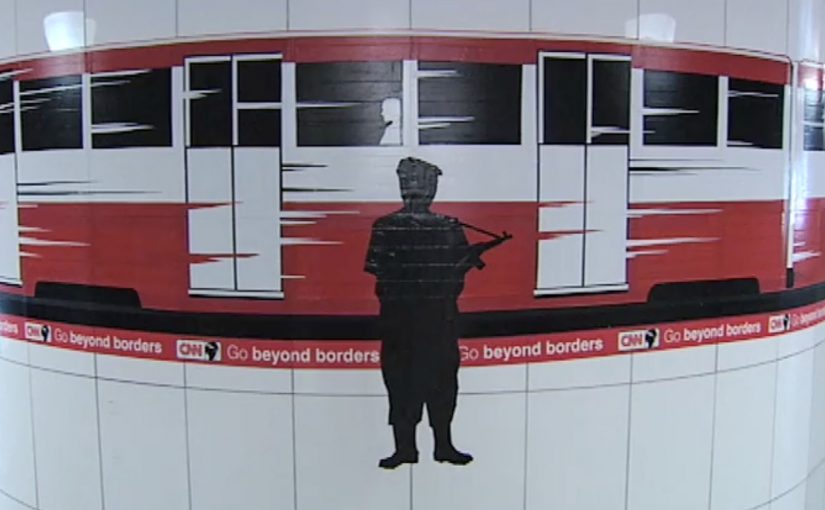
40 km of Go Beyond Borders tape was produced to mark the original position of the Berlin Wall, and eight street art installations told heroic stories of those who conquered the divide between East and West Berlin.

How the project worked as a city-scale marker

The mechanism combined two layers. A city-scale marker is a simple physical rule repeated along a route so the city itself becomes the medium.

First, the tape traced the former Wall line, turning an invisible historical boundary into a visible path you could follow. Second, the street art installations anchored that path with human stories, making the line about people, not only geography.

Because the tape turned an invisible boundary into a route you could walk, it made the former Wall line feel present in everyday movement.

It was simple enough to understand instantly, but large enough to feel unavoidable once you encountered it.

In European cities where collective memory is written into streets and transit, a walkable marker can carry meaning faster than a ceremony can.

The real question is whether your message can be experienced as a physical rule, not merely read as copy.

If the story is spatial, you should build the physical marker first and let media coverage follow.

Why it landed harder than a conventional commemoration

Most anniversaries stay inside ceremonies, speeches, and media coverage. This one put the memory back into the street. The tape created a direct, physical confrontation with “where the divide was.” The art installations made the meaning legible by focusing on courage and crossing, not abstraction.

Extractable takeaway: When meaning depends on place, turn the place into the medium with one walkable marker, then add human stories so the marker carries emotion, not just coordinates.

That shift matters because it turns history into presence, and presence into conversation.

The intent behind “Go Beyond Borders”

The action also marked the launch of CNN’s new international slogan: Go Beyond Borders.

The business intent was to associate the brand with perspective, movement, and crossing divides, using a real-world symbol that already carries emotional weight. Rather than declaring what the slogan means, the initiative demonstrated it through a place-based experience people could encounter and share.

What Go Beyond Borders teaches about place-based branding

A place-based brand initiative uses a physical location or route as the primary medium for the message, not only media.

  • Make the invisible visible. If the story is spatial, mark it in the real world so people can physically encounter it.
  • Pair scale with human narrative. A city-scale gesture earns attention. Stories earn meaning.
  • Use a simple rule. One clear device. Here, tape tracing the line. Makes participation and comprehension effortless.
  • Let the message be demonstrated. If your slogan is about crossing boundaries, show a boundary and what it took to cross it.

A few fast answers before you act

What was the Go Beyond Borders Project?

An initiative by Heimat Berlin and CNN International with artist El Bocho that used tape and street art to mark the former Berlin Wall line and tell stories of crossing East and West Berlin.

What was the core mechanism?

40 km of tape traced the Wall’s original position, while eight street art installations provided narrative anchors and human context.

Why did the tape approach work so well?

Because it turned an abstract memory into a physical, walkable marker that people could encounter in everyday life.

What business goal did this support?

Launching and giving meaning to CNN’s “Go Beyond Borders” slogan by demonstrating it through a culturally significant, real-world experience.

What is the main takeaway?

If you want a message to stick, embed it in a place people can experience, then reinforce it with stories that explain why it matters.
LavOnline: Tomato Splat

LavOnline: Tomato Splat

A direct mail piece that dares you to make a mess

In Italy, awareness and penetration of online laundry services is described as low. LavOnline asked DDB Milan to build awareness and engagement by stressing two core benefits. Speed and simplicity.

The target was narrowed to young managers and professionals. People who work long hours and struggle to find an open shop after leaving the office. The solution was a playful direct mail pack sent to 1,000 time-strapped recipients that turns “laundry” into an action you can do in seconds.

The mechanic: splat a tomato, watch it spring back

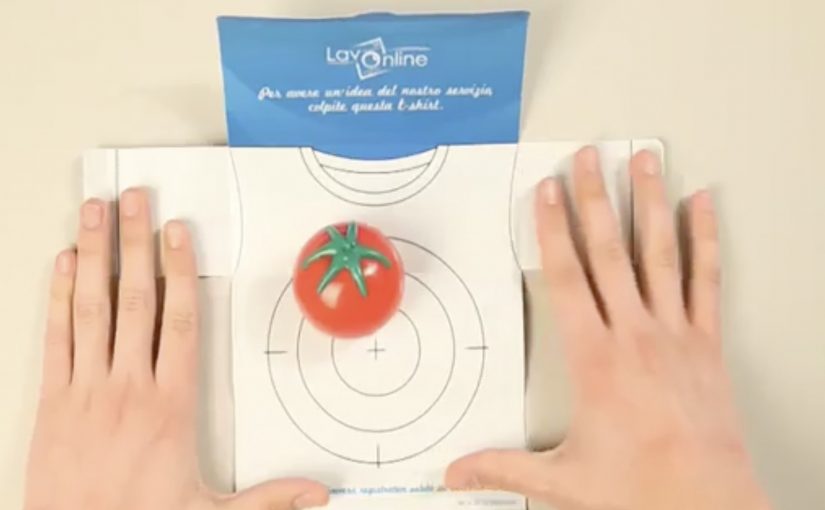
The mailer opens into a white t-shirt shape with a target at the center. Inside is a squishy tomato toy that recipients are encouraged to splat. The toy “splat” moment creates a satisfying mess, then reforms back into a neat tomato, mirroring the promise of a fast, simple service that handles stains without fuss.

Recipients are then pushed to act. If they enjoyed the experience, they are prompted to register on www.lavonline.it, try the service, and tell friends.

In consumer services marketing, interactive direct mail can outperform broad awareness when the physical action demonstrates the product promise faster than a paragraph of copy can.

Why it lands

The idea is built around a smart contradiction. To sell “no hassle laundry,” you briefly invite the audience to create hassle on purpose. That tension makes the piece memorable, and the reset behavior turns the metaphor into proof. It is also office-friendly. It sits on a desk, attracts curiosity, and naturally recruits secondary viewers who want to try the splat for themselves.

Extractable takeaway: If your promise is “simple and fast,” build a physical interaction that creates a tiny problem, then resolves it instantly. The resolution is the message people remember.

What the numbers are trying to prove

Results are reported as unusually strong for a targeted mailer. Within four weeks, 32% of recipients registered, 8% tried the service, and overall site traffic increased by 15%. The bigger point is not the percentages. It is that a single tactile mechanic turned a low-awareness category into a story people wanted to repeat. The real question is how to make an invisible service feel tangible before asking for sign-up. This is a stronger awareness play than a conventional mailer because the interaction makes the service promise feel real.

What to borrow from Tomato Splat

  • Make the benefit physical. Do not describe speed and simplicity. Demonstrate them with an action that resolves fast.
  • Target by daily friction. “No time after work” is a sharper trigger than broad demographics.
  • Design for desk spread. If the object invites a second person to try it, your reach multiplies inside the office.
  • Keep the CTA immediate. One link, one next step, no extra explanation required.

A few fast answers before you act

What is LavOnline’s “Tomato Splat” campaign?

It is an interactive direct mail activation where a mailed pack invites recipients to “splat” a tomato toy on a t-shirt target, then uses that quick reset metaphor to promote a fast, simple online laundry service.

Why use a physical mailer for an online service?

Because the physical interaction creates attention and memory in a category people ignore, then funnels that attention to a single online registration step.

What is the core creative mechanic in one line?

Create a small mess, then instantly restore order. A tactile metaphor for stain removal and convenience.

Why does this work for busy professionals?

The interaction is fast, playful, and office-compatible, and it speaks directly to the “no time after work” friction that blocks traditional laundry trips.

What is the main transferable principle?

When your value proposition is experiential, make the audience perform a micro-version of the experience, then connect it to a frictionless next step.

McDonald’s: Adult Playland in Sydney

McDonald’s: Adult Playland in Sydney

A Playland built for adults, not kids

In order to awaken the inner child in McDonald’s adult consumers, McDonald’s and DDB Sydney built an adult sized Playland in the middle of Sydney.

Supersizing the familiar to make it feel new again

The mechanism is physical and immediate. Take an icon people associate with childhood, then rebuild it at adult scale and put it directly in the path of commuters. It is not a message about fun. It is fun, placed in public, with no explanation required.

In Australian CBD (central business district) commuter culture, a surprising public installation can interrupt routine and create instant permission to behave differently for a moment.

The real question is whether you can give adults permission to participate without making them feel childish.

Why it lands: it removes the awkwardness of “acting like a kid”

Adults do not need to be convinced that play is enjoyable. They need permission. By making the Playland explicitly adult-sized and placing it in the city centre, the brand turns nostalgia into a socially acceptable break from routine.

Extractable takeaway: When adults hesitate, design the environment so participation feels socially legitimate, not self-conscious.

The business intent: rebuild emotional closeness through participation

This is a reconnection play, meaning it is designed to rebuild emotional closeness through participation rather than persuasion. This is the better move than a nostalgia message when you need adults to act in public. Instead of asking adults to remember McDonald’s, it gives them a shared experience they can literally step into, then ties that memory back to the brand.

Since the time of the launch in March, McDonald’s reported that more than 300 people have taken advantage of this playground on a daily basis and engaged with McDonald’s in a way they had not for years.

Design moves that get adults to play in public

  • Use a recognisable icon. Familiarity lowers the barrier to participation.
  • Change scale to change behaviour. Adult-sizing makes the experience feel legitimate, not childish.
  • Place it where routine is strongest. The contrast is what creates attention and talk value.
  • Make the experience the proof. Participation creates memory faster than any claim can.

A few fast answers before you act

What did McDonald’s build here?

An adult-sized Playland installation in central Sydney, designed to let adults play in a familiar McDonald’s-style playground environment.

What is the core mechanism?

Rebuild a childhood icon at adult scale and place it directly in the path of commuters. The experience is the message, with no explanation required.

Why does it work psychologically?

Adults do not need to be convinced that play is fun. They need permission. Adult-sizing plus public placement makes participation socially acceptable.

What business intent does it serve?

Rebuild emotional closeness through participation. A shared, physical experience creates memory and talk value that a standard campaign claim cannot.

What is the most transferable takeaway?

If you want real engagement, put a recognisable, low-friction action in a high-routine place, and let participation do the persuasion.