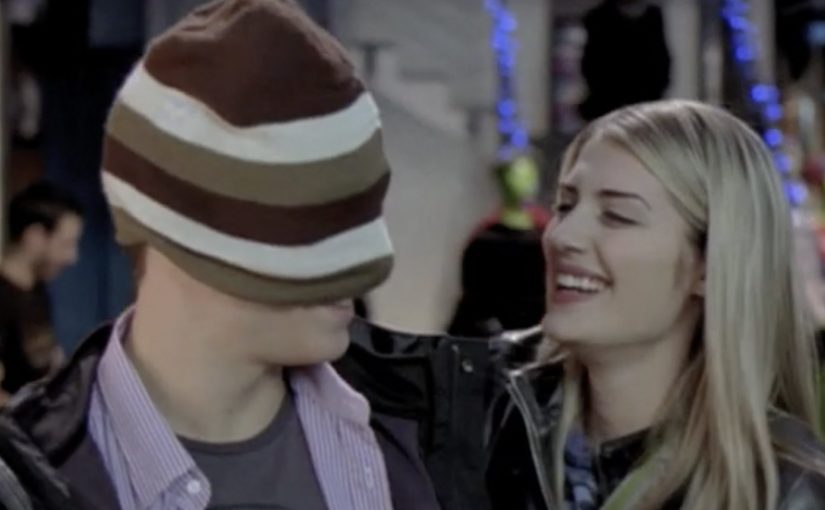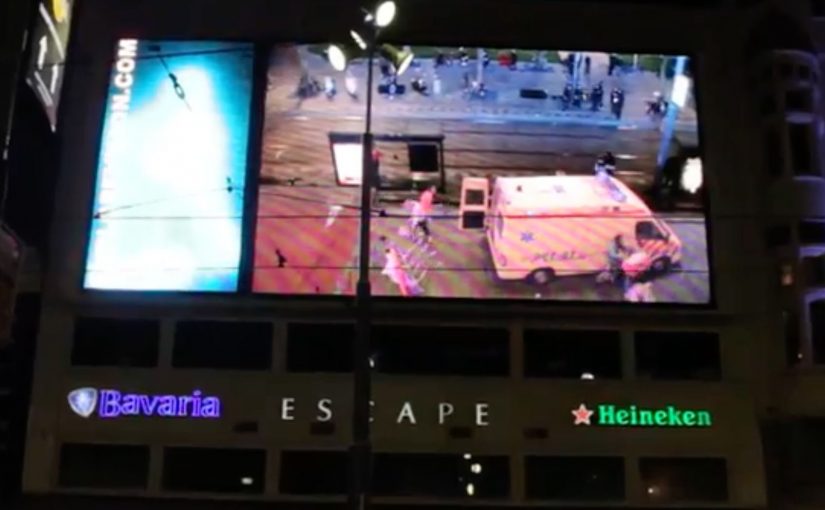
You walk past a giant outdoor screen in Amsterdam or Rotterdam and suddenly find yourself inside a street-violence scenario. Public service employees in the Netherlands face aggression and violence on the streets more and more often. Onlookers unfortunately do not intervene often enough when they encounter a situation like this. A live interactive billboard places people in a similar situation and confronts them with their inactivity.
Here, “live interactive” means recorded confrontation scenes are blended with a real-time street feed so passers-by appear inside the event.
What the billboard is designed to trigger
This is not entertainment. It is a public-awareness intervention. It puts the bystander role on display and forces a moment of self-recognition. If you do nothing, you see yourself doing nothing. The campaign intent is to turn passive awareness into a stronger sense of responsibility when aggression happens in public.
How the “live” effect is created
The experience blends previously recorded footage with a live street feed, so passers-by feel like the scenario is happening in their space, with their presence in the frame.
Why this works as a behaviour nudge
Because the live blend moves people from observer to participant, it turns an abstract social issue into a personal moment, and that is why the message sticks. In public-sector behaviour-change work, the hard part is not awareness alone but making bystanders feel immediate personal responsibility before the moment passes.
Extractable takeaway: When a campaign can place people inside the consequence of their inaction, reflection becomes harder to avoid and the desired behaviour feels more immediate.
The real question is how to make passive witnesses feel accountable before the moment passes.
For serious behaviour-change topics, participation works better than passive messaging when the mechanic stays clear and the context feels real.
What behaviour-change teams can borrow
- Put the audience inside the situation. When people recognise themselves in the moment, the message stops being abstract.
- Use context as the trigger. A street setting and a live feed make the behaviour question feel immediate, not theoretical.
- Design for self-recognition, not spectacle. The point is reflection and responsibility, not entertainment value.
- Keep the mechanic explainable in one line. If the concept cannot be repeated quickly, it will not travel beyond the location.
A few fast answers before you act
What is this interactive billboard trying to change?
It targets bystander inaction. It makes people aware of how often they do not intervene when witnessing aggression and violence against public service employees.
Why use “live” interaction instead of a normal poster?
Because the live element increases personal relevance. When people recognise themselves in the situation, the message becomes harder to dismiss as “someone else’s problem”.
What is the core mechanic in one line?
A staged violence scenario is combined with a live feed so passers-by see themselves present in a situation that calls for action.
When is this approach appropriate for brands or public bodies?
When the goal is behaviour change, not awareness alone, and when the topic is serious enough that participation creates reflection rather than trivialisation.
What has to be true for this format to work?
The blend between staged footage and live context has to be instantly legible. If people cannot understand the setup quickly, the reflection moment is lost.