Flyvertising!!!

Trust the Germans to come up with some real new age ideas…Jung von Matt an advertising agency from Germany just re-defined advertising for their client Eichborn. 😎

At the recent Frankfurt book convention they attached banners to 200 flies and set them loose to do their jobs as miniature sky ads around the convention center. Thus inventing Flyvertising or as they would call it in German…Fliegenbanner. 😆

The weight of the banner itself, attached with a string and some sticky stuff that allowed it to eventually fall off without harming the fly, was so that the fly could fly with it, but not very high and they kept landing on visitors.

Road Safety: The Bleeding Billboard

A roadside warning that reacts to rain

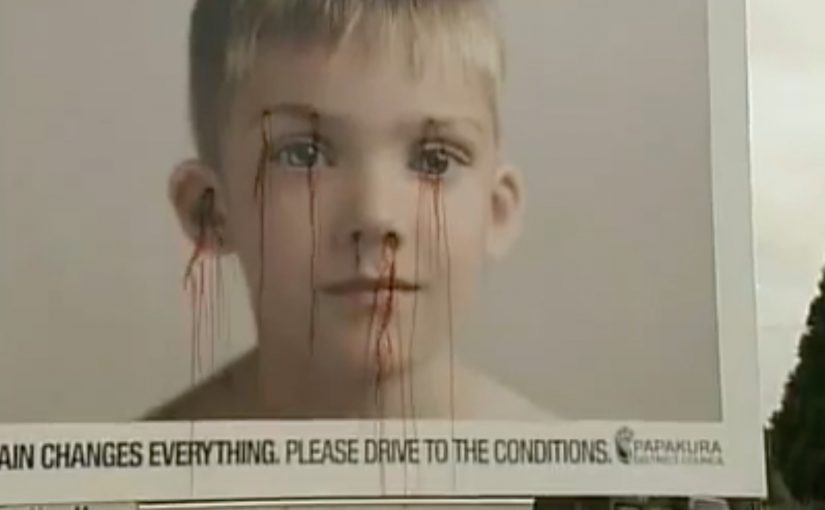
An impressive device was concocted by Colenso BBDO to demonstrate to drivers that vigilance is needed when it rains. The special billboards were installed on the roadsides in Papakura District, New Zealand.

When it began to rain these billboards started bleeding profusely.

How the device works as a message, not just a stunt

The mechanism is environmental trigger plus instant consequence. Rain does not just “set the scene”. It activates the medium, turning weather into the switch that makes the warning unavoidable.

In public-safety communication, linking a message to the exact moment of risk can outperform awareness-style reminders, because it removes the gap between knowing and doing.

Why it lands: it makes the danger feel present

The effect is deliberately uncomfortable. Blood signals harm, urgency, and the possibility of impact. It forces a driver to confront “what could happen” precisely when conditions are deteriorating.

A fairly violent but successful approach to drive home the message. “Rain changes everything. Adjust speed to conditions on the road”.

The business intent: behaviour change at the point of decision

This is less about recall and more about compliance. The goal is to interrupt automatic driving habits and create a micro-moment of self-correction: slow down because the road has changed.

What to steal for safety, infrastructure, and behaviour-change briefs

  • Trigger the message when the risk is real. Tie the communication to a condition the audience can see and feel.
  • Make the medium part of the proof. The environment becomes the “reason” the message is credible.
  • Choose a signal that reads instantly. Drivers have seconds, so the cue must be immediate and universal.
  • Design for instinct, not analysis. Behaviour change often happens through emotion and interruption, not persuasion.

A few fast answers before you act

What is the “bleeding billboard” campaign?

It is a road-safety outdoor installation where special billboards appear to bleed when it rains, warning drivers to adjust speed to conditions.

What is the core mechanism?

An environmental trigger plus instant consequence. Rain activates the medium, turning the weather into the switch that makes the warning unavoidable.

Why is the timing of the message so important here?

Because it collapses the distance between “knowing” and “doing”. The warning appears precisely when risk increases, at the point of decision.

Why use an uncomfortable visual like blood?

It reads instantly and signals harm without explanation. Drivers have seconds, so the cue must be immediate and universal.

What is the most transferable takeaway?

If you can trigger a behaviour-change message when the risk is real, the environment itself becomes the proof, and compliance becomes more likely than with generic reminders.

Vodafone NZ: 1000 phones, 53 ringtones, 1 song

When “viral” requires real engineering

To create a viral video these days, you need to do something great and unique. Vodafone NZ hired a production team to orchestrate cellphones into “playing” Tchaikovsky’s 1812 Overture.

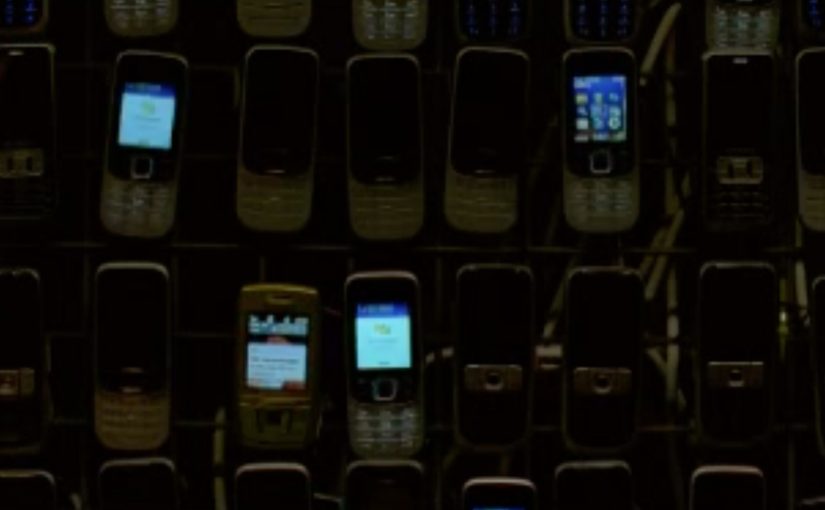
This was done using 1000 phones and 53 different ringtone alerts, synchronized to recreate the classical piece.

How 1000 phones became an orchestra

The mechanism was constraint-driven composition.

Instead of instruments, the “sound palette” was a fixed set of ringtone alerts. The team then arranged phones like sections in an orchestra and synchronized their playback so the combined output recreated the music.

What makes this work on camera is that you can see the system. Rows of devices. Repetition at scale. A human-built machine producing a familiar piece.

In global telecom marketing, the most shareable films often work because the effort is visible. Vodafone NZ’s Symphonia-style execution is a clean example of spectacle built from real craft.

Why the idea lands with viewers

It lands because it is both absurd and precise.

Absurd in the best way. A classical overture performed by ringtone alerts should not work. Precision is what makes it impressive. The viewer can sense the complexity without needing to understand the full production process.

It also bridges cultures. Highbrow music meets everyday tech, creating an unexpected contrast that feels fresh instead of forced.

The business intent behind the ringtone orchestra

The intent was to associate Vodafone with coordination, scale, and modern connectivity, without having to say those words.

Thousands of connected devices acting as one is a visual metaphor for a telco’s promise, and the film makes that metaphor entertaining rather than technical.

What to steal for your next “impossible” content idea

  • Make effort visible. When the craft can be seen, viewers reward it with attention and sharing.
  • Use a constraint as the hook. “Only ringtones” creates a clear challenge people instantly understand.
  • Engineer a spectacle that reads in one frame. Scale should be obvious without explanation.
  • Let the metaphor do the branding. Show coordination and connectivity instead of claiming it.

If you like the resulting tune, you can download it to your computer, as well as the 53 ringtones used to create it, from www.vodafone.co.nz/symphonia.


A few fast answers before you act

What did Vodafone NZ create?

A film where 1000 mobile phones, using 53 different ringtone alerts, were synchronized to perform Tchaikovsky’s 1812 Overture.

What is the core mechanism?

Constraint-driven composition. A fixed set of ringtone sounds becomes the “instrument set”, and synchronization plus physical arrangement makes the system readable on camera.

Why does it work as shareable content?

The effort is visible. The scale reads instantly, and the contrast between classical music and ringtones creates a surprising but coherent hook.

What business goal does this support for a telco brand?

It turns “connectivity at scale” into a watchable metaphor. Many devices acting as one becomes an entertaining proof of coordination and network promise.

What is the most transferable takeaway?

If you can make the constraint and the craft legible in one frame, the build itself becomes the reason people share.