Kit Kat: Jesus Loves Kit Kat

Kit Kat: Jesus Loves Kit Kat

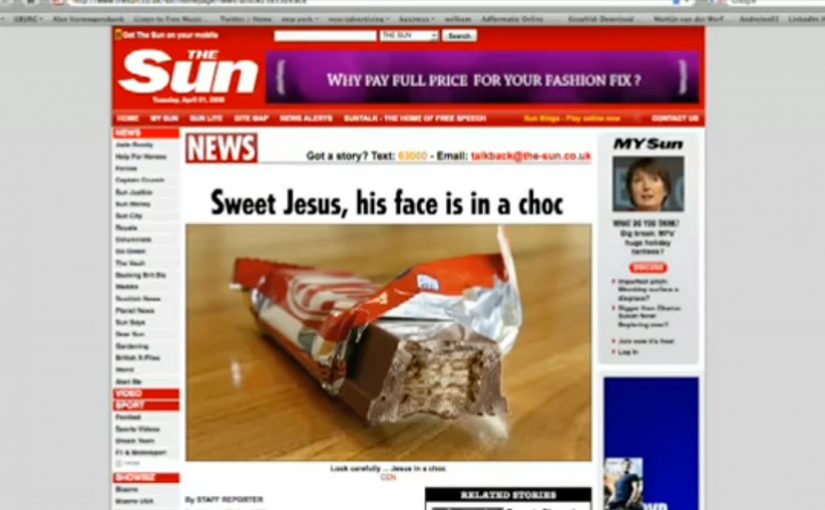
When a bite turns into a “sighting”

Every so often the internet latches onto a “miracle” story. This one starts with a simple, everyday moment. Someone takes a bite of a Kit Kat, and suddenly the bite pattern is framed as a face. Cue the inevitable question. Is it real, or is it just our brains doing what they always do with patterns?

Either way, the punchline lands immediately because the brand line is already waiting for it. Jesus loves Kit Kat. Have a break. Have a Kit Kat.

The stunt behind the headline

The mechanism is a simple one. Take a familiar cultural pattern. The “miraculous sighting” story. Then attach it to an everyday object and let curiosity do the distribution work.

In European FMCG marketing, low-budget PR seeding, meaning you plant the story with a few publishers to trigger pickup, can outperform paid media when the story is easy to retell and the brand cue, the unmistakable product signal inside the joke, is inescapable.

In this case, the campaign is described as being kick-started by sending a tip to major Dutch news sites about a “Jesus face” discovered in a bitten Kit Kat, complete with “proof” photos. Once the story lands, the audience spreads it for free, partly to react, partly to mock, and partly to forward the joke. That works because the audience is invited to judge the “realness” and repeat the brand line while they do it.

Why it lands: the audience writes the punchline

It works because the viewer instantly knows what to do with it. “Is it real” is the hook. “Obviously not” is the release. Then the slogan becomes the comment section fuel, because “Have a break” and “Give me a break” are ready-made responses that keep repeating the brand.

Extractable takeaway: If you use a familiar “sighting” format, design the sharing loop so people repeat the brand line as they debate whether it is “real”.

What the brand is really buying

The real question is whether the stunt forces a repeatable brand line, not whether anyone believes the “sighting”.

This is not persuasion. It is memory and talk value, meaning the worth of being talked about. The goal is to force a moment of attention in a low-involvement category, then lock the attention to a slogan people already know well enough to quote without effort.

Steal the “sighting” shape for earned reach

  • Use a story shape people already recognise. Familiar formats travel faster than “new idea” explanations.
  • Make the brand cue inseparable from the joke. If the gag works without the product, you are funding entertainment, not brand recall.
  • Design for repeatable phrasing. The best hooks come with a built-in line people will type in their own words.
  • Know the risk. Hoax-style PR, where you let people briefly wonder if it is real, can backfire if your category depends on trust, seriousness, or institutional credibility.

A few fast answers before you act

What is happening in “Jesus Loves Kit Kat”?

A playful “sighting” style story frames a bitten Kit Kat as if it reveals a face, and the curiosity and debate around it drives sharing.

What is the core mechanism?

PR seeding plus a familiar meme-like story format. People click to judge it, then share to react, mock, or pass along the joke.

Why does this kind of story travel fast?

Because it is easy to retell and invites opinion. The audience becomes the distributor by arguing about whether it is “real”.

What is the brand risk to watch?

Hoax-style hooks can backfire in categories where trust and seriousness matter. The technique needs category-fit and tone discipline.

What is the most transferable takeaway?

If you use a cultural format people already recognise, make sure the brand cue is inseparable from the punchline, otherwise the joke outlives the brand.
Pepsi Refresh: Monthly Grants for Ideas

Pepsi Refresh: Monthly Grants for Ideas

Pepsi wants to make the world a better place and so it has up to $1.3 million in Refresh grants to give out every month, ranging from $5,000 through to $250,000.

The social investment campaign can be seen online at www.refresheverything.com, and is being presented as Pepsi’s alternative to spending on television advertising at the Super Bowl this year.

From January 13, US residents can submit an idea online, choosing categories of health, arts and culture, food and shelter, the planet, neighborhoods, and education.

From February 1, 2010, visitors to the site will be able to vote on ideas, with the first 32 awards being announced on March 1.

The clever part is the trade

The headline here is not just the money. It is the positioning. The real question is whether you can trade a single paid burst for a repeatable participation loop without losing clarity or trust. Pepsi is framing this as an alternative to a single high-cost burst of attention, and shifting that investment into a participatory program where people submit, rally support, and vote.

Why this format can generate momentum

It works because the format creates a loop people can re-enter. Each month resets urgency, gives participants a clear job to do, and turns support-building into something visible.

Extractable takeaway: If you want participation to create reach, make recruiting support effortless and make the cycle easy to repeat.

  • A clear incentive. Monthly grants create repeated urgency, not a one-off moment.
  • Built-in categories. Health, arts, food and shelter, the planet, neighborhoods, and education make participation easy to understand.
  • Voting creates distribution. If your idea needs votes, you recruit your network. That recruitment becomes the media.

In large-scale brand purpose programs, participation grows when funding, voting, and sharing are designed as a repeatable cycle rather than a one-off moment.

What to watch if you run campaigns like this

  1. Transparency. People will want to understand how ideas are evaluated and funded.
  2. Participation fatigue. Monthly cycles help, but the experience has to stay simple to repeat.
  3. Proof of impact. The long-term credibility comes from showing what the funded ideas actually achieved.

What to steal from Pepsi Refresh

  • Make the trade explicit. Position the program as the alternative to a single high-cost attention burst.
  • Design for repeat participation. Use a simple monthly rhythm, clear categories, and a predictable submit-and-vote flow.
  • Let supporters do the distribution. Require votes so participants recruit their networks, and that recruitment becomes the media.

A few fast answers before you act

What is the Pepsi Refresh Project?

It is a social investment program where Pepsi offers monthly “Refresh grants” and invites people to submit community ideas and rally votes to get them funded.

How much funding is available?

Up to $1.3 million in grants per month, with awards ranging from $5,000 to $250,000.

When can people submit and vote?

From January 13, US residents can submit ideas. From February 1, 2010, visitors can vote, with the first 32 awards announced on March 1.

What categories can ideas be submitted under?

Health, arts and culture, food and shelter, the planet, neighborhoods, and education.

What is the strategic alternative being positioned here?

Pepsi is presenting the program as an alternative to spending on television advertising during the Super Bowl, shifting that spend into a participatory grant platform.

Starbucks love project

Starbucks love project

At exactly 8:30 a.m. ET on Monday, December 7th, Starbucks joined forces with (RED) and creative agency BBDO to coordinate a global sing-along. Musicians worldwide performed The Beatles classic “All You Need Is Love” at the same moment, positioning the Love Project as a proof point for how connected the world is and how a small decision by one person can make a grand difference elsewhere.

The performance was broadcast live via the internet from far reaches such as Gabon and Fiji, with participation spanning over 100 countries. The initiative raised money and reinforced awareness for Africa’s fight against AIDS, while giving people a clear way to take part in the solution.

The campaign. A global moment that lives online

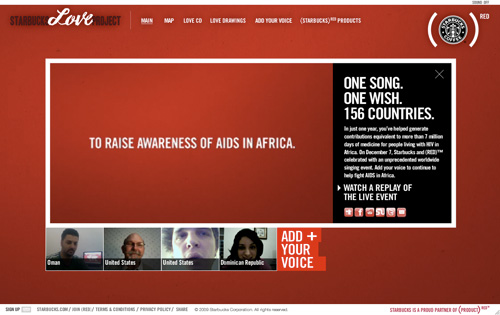
The performance was streamed live online at starbucksloveproject.com and acted as the anchor moment. Here, “anchor moment” means the single shared live event that gives the campaign a timestamp and a reason to gather.

Homepage of starbucksloveproject.com

After the live sing-along, people continued the campaign by going to the Starbucks website and uploading their own:

  • versions of “All You Need Is Love” videos
  • love drawing sketches

Each uploaded performance generated a donation from Starbucks to the cause, supporting (RED) and the Global Fund’s work.

In global consumer brands, the hardest part of cause marketing is turning a feel-good message into a repeatable participation mechanic.

The real question is how you design participation so it feels personal, public, and causally linked to impact.

Why it lands: participation that feels causal

This works because the mechanism makes the “how do I help?” step obvious and measurable. When contribution is triggered by a specific user action, scale stops being a vague aspiration and becomes a compounding loop that people can explain to each other.

Extractable takeaway: If you want a cause campaign to travel, make the participation act simple, visible, and directly tied to a concrete contribution.

The distribution layer. Partnering with Facebook

Starbucks partnered with Facebook to spread the message through the social network. The campaign was positioned as the largest global campaign ever for both Facebook and Starbucks.

The commercial layer. Turning participation into a product

The song was also commercially sold in stores on Starbucks’ Love CD, extending the fundraising and awareness beyond the live moment and the online uploads.

The scale signal. A record for global participation

A Guinness World Record was set for the “Most Nations in an Online Sing-Along,” reinforcing the Love Project as a massive organizational task that reaped the benefits of integrated marketing. Here, “integrated marketing” means the same idea expressed through a live anchor event, social distribution, and a product extension.

Steal this for your next global cause moment

  • Stage one timestamped anchor moment: Give the world a single time to show up, then let everything else ladder back to that moment.
  • Make participation generate impact: Tie a clear user action (uploads) to a concrete contribution (a donation) so people can explain the loop.
  • Design for sharing as distribution: Pick a network layer (Facebook here) that makes participation visible without extra effort.
  • Extend beyond the moment: Add a second way to participate (the Love CD) so the campaign does not end when the livestream ends.
  • Use proof signals carefully: If you claim scale (records, “largest ever”), ensure the mechanism and operations actually support it.

A few fast answers before you act

What is the Starbucks Love Project?

A global sing-along campaign with (RED), coordinated with BBDO, anchored by a simultaneous performance of “All You Need Is Love.”

How big is it?

The campaign described participation spanning over 100 countries, with performances broadcast live online from locations including Gabon and Fiji.

How does participation continue after the live event?

People upload their own “All You Need Is Love” videos and love drawing sketches on Starbucks’ campaign site.

How does it drive donation impact?

Each uploaded performance generates a donation from Starbucks to the cause, supporting (RED) and the Global Fund.

What role does Facebook play?

Facebook is presented as the distribution partner used to spread the message and participation through the social network.

What else extends the campaign beyond the moment?

The song is also sold commercially on Starbucks’ Love CD in stores.