
The Swedish Post: The Sound of Green

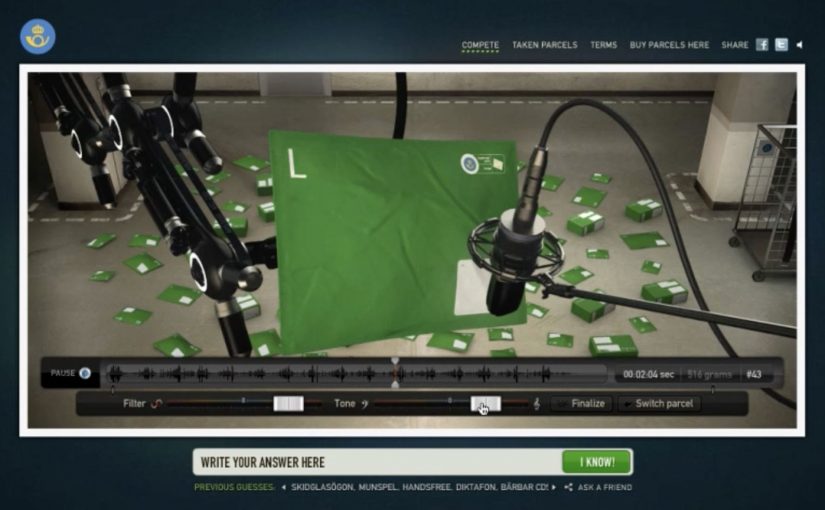
The Swedish Post has a collection of pre-stamped parcels that makes it easy to send things. The task for ad agency Åkestam Holst was to tell people that it was possible to send almost anything overnight with these pre-stamped parcels.

So they packed 80 parcels with all sorts of stuff and recorded 80 specific sounds. Those sounds powered “The Sound of Green” competition. Users picked a parcel, listened closely, and guessed what was inside. If they got it right, the Swedish Post sent the same parcel to the winner the very same day.

After a reported 140,240 guesses, the competition finally came to an end.

When proof beats promise

The mechanism is a neat translation of capability into play. Instead of listing what you can ship, you create 80 mystery parcels, record what they sound like, and let the public test their attention. The prize is not a voucher or a discount. The prize is the actual thing, delivered fast, which quietly demonstrates the core promise.

In consumer postal markets where “overnight delivery” sounds like a commodity claim, capability stories land better when they are demonstrated through a simple, repeatable experience.

The real question is whether the brand can make overnight delivery felt before someone ever ships a parcel.

Why it lands

This works because it turns logistics into curiosity. Sound is intimate and surprisingly hard to fake, so the listener leans in. The guessing format also creates a low-friction reason to spend time with the brand, and the same-day fulfilment makes the payoff feel real, not promotional.

Extractable takeaway: If you are selling an invisible service, build a public game that forces the benefit to show up as evidence, not copy.

What service brands can borrow

  • Demonstrate the promise. Replace “we can do anything” with proof people can experience.
  • Use a constraint to create focus. 80 sounds is large enough to feel rich, small enough to feel curated.
  • Make the prize the product. Shipping the parcel is the cleanest way to validate shipping.
  • Design for repeat attempts. A guessing mechanic naturally invites “one more try”.

A few fast answers before you act

What is “The Sound of Green”?

An online competition by the Swedish Post and Åkestam Holst where people listen to recorded parcel sounds, guess the contents, and winners receive the same parcel delivered the same day.

What is the core mechanism?

Pack real parcels, record the sounds they make, then let users choose a parcel sound and submit a guess. Correct guesses trigger real fulfilment.

Why use sound instead of photos?

Sound forces attention. It is less immediately obvious than visuals, and it creates a stronger sense of discovery when you finally figure it out.

What does this teach about marketing service businesses?

Claims are easy to ignore. Demonstrations are harder to dismiss, especially when the demonstration is interactive and ends in real delivery.

How do you keep a contest like this from feeling gimmicky?

Make the payoff identical to the promise. In this case, the reward is the service itself, delivered fast.

Royal Dutch Army: #Question Recruitment

The Royal Dutch Army has only a few specific job openings this year, and the challenge is to get qualified candidates to the website.

Turning Twitter questions into a recruitment filter

The “Qualified / Not Qualified” theme is already well known in the Netherlands. Here it is reused as a live judging mechanic on Twitter. People post questions using a designated hashtag, and the campaign replies by rating the answers as qualified or not qualified, then routes the right people toward the Army’s recruitment site.

In specialist public-sector recruitment, the hardest part is earning the first click from people who already have a stable job.

Why it lands: it hijacks attention that already exists

The smartest part is distribution. Instead of building a follower base from scratch, the concept leans on the fact that many Twitter users already track question hashtags. That means the campaign can show up in an existing stream of intent, where people are already in “answer mode”.

Extractable takeaway: If you have limited openings and strict qualification needs, design a public screening mechanic that lives inside an existing behavior. You get fewer clicks, but the clicks you get are self-selected and easier to convert.

What the brand is really doing

This is not about being funny on social. It is about pre-qualification in public. The Qualified or Not Qualified response turns the brand into an assessor, and the assessor role is exactly what a military employer needs to signal when roles are scarce and standards are real.

The real question is how to turn public participation into a credible first-stage filter that attracts fewer, better applicants.

What to steal for your own hard-to-hire role

  • Recruit inside an existing intent stream: go where people are already asking, answering, or problem-solving.
  • Make the filter visible: a simple rating frame can do more than a long job spec.
  • Keep the response format consistent: repetition builds recognition fast.
  • Route immediately: when someone looks qualified, give a clear next step to the right page.
  • Stay disciplined on tone: the format can be playful, but the standards must feel credible.

A few fast answers before you act

What is the #Question idea in one sentence?

It uses a Twitter question hashtag to attract answers, then labels them “Qualified” or “Not Qualified” to steer the right candidates to recruitment information.

Why does a hashtag mechanic help without a follower base?

Because people discover the content through the hashtag stream itself, not through the campaign account’s followers.

What makes this a recruitment campaign rather than brand social posting?

The public rating acts as a screening signal, and the interaction is designed to drive candidates toward a concrete next step on the recruitment site.

What is the key risk with public “qualified” judgments?

Misclassification or tone-deafness. If the criteria feel arbitrary or disrespectful, the campaign can discourage exactly the audience it wants.

What should you measure if you copy this approach?

Click-through to role pages, application starts, application completion rate, and the quality of applicants compared to baseline channels.

Flair: Fashiontag

Women are always looking for inspiration for their wardrobe and most of the time they find this inspiration by looking at other women.

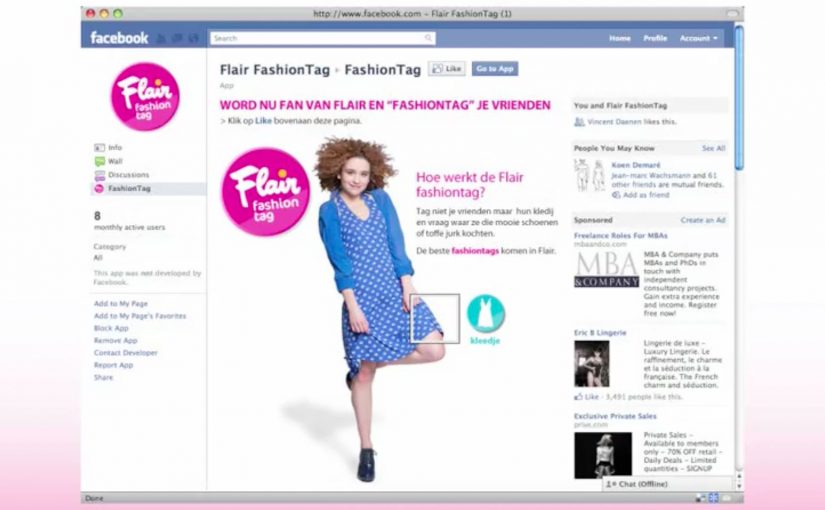
This inspired agency Duval Guillaume to create a Flair Fashiontag Facebook app for Belgian women’s magazine Flair. In the app, instead of tagging people, you can tag people’s clothes or accessories and ask them where they got them.

All fashiontags are displayed in a Facebook gallery, and the best are published in the weekly edition of Flair. This way there is constant interaction between the Facebook application and the magazine itself.

Turning social curiosity into a repeatable format

The mechanism is a simple swap. Replace social tagging of people with social tagging of products. A photo becomes a shoppable question. The owner of the outfit becomes the source. The magazine becomes the curator that elevates the best finds from feed to print.

In fashion and lifestyle publishing, converting casual “where did you get that” moments into a structured loop is a practical way to keep community activity and editorial output feeding each other.

The smart move here is to treat wardrobe curiosity as a content engine, not as a side effect of social chatter. The real question is how to turn that curiosity into a repeatable loop that helps readers in the moment and gives the magazine something worth curating.

Why it lands

This works because it formalizes a behavior that already exists. People already look at outfits, notice details, and ask friends for sources. Fashiontag simply gives that behavior a native interface and a public gallery, then adds a prestige layer by featuring the best tags in the weekly magazine.

Extractable takeaway: If your audience already asks each other for product sources, build a lightweight format that captures those questions in the moment and rewards the best contributions with visible amplification.

What to steal from Fashiontag

  • Swap the object of attention: tag the item, not the person, when product discovery is the real intent.
  • Close the loop with curation: a gallery is useful. Editorial selection makes it aspirational.
  • Make participation low-friction: one tag, one question, one shareable output.
  • Bridge channels on purpose: use print, site, and social as a single system, not separate campaigns.
  • Protect the social contract: ensure the person in the photo is comfortable with tagging and featuring, especially when content moves into a magazine.

A few fast answers before you act

What is Flair Fashiontag?

It is a Facebook app for Flair magazine that lets users tag clothes or accessories in photos and ask where those items were purchased.

What makes it different from normal photo tagging?

Normal tagging identifies people. Fashiontag identifies items. It turns fashion curiosity into a structured question-and-answer interaction.

How does the magazine benefit from the Facebook app?

The app creates a steady flow of wardrobe inspiration and real questions from readers. The magazine then curates and publishes the best tags, which reinforces participation.

Why is this a strong community mechanic?

Because it rewards helpfulness. People contribute sources and recommendations, and the gallery plus print selection turns that help into recognition.

What is the biggest risk in this format?

Consent and comfort. Tagging items in someone’s photo can feel intrusive if the person did not opt in, especially if content can be featured publicly in print.