The Swedish Armed Forces needed to recruit young people to an occupation that, in many ways, requires giving up personal comfort in order to help others. To highlight that trade-off, DDB Stockholm created a digitally integrated event in Stockholm, meaning a live experience amplified online but solved only through offline action, to test how far people were willing to go for one another.
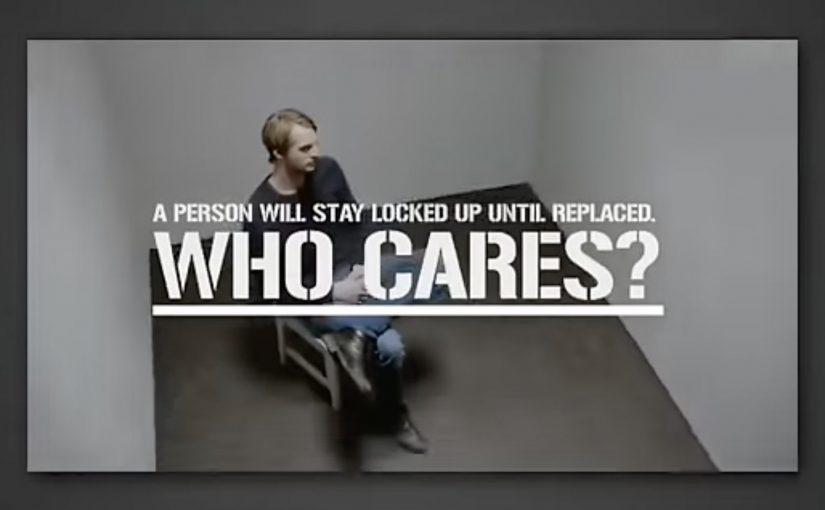
One person agreed to sit in a small boxed room and give up his freedom. The experiment was live-streamed over the internet, and nobody could help him via social media. The only way to help was to physically take his place yourself.
Would you have entered that room?
A recruitment test you cannot “like” your way out of
The mechanism is a single constraint with a hard rule. A person stays locked in a box until someone else arrives and swaps places. “Digitally integrated” here means the story travels through live video and online conversation, but the action can only happen in the physical world.
In public-sector recruiting, sacrifice is rarely persuasive as a slogan, so demonstrations that make the cost tangible tend to cut through faster than promises.
Why it lands
This works because the hard swap rule turns abstract values into a visible choice with a real cost. Watching a live stream makes you a witness, but the rule forces a sharper question. The real question is whether you care enough to surrender comfort, not whether you can signal support from a distance. The gap between those two states is the point of the experiment, and it makes the recruitment message feel earned rather than announced.
Extractable takeaway: If your role requires commitment, build a mechanic where commitment has a visible cost, and make the only path to “help” require real participation.
What the Armed Forces are actually testing
On the surface this is a recruitment film and an event. Underneath, it is a filter for mindset. This is recruitment built on proof, not persuasion. The work asks whether a young audience is willing to trade comfort for responsibility, and it frames that trade-off in the simplest possible form. One person is stuck. Only another person can free him.
What to steal from this participation mechanic
- Make the value measurable. “Caring” becomes an action with a clear threshold.
- Use digital for scale, not for the solution. Let the internet amplify, but keep the decisive moment real.
- Design a rule people can retell. “He gets out only if you go in” travels in one sentence.
- Let tension do the storytelling. A live situation creates attention without extra explanation.
A few fast answers before you act
What is “Who Cares?” in one line?
A Swedish Armed Forces recruitment experiment where a person remains locked in a box until someone physically arrives to replace him.
Why is the “no social media help” rule important?
It blocks low-effort participation and forces a real-world decision, which aligns with the message about giving up comfort to help others.
What does “digitally integrated event” mean here?
The event is distributed through live streaming and online conversation, but the only effective intervention is an offline, physical action.
What is the main psychological trigger?
It turns spectatorship into a moral fork. Watching is easy. Acting carries a cost, and that contrast creates the impact.
When does this pattern work best?
When you need to recruit or motivate for roles that require real commitment, and you can express that commitment through a simple, uncheatable rule.