
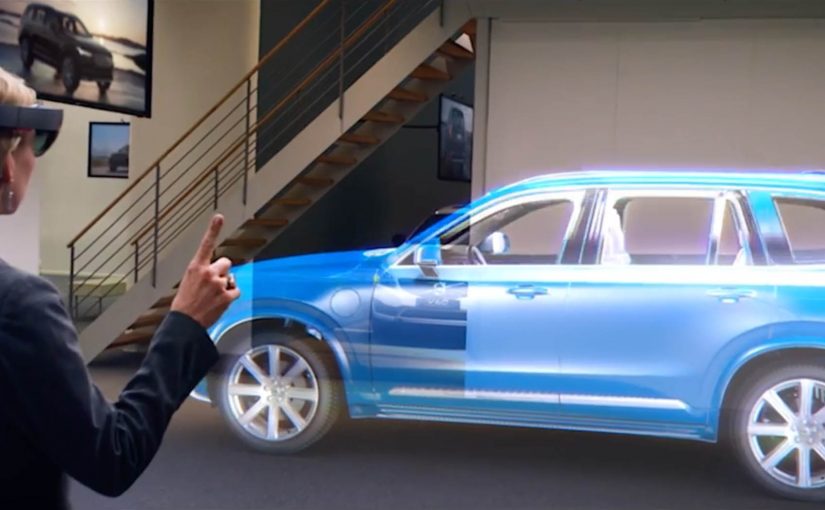
Volvo HoloLens Showroom: Virtual Dealership

The showroom no longer needs cars

Car dealerships traditionally depend on physical inventory.

Space, logistics, and availability limit what customers can see, touch, and configure. That constraint disappears when Volvo introduces a showroom experience powered by Microsoft HoloLens.

Instead of walking around parked cars, customers step into a virtual environment where full-size vehicles appear as holograms.

How the HoloLens showroom works

Using HoloLens, customers explore Volvo cars at real scale. This is mixed reality, digital objects anchored to the physical space around you.

They walk around the vehicle. Look inside. Inspect details. Colors, trims, and configurations change instantly. The experience feels physical, even though no car is present.

The showroom becomes software-driven. Inventory becomes optional.

In high-consideration retail, the job is helping people visualize options confidently before commitment, even when the product is not physically present.

Why this matters for automotive retail

This is not a gimmick. Virtual showrooms reduce the need for large floor space and allow dealerships to showcase the full portfolio, including models and options that are rarely stocked physically. Because customers can see the car at full scale and switch configurations instantly, they can compare options without relying on imagination, which makes commitment feel safer.

Extractable takeaway: If you can make options visible at real scale and changeable in seconds, you can sell preference, not availability, even when the product is not physically present.

For customers, the experience becomes calmer and more focused. There is less pressure. More exploration. Better understanding before committing.

Experience beats inventory

The deeper shift is about viewer control.

The real question is whether your showroom is designed for preference discovery or for stocking convenience.

Dealerships should treat mixed reality as a configuration layer that complements physical touchpoints, not as a tech demo.

Customers explore at their own pace. Sales staff guide rather than push. The conversation moves from availability to preference.

The dealership turns into a configuration studio, not a warehouse.

  • Make configuration the starting point. Let customers explore options first, then map the shortlist to what they can test and buy.
  • Keep staff in guide mode. Use people to frame trade-offs and confirm choices, not to gate access to information.
  • Design the experience like software. Treat the showroom as a repeatable configuration studio, not a one-off installation.

A few fast answers before you act

Is this replacing test drives?

No. A mixed reality showroom helps customers narrow configurations before a physical test drive.

What do customers actually do in the HoloLens showroom?

They walk around a life-size hologram, look inside, inspect details, and switch colors, trims, and configurations in real time.

What is the real business benefit?

Reduced reliance on physical inventory, clearer configuration conversations, and better use of showroom space.

Why does mixed reality fit automotive retail?

Cars are high-consideration purchases, so visualization can carry as much weight as specification.

What has to be true for this to feel real?

The hologram must stay aligned to the physical space, and configuration changes must respond instantly so customers trust what they are seeing.
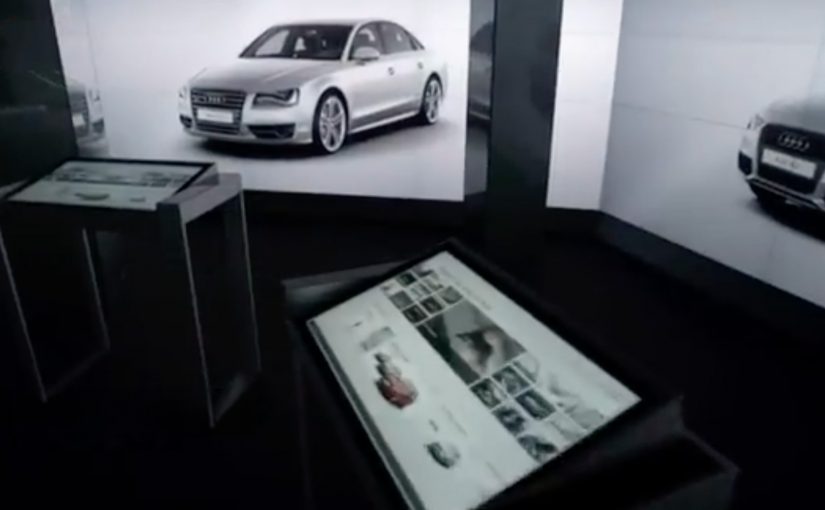
Audi City London: Future of Auto Retail

To solve space challenges at its retail outlet in Piccadilly Circus, Audi has used groundbreaking technology to present its growing model line-up.

Visitors can now digitally select their vehicle from several hundred million possible configurations and experience it in realistic 1:1 scale on special powerwalls. Here, “powerwalls” are wall-sized, high-resolution display surfaces built for life-size visualization.

Various details such as drivetrain, bodyshell, LED light technology etc are presented with interactive gestures, touch and physical sample recognition methods. Physical sample recognition means the system detects physical samples as an input. The whole immersive experience helps make the innovations understandable on an intuitive level.

The future of automotive retail is here and Audi is leading the way, with plans to roll out the experience at 20 locations in major international cities by 2015.

Why Audi City matters beyond “wow”

This is not digital for digital’s sake. It is a retail operating model that turns limited floor space into effectively unlimited shelf space, without forcing the customer to imagine the product from a brochure or a small screen.

Extractable takeaway: When physical space is scarce, move your long tail of options into a high-fidelity interface so the store sells decisions, not inventory.

  • Scale without inventory. Hundreds of millions of combinations without storing hundreds of cars.
  • Confidence through realism. A 1:1 representation reduces the gap between selection and purchase.
  • Innovation made tangible. Drivetrain, bodyshell, and lighting become understandable through interaction.

The showroom becomes an interface

Audi City treats the store like an interface layer between customer intent and product complexity. Gesture, touch, and physical sample recognition are not gimmicks. They are interaction patterns designed to help people explore, compare, and decide.

That is the critical shift. Instead of staff explaining everything verbally, the environment itself becomes the explainer. The real question is whether your showroom is optimized to help customers decide, or just to show what you have in stock. Because the interface externalizes complexity into something people can manipulate, it shortens the explanation loop and increases decision confidence.

In global automotive retail, immersive configuration experiences matter most when they reduce decision friction without expanding showroom footprint.

What this signals about the future of automotive retail

If Audi rolls out this concept across major cities, the implication is clear. Physical retail will not disappear. It will evolve into fewer, smaller, higher-impact locations that are designed for configuration, education, and decision-making, while fulfilment happens elsewhere.

  1. Fewer cars on the floor. More options in the system.
  2. More guided discovery. Less brochure-driven selling.
  3. More consistent global experience. Less dependence on local store size.

What to take from this if you run retail or CX

  1. Use digital to remove physical constraints. The business problem here is space, not “innovation theatre”.
  2. Design interaction for comprehension. Gestures, touch, and samples work when they help people understand complexity quickly.
  3. Make exploration feel premium. 1:1 scale and high fidelity visuals create confidence and desire.
  4. Separate “experience” from “inventory”. Let stores sell decisions, not stock.

A few fast answers before you act

What is Audi City London?

It is an Audi retail concept in Piccadilly Circus that uses large digital powerwalls to let visitors configure vehicles from hundreds of millions of combinations and view them in realistic 1:1 scale.

Why does 1:1 scale matter in a configurator?

It reduces uncertainty. People can judge proportions, design choices, and visual details more confidently than on a small screen.

How does the experience help explain innovation?

By presenting components like drivetrain, bodyshell, and LED lighting through interactive exploration using gestures, touch, and physical sample recognition.

What business problem does Audi City solve?

It addresses limited showroom space while still presenting a broad and growing model line-up and configuration depth.

What is the transferable lesson for other retailers?

Use immersive digital interfaces to expand choice and understanding without expanding physical footprint, and design interactions that make complex decisions feel intuitive.