
BMW Christmas Safety Card

To wish customers a new year of safe driving, BMW, together with ad agency AIR and electronics company Selectron, creates a Christmas card meant to be hung in the car.

A micro-sensor is built into the card to measure driving behaviour and react with a spoken message, “Ho! Ho! Hooo! Just like Santa!”, when the car is driven unsafely. The sensor measures G-forces and reacts when the car accelerates too much, or when it brakes or drives too quickly through bends. Here, “G-forces” are used as a proxy for sudden changes in speed and direction.

In performance-focused automotive communities, safety messaging lands best when it shows up inside the driving moment rather than after the fact.

A Christmas card that behaves like a safety co-driver

This is not a decorative greeting. The card acts like a lightweight in-car safety layer. It listens for aggressive driving signals, then interrupts with a playful warning that is hard to ignore. Because the feedback triggers during the manoeuvre, it is harder to dismiss than a post-drive message.

The real question is how you make safer behaviour feel like part of the performance identity, not a constraint imposed from outside.

Behaviour change beats awareness here. A small “nudge” is simply a timely prompt that makes the next decision easier, and this one does it without turning the experience into a lecture.

Why this fits the BMW M League audience

These limited-edition cards are sent to members of the BMW M League who recently buy their car and participate in the BMW Track Days. For that audience, performance driving is part of the identity. This card nudges safer habits without lecturing, because it speaks in a tone that feels seasonal and disarming.

Extractable takeaway: If your audience prizes performance, frame safety as a co-driver that protects the fun, and deliver the correction in their own tone at the moment it matters.

The pattern to steal

  • Measure the behaviour directly. Choose one behaviour you want to influence and measure it directly.
  • Put the intervention where it lives. Embed the intervention into a physical object people will actually place in the environment.
  • Correct in the moment. Trigger feedback at the exact moment of behaviour, not later in an email or app.
  • Make correction socially acceptable. Use a tone that makes the correction acceptable, so people do not reject it on instinct.

A few fast answers before you act

What is the BMW Christmas Safety Card?

A Christmas card designed to hang in a car, with a built-in micro-sensor that detects unsafe driving and plays a Santa-style voice warning.

What does the sensor measure?

G-forces. It reacts to strong acceleration, hard braking, and taking bends too quickly.

Who receives these cards?

Members of the BMW M League who recently buy their car and participate in the BMW Track Days.

What is the core idea?

Turn a seasonal greeting into an in-car behavioural nudge that activates in the moment.
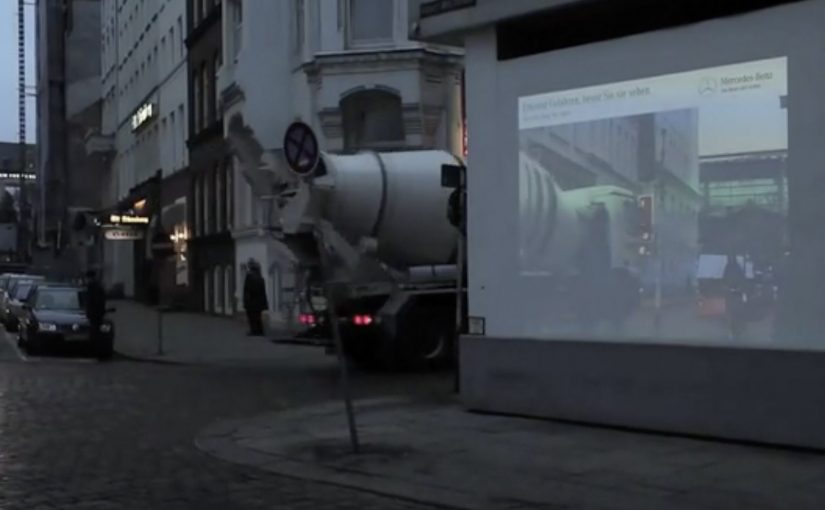
Mercedes-Benz: Transparent Walls for PRE-SAFE

For the PRE-SAFE® precrash system from Mercedes-Benz, ad agency Jung von Matt in Germany set out to make chaotic traffic intersections safer.

The idea was to let everyone “look around the corner” as if walls were transparent. In this execution, “transparent walls” means projecting a live camera view onto the building edge so the blind spot becomes visible. A camera filmed what was happening out of sight around the corner, and the live images were projected onto an 18/1-format billboard mounted on the building edge for approaching traffic to see.

When out-of-home becomes a live safety interface

This is not an awareness poster. It behaves like infrastructure. The corner. The blind spot. The moment of uncertainty. All become the media placement and the message at the same time.

The real question is whether your safety story behaves like a tool at the decision point, not a slogan people ignore.

How the mechanism creates “transparent walls”

  • Capture. A camera records the street view that drivers cannot see until they commit to the turn.
  • Project. A large-format display on the building corner shows that view in real time.
  • Anticipate. People approaching the intersection get a few extra seconds to recognise a cyclist, car, or hazard.

In urban mobility and automotive safety communications, making risk visible in the moment can change behaviour faster than warning copy.

Why it lands

Safety messages often fail because they arrive as abstract advice. This one arrives as immediate utility. It gives people a concrete, legible advantage at the precise point where bad outcomes happen. Because the live projection turns hidden risk into visible information, the benefit is believed without asking anyone to trust a claim. Safety-led brand work should earn attention through utility, not admonition. The result feels less like advertising and more like “someone fixed a problem.”

Extractable takeaway: The most persuasive safety communication is not a claim. It is a demonstrable reduction of uncertainty, delivered at the exact moment people need it.

What the brand intent looks like underneath

The stunt does double duty. It dramatizes what PRE-SAFE® is for without explaining sensors, thresholds, or system logic. It also signals a brand posture. Mercedes-Benz is not only selling performance. It is selling anticipation.

Steal this pattern: make uncertainty visible

  • Build the message out of the environment. Pick a real-world constraint your audience feels, then solve it visibly.
  • Make the proof self-evident. If people can understand the benefit in one glance, the idea scales.
  • Reduce uncertainty, not fear. Practical clarity outperforms shock in public safety-adjacent work.
  • Choose the right “moment.” Place the intervention where decisions are made, not where people are merely passing through.
  • Design for all road users. Intersections are shared systems. Make the benefit readable for drivers, cyclists, and pedestrians.

A few fast answers before you act

What is “Transparent Walls” in one sentence?

It is a digital out-of-home installation that shows live footage from around a blind corner on a building-edge billboard, so approaching traffic can spot hazards earlier.

How does this connect to PRE-SAFE®?

It demonstrates the value of anticipation. Seeing danger earlier is the human equivalent of what precrash systems aim to deliver technologically.

Why use a live camera feed instead of a scripted film?

Because real-time content makes the utility undeniable. People trust what they can see unfolding right now.

What are the main execution risks?

Latency, visibility in different lighting conditions, weather robustness, and ensuring the display informs rather than distracts drivers.

How would you measure success?

Observed speed adjustments, braking behaviour changes, near-miss reduction at the intersection, dwell/attention metrics, and sentiment around perceived usefulness.