
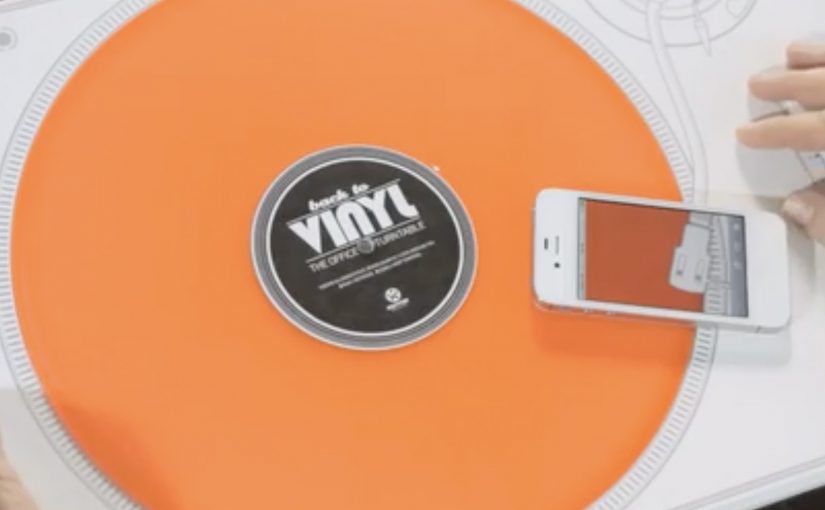
Back to Vinyl: The Office Turntable

Demo CDs created by music labels are often treated like spam. So to promote a new track from DJ Boris Dlugosch, Kontor Records decided to send out a bright orange vinyl along with a 2D turntable as part of a direct mailing.

The people who received the mailing activated the turntable by scanning the QR code on it. That simple action enabled the missing piece of the turntable on the user’s smartphone, which then allowed them to play the music by placing the phone over the “deck”.

Making the mailer do the work

The mechanism is a tight little trick. The envelope becomes the turntable. The QR code becomes the start button. The smartphone becomes the “needle”. It is analogue theatre powered by a digital unlock, meaning the physical format itself becomes a short performance the recipient has to complete, and it forces the recipient to complete the experience instead of ignoring it.

In B2B marketing where your audience is drowning in promos, the fastest way to earn attention is to turn the first interaction into a short, satisfying action that cannot be skipped.

Why it lands

This works because it turns listening into participation. You do not just receive a track. You assemble the moment, and the novelty is directly tied to the product. The design also flatters the target. It treats creative directors like DJs. People with taste and a fondness for well-made objects. Because the recipient has to scan, place, and play, the mechanic turns passive exposure into participation, which makes the track harder to ignore and easier to remember.

Extractable takeaway: If your content is easy to ignore, do not beg for attention with more messaging. Engineer a simple physical or digital action that unlocks the content, and make that action feel like a reward rather than a chore.

The real question is how you make the format itself impossible to ignore before the message even starts. This is a stronger approach than sending another promo that asks for attention without earning it.

The numbers are the proof

According to campaign case-study reporting, 71% of 900 mailings were activated via the QR code. The same reporting notes that 42% of recipients also visited the Kontor site. For a target group known for deleting promos on sight, that is the clearest signal that the mechanic did its job.

How to make direct mail behave like a product

  • Build a “first step” that is irresistible. If the first step is fun, the rest of the funnel happens almost accidentally.
  • Fuse the medium and the message. Here, the packaging is the product experience, not just a container.
  • Use phones as functional components. Not as a second-screen gimmick, but as a literal missing part.
  • Target the ego carefully. Positioning recipients as tastemakers, not “buyers”, increases the odds they will engage.

A few fast answers before you act

What is “The Office Turntable”?

It is a direct mail piece for Kontor Records where the envelope folds into a paper turntable, and a smartphone activated via QR code completes the player so the recipient can listen to a vinyl release.

Why use vinyl instead of a promo CD?

Because vinyl is a status object and a curiosity trigger. It signals “this is different” before any copy is read.

What role does the QR code play?

It is the activation switch. Scanning it unlocks the mobile component that makes the paper turntable usable.

What results were reported?

Case-study reporting cites 71% activation across 900 mailings, and 42% of recipients visiting the Kontor site.

How do you apply this pattern without copying it?

Turn your distribution format into a usable object, then make one simple action unlock the content. The best versions feel like a clever tool, not a stunt.
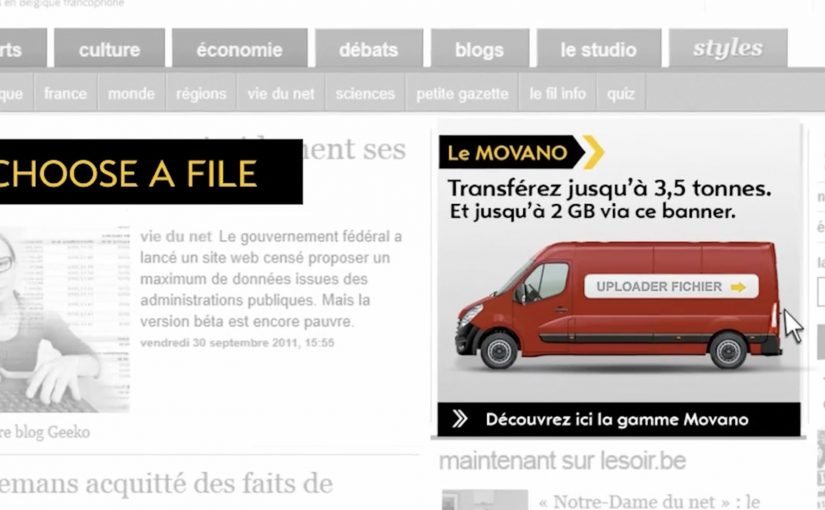
Opel Movano: File Mover banner

To promote the Opel Movano van range, McCannLowe created a banner that is both useful and innovative. Working like file transfer services such as YouSendIt or WeTransfer, the banner lets users upload up to 2GB of data “into the rear of the van” and send it to someone across the web.

The recipient then gets an email to download the file and learn about the Opel Movano. Simple, practical, and spot-on for the target audience. This is the right kind of B2B creativity because it turns “capacity” into something you can use.

In B2B and SME logistics markets, utility-based advertising wins when the ad itself performs a real job for the viewer. Here, “utility-based advertising” means the ad unit delivers a small, real service before it asks for attention.

When the ad behaves like a service

The smart move is that the interaction mirrors the product story. The Movano is built to carry stuff. So the banner becomes a carrying service for digital “stuff.” That alignment makes the message feel proved, not claimed. The real question is whether your creative can earn attention by doing a job your audience already needs done.

Extractable takeaway: If your product promise is functional, build a functional ad. A banner that does a real task can earn attention without needing a hard sell.

The mechanism: upload, send, deliver

The mechanic is easy to explain and easy to repeat. Choose a file. Upload it into the banner unit. Send it to a contact. The brand payload arrives as part of the delivery moment, which is when the recipient is most attentive. Here, “brand payload” is the branded context and message that rides along with the delivery. Because the brand arrives at the exact moment the task succeeds, the mechanism turns utility into positive brand proof.

In B2B commercial vehicle marketing, utility-first creative tends to work best when it removes friction inside an existing workflow.

Why this is a strong commercial vehicle play

Commercial vehicle advertising often struggles because capabilities blur together. This execution dramatizes “capacity” in a way people can feel immediately, and it does it in the same environment where business users already move files and coordinate work.

Service-first takeaways for B2B banners

  • Make the benefit experiential. If the product carries, let the ad carry.
  • Keep the flow obvious. One task, one outcome, no learning curve.
  • Use the recipient moment. Delivery creates a second touchpoint that feels useful, not intrusive.
  • Match the utility to the audience. File sending is naturally relevant for business users.
  • Keep branding inside the service. The brand should feel like the enabler, not the interruption.

A few fast answers before you act

What is the Opel Movano “File Mover” banner?

It is an interactive banner that works like a file transfer tool. Users upload a file into the banner, send it, and the recipient receives an email to download the file along with Opel Movano information.

Why is “utility” such a strong creative strategy in B2B?

Because it earns attention through usefulness. A business audience is more likely to engage when the ad helps them do something real, even briefly.

What makes this different from a standard lead-gen banner?

The value exchange is immediate. The user gets a working service, and the brand message is attached to the service delivery rather than gated behind a form.

What’s the biggest execution risk in a “service banner”?

Reliability and trust. If uploads fail, emails do not arrive, or the experience feels unsafe, users abandon quickly and the brand takes the blame.

How could a brand update this idea today?

Keep the same principle. Offer a real micro-service inside the ad unit. Then design the handoff so it is fast, secure, and clearly permission-based.

Lenovo ThinkPad T420: Enjoy It Responsibly

Lenovo, one of the world’s largest laptop brands, developed a series of online viral videos for their then-flagship ThinkPad T420. Across the set, they try to highlight all the extra time one can gain when a laptop promises faster graphics performance, faster boot up, faster wireless connections, faster data transfer, and similar “speed” wins.

However only one of these videos caught my eye. Please enjoy it responsibly.

Speed as a story, not a spec sheet

The mechanism is a simple translation layer. Take performance claims that are usually buried in benchmarks, then turn them into a human currency. Time. The videos do not ask you to care about milliseconds. They ask what you would do if the waiting disappeared.

In global enterprise and prosumer computing categories, performance messaging lands best when it is framed as reclaimed time and reduced friction, not raw technical superiority.

This is the right way to market performance because people respond faster to friction removed than to technical superiority explained.

The real question is how to make speed feel useful before a buyer ever sees the benchmark.

Why it lands

Most performance ads fail because the benefit is abstract. “Faster” only matters when you can picture the moment it saves you. This approach works because it repeatedly converts speed into everyday relief, and then uses humor to make that relief memorable.

Extractable takeaway: If you need to sell performance, convert benchmarks into a repeatable human outcome, then dramatize that outcome with one clear scenario people can retell in a sentence.

Where Lenovo is aiming this set

Lenovo’s emerging marketing team developed the virals for use in Russia, India, Middle East, Eastern Europe, Turkey, South Africa, South East Asia, Hong Kong and Taiwan.

What performance marketers can steal from this

  • Translate tech into time. People buy saved minutes more readily than they buy “20% faster”.
  • Build a series around one promise. Repetition creates recall, especially in multi-market rollouts.
  • Use one standout film as the hook. The sharpest piece pulls attention, the rest does the persuasion work.
  • Keep the claim legible. One benefit per scene beats stacked feature lists.

A few fast answers before you act

What is Lenovo trying to communicate with these T420 virals?

Lenovo is trying to show that performance improvements translate into reclaimed time in daily work, such as faster start-up, faster connectivity, and smoother graphics.

Why use “time saved” instead of performance specs?

Time saved works better because it is universal. Specs require interpretation, but time savings are instantly understood and easier to remember.

What makes one viral stand out in a series?

One viral stands out when it gives the promise a single memorable scenario that people can retell without needing the rest of the campaign for context.

What is the risk of humor in enterprise product marketing?

The risk is that viewers remember the joke but forget the product truth. The humor has to sharpen the benefit, not bury it.

How can other marketers apply this without copying the creative style?

They can keep the same structure. Convert a technical claim into one visible human benefit, then build a simple scene that makes that benefit immediately clear.