
Nar Mobile: The Donor Cable

Nar Mobile: The Donor Cable

Azerbaijan is often described as having an unusually high incidence of children born with thalassemia, a hereditary blood disorder found across Mediterranean and nearby regions. The illness can require extensive blood transfusions for babies, and hospitals can struggle with shortages of donated blood.

So Y&R Moscow partnered with Azerbaijan cellular network Nar Mobile to re-imagine blood donation for a more digital daily life. Together they created a special wearable bracelet. A donor cable is a wearable charging cable that lets smartphone owners easily donate battery power to another person, and uses that act as a prompt to donate blood.

A wearable that makes donation tangible

The Donor Cable is a charging cable designed as a bracelet. When someone’s phone is dying, you can connect phone to phone and transfer power. The campaign then bridges that familiar “help” moment to a bigger one. Donate blood.

A donor cable is a physical connector that enables one person’s phone battery to recharge another device. The campaign uses that simple transfer as a metaphor for medical donation.

In mobile-first markets, translating “helping” into a familiar phone habit can lower friction for real-world donation behaviour.

Why this lands

This works because it does not start with guilt or abstract altruism. It starts with a small, instantly useful act between two people, then reframes that feeling of helping as the reason to do the harder, higher-impact thing. The bracelet format also keeps the reminder on you without requiring ongoing media.

Extractable takeaway: If you need behaviour change, start with a low-friction action that already feels rewarding, then create a clear bridge and an immediate next step to complete the “real” action while motivation is still warm.

What the numbers are trying to prove

The stronger strategic move here is the bridge from everyday phone help to real blood donation, not the bracelet itself.

The real question is whether the campaign makes the jump from symbolic transfer to actual donation immediate enough to convert intent into action.

Campaign coverage described the donor cables as an instant hit and reported an increase in blood donation of 335%. Treat that percentage as reported performance unless you have a primary measurement source to cite.

What behaviour-change teams should steal

  • Make the metaphor usable. A real action beats a slogan.
  • Put the reminder on the object. Wearable prompts outlast a media flight.
  • Collapse distance to conversion. Pair the story with an easy path to donate.
  • Keep the rule explainable. If it takes a paragraph to understand, it won’t spread.

A few fast answers before you act

What is the Donor Cable?

A wearable charging cable that lets one person transfer battery power to another phone. It is used as a behavioural prompt to encourage blood donation.

Why connect phone charging to blood donation?

The idea uses a clear analogy. A small, immediate “donation” of power makes the bigger act of donating blood feel more approachable, and more top-of-mind.

How does the bracelet change behaviour beyond awareness?

It creates a repeatable micro-action people can perform in public, then links that positive social moment to a concrete next step. Donate blood.

Is the 335% figure a verified metric?

It is presented in campaign coverage as a reported result. If you want it stated as verified, you would need a primary measurement source.

What’s the main risk if you copy this pattern?

If the bridge from the small action to the real action is not immediate, the analogy stays clever but does not convert. The donation step must be easy to find and easy to complete.
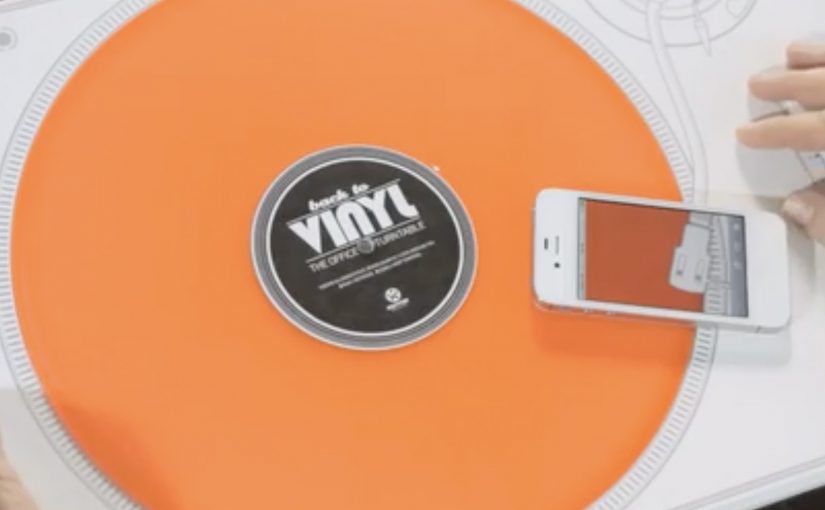

Back to Vinyl: The Office Turntable

Back to Vinyl: The Office Turntable

Demo CDs created by music labels are often treated like spam. So to promote a new track from DJ Boris Dlugosch, Kontor Records decided to send out a bright orange vinyl along with a 2D turntable as part of a direct mailing.

The people who received the mailing activated the turntable by scanning the QR code on it. That simple action enabled the missing piece of the turntable on the user’s smartphone, which then allowed them to play the music by placing the phone over the “deck”.

Making the mailer do the work

The mechanism is a tight little trick. The envelope becomes the turntable. The QR code becomes the start button. The smartphone becomes the “needle”. It is analogue theatre powered by a digital unlock, meaning the physical format itself becomes a short performance the recipient has to complete, and it forces the recipient to complete the experience instead of ignoring it.

In B2B marketing where your audience is drowning in promos, the fastest way to earn attention is to turn the first interaction into a short, satisfying action that cannot be skipped.

Why it lands

This works because it turns listening into participation. You do not just receive a track. You assemble the moment, and the novelty is directly tied to the product. The design also flatters the target. It treats creative directors like DJs. People with taste and a fondness for well-made objects. Because the recipient has to scan, place, and play, the mechanic turns passive exposure into participation, which makes the track harder to ignore and easier to remember.

Extractable takeaway: If your content is easy to ignore, do not beg for attention with more messaging. Engineer a simple physical or digital action that unlocks the content, and make that action feel like a reward rather than a chore.

The real question is how you make the format itself impossible to ignore before the message even starts. This is a stronger approach than sending another promo that asks for attention without earning it.

The numbers are the proof

According to campaign case-study reporting, 71% of 900 mailings were activated via the QR code. The same reporting notes that 42% of recipients also visited the Kontor site. For a target group known for deleting promos on sight, that is the clearest signal that the mechanic did its job.

How to make direct mail behave like a product

  • Build a “first step” that is irresistible. If the first step is fun, the rest of the funnel happens almost accidentally.
  • Fuse the medium and the message. Here, the packaging is the product experience, not just a container.
  • Use phones as functional components. Not as a second-screen gimmick, but as a literal missing part.
  • Target the ego carefully. Positioning recipients as tastemakers, not “buyers”, increases the odds they will engage.

A few fast answers before you act

What is “The Office Turntable”?

It is a direct mail piece for Kontor Records where the envelope folds into a paper turntable, and a smartphone activated via QR code completes the player so the recipient can listen to a vinyl release.

Why use vinyl instead of a promo CD?

Because vinyl is a status object and a curiosity trigger. It signals “this is different” before any copy is read.

What role does the QR code play?

It is the activation switch. Scanning it unlocks the mobile component that makes the paper turntable usable.

What results were reported?

Case-study reporting cites 71% activation across 900 mailings, and 42% of recipients visiting the Kontor site.

How do you apply this pattern without copying it?

Turn your distribution format into a usable object, then make one simple action unlock the content. The best versions feel like a clever tool, not a stunt.

Obra do Berço: The SOS SMS

Obra do Berço: The SOS SMS

Street children begging for food and money near busy traffic stops are a common sight in metropolitan cities like Rio de Janeiro. Accustomed and tired of this routine, drivers often shut their car windows to ignore the children and avoid any contact.

To raise awareness and trigger more donations, “Obra do Berço”, a day care for underprivileged children in Brazil, found a way to make the children’s voices heard through those closed windows.

Bluetooth antennas were hidden near traffic signals where large groups of children tended to gather. When drivers stopped at the lights, the antennas sent an SOS SMS to nearby phones.

A message that slips past the closed window

The mechanism is a proximity-triggered interruption. Drivers can shut out the street by rolling the glass up, but they still carry one open channel with them. Their phone. The campaign uses that channel to deliver a short, unavoidable nudge at the exact moment the social problem is physically present.

In dense urban commuter settings, the hardest part of fundraising is breaking habitual avoidance without escalating the intrusion.

The real question is how you interrupt a learned act of avoidance without making the intervention feel more invasive than the problem itself.

Why this lands

This works because it reframes the “ignore” reflex. The driver’s default action is to reduce discomfort by closing the window. The SMS reopens the reality in a different place, and it does it at a moment when the person has time. Waiting at the red light. That works because the channel change breaks the driver’s avoidance pattern without forcing face-to-face contact. The intervention is also personal. It arrives one-to-one, not as a public shaming message blasted at everyone.

Extractable takeaway: If your audience has learned to tune out a problem in a specific physical context, move the prompt to a channel they still keep open in that context, and time it to a pause moment where action is possible.

What the campaign is really doing

It is converting location into relevance. Instead of asking for empathy “in general,” it triggers the ask at the exact place where indifference usually happens. That makes the message harder to dismiss as abstract, and it gives the NGO a fighting chance to turn a routine stop into a micro-decision to help.

This is smart low-budget fundraising because it uses context and timing to create relevance instead of relying on guilt alone.

What to steal from this roadside trigger

  • Target a repeatable micro-moment. Red lights create predictable dwell time.
  • Use a channel people already carry. You do not need new hardware in the user’s hands.
  • Keep the prompt short. The first goal is attention, not a long explanation.
  • Link the ask to immediate context. Relevance beats persuasion when budgets are small.

A few fast answers before you act

What is “The SOS SMS”?

It is a charity activation where hidden Bluetooth antennas near traffic lights sent an SOS SMS to drivers’ phones to raise awareness and prompt donations.

Why use traffic lights as the media placement?

Because drivers are stopped, attention is idle, and the social issue is physically present in the same moment, making the message feel relevant.

What problem does this solve versus traditional street fundraising?

It bypasses the closed-window barrier and reduces the face-to-face avoidance loop by moving the first contact into a private phone message.

Is this more effective than posters or billboards?

It can be, because it is timely and personal. The message arrives when the audience is already in the situation, not hours later.

What’s the main risk with proximity-triggered messaging?

If it feels spammy or unclear why the message arrived, people may react negatively. The copy and consent expectations need to feel respectful and transparent.