
MINI: Photo Box Billboard

A billboard that turns fans into the creative

MINI has launched an innovative electronic billboard on Berlin’s Kurfürstendamm shopping boulevard. The billboard is connected to a Photo Box booth that captures the faces of MINI fans and puts them onto a massive screen along with each participant’s favourite MINI model, for a chance to win their preferred car.

Contestants have four colours and four models to choose from, including the MINI Hatch, Convertible, Clubman and Countryman.

The mechanic: Photo Box in Berlin. Facebook everywhere else

On the street, you step into the Photo Box, clamp on a pair of headphones, pick your colour and model, and the system outputs a ready-to-share moment on a giant public screen.

Fans from around the world can also join through the MINI Facebook app, where you can snap a picture with your webcam wearing a pair of virtual headphones in your favourite MINI colour.

In high-footfall city retail corridors, interactive out-of-home turns passersby into opt-in media by making participation itself the content.

Why it feels modern: ecommerce choice, but on a building

The experience borrows the best part of online shopping. Configuration. without forcing the rest of it. Specs, comparisons, and checkout. The “product” is self-expression, delivered in seconds, in public.

That public context matters. It creates instant social proof, and it makes the moment feel bigger than a personal post because it physically occupies the street.

The business intent: acquisition through identity

This is acquisition marketing that avoids hard selling. MINI lets people declare a preference. model plus colour. and then wraps that declaration in a contest mechanic. The brand gets reach, participation data, and a stream of shareable assets without asking people to create anything from scratch.

What to steal for your next interactive OOH build

  • Make the choice set small and satisfying. Four colours and four models is enough to feel personal, without feeling complex.
  • Design one iconic prop. Here, the headphones act as a visual signature that unifies street and Facebook participation.
  • Let the environment do the distribution. A giant screen creates built-in attention and bystander reach.
  • Mirror the experience online. The Facebook version keeps the same core mechanic so the idea travels beyond the location.

A few fast answers before you act

What is MINI’s Photo Box billboard activation?

It is an interactive out-of-home experience where fans take a photo, choose a MINI model and colour, and see themselves displayed on a massive screen, with a chance to win their preferred car.

How does the Facebook app extend the idea?

It recreates the same participation loop online. People take a webcam photo, add the virtual headphones in their chosen colour, pick a model, and join the same campaign experience from anywhere.

Why does this work as acquisition marketing?

It converts brand preference into a public, shareable artifact. The configuration step makes it feel personal, and the big-screen moment adds social proof and reach.
Check in! Snack Out!

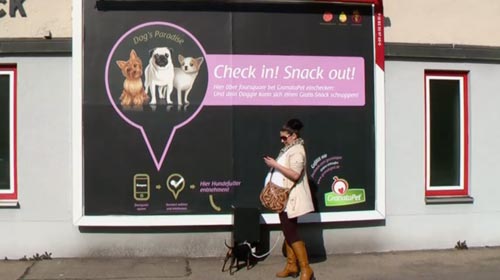
GranataPet is one of the innovative leaders of high premium petfood in Germany. Their ad agency, Agenta Berlin was given the challenge to create awareness for the GranataPet dog food with a slim budget!

So Agenta targeted dog owners as they took their best friend for a walk. Socially activated installations were positioned on key walking paths. Dog owners walking past would then be stopped by their dogs smelling treats and they would only see a billboard saying “Check in! Snack Out!” with accompanying information telling each person on how to check in with Foursquare in order to activate a free bowl of dog food.

Along with the free publicity generated on Facebook, the hundreds of billboard visitors also generated an additional demand for GranataPet at the local pet stores.

Augmented Reality Calendar by Audi

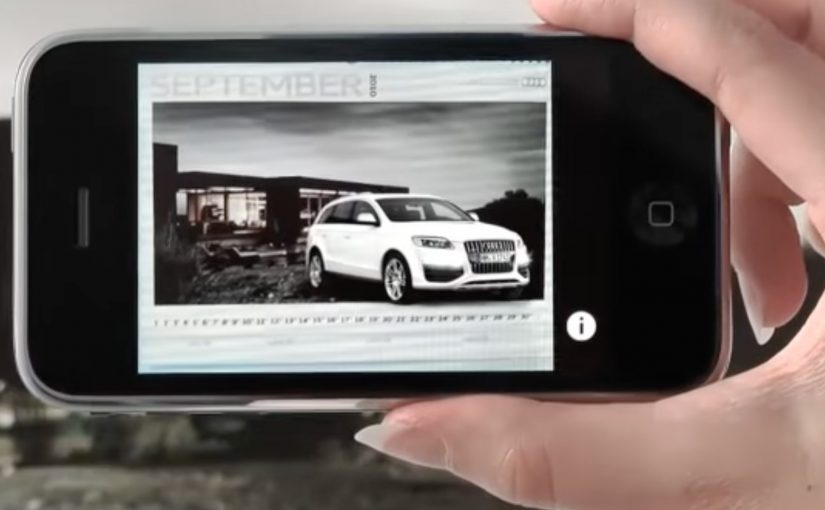
An Audi calendar arrives and it looks almost wrong. Each month is a beautiful landscape, with a deliberate empty space and no car in sight. You open Audi’s iPhone app, point the camera at the page, and the missing piece appears. An Audi A1 fills the blank area in augmented reality, sitting inside the printed scene as if it belongs there.

The idea. A car calendar without cars

Audi takes a familiar format. The premium calendar. Then it removes the expected hero asset. The car. The calendar becomes an invitation to discover, not a static brand object.

How it works. Print as trigger, iPhone as lens

  • The printed calendar pages feature landscapes and intentional negative space.
  • People download and open the dedicated Audi iPhone app.
  • They point the phone’s camera at the calendar page.
  • The app overlays a car into the empty area, turning the page into a live scene.

The interaction is simple, but the effect is surprising because it uses a physical artifact as the interface. The calendar is not just content. It is the marker that activates the experience.

Why this works. A tangible product that earns a second look

This is not augmented reality for the sake of augmented reality. It is a clean integration of print and mobile that rewards curiosity. The calendar builds anticipation with absence, and the app completes the story in the moment you engage.

What to take from it. Designing the reveal

  • Use restraint to create intrigue. Removing the obvious element can be more powerful than showcasing it.
  • Make the physical object the trigger. When the real-world asset is the interface, the digital layer feels earned.
  • Keep the action obvious. Point camera. See result. Low friction beats complex onboarding.
  • Build around a single wow moment. One crisp reveal is often enough to make the experience memorable.

This idea is developed by Neue Digitale / Razorfish Berlin and executed for Audi.


A few fast answers before you act

What is Audi’s augmented reality calendar?
A printed Audi calendar designed to work with an iPhone app, where pointing the phone camera at a page reveals a car in augmented reality.

What is the core creative twist?
It is a car calendar without cars. The car appears only when you view the page through the app.

What role does the calendar page play?
It acts as the trigger. The printed layout and empty space are intentionally designed to be “completed” by the AR overlay.

What makes it effective as a brand experience?
It turns a passive object into an interactive reveal, linking print, mobile, and product desire in one simple action.

What is the transferable pattern for other brands?
Design a physical artifact that creates curiosity, then use mobile to deliver a single high-impact reveal with minimal friction.